Why Continuous Learning Is the Only Career Insurance You Need
Chintan Poriya
Lead Career Editor & AI Research Director
Published: July 1, 2026
Table of Contents
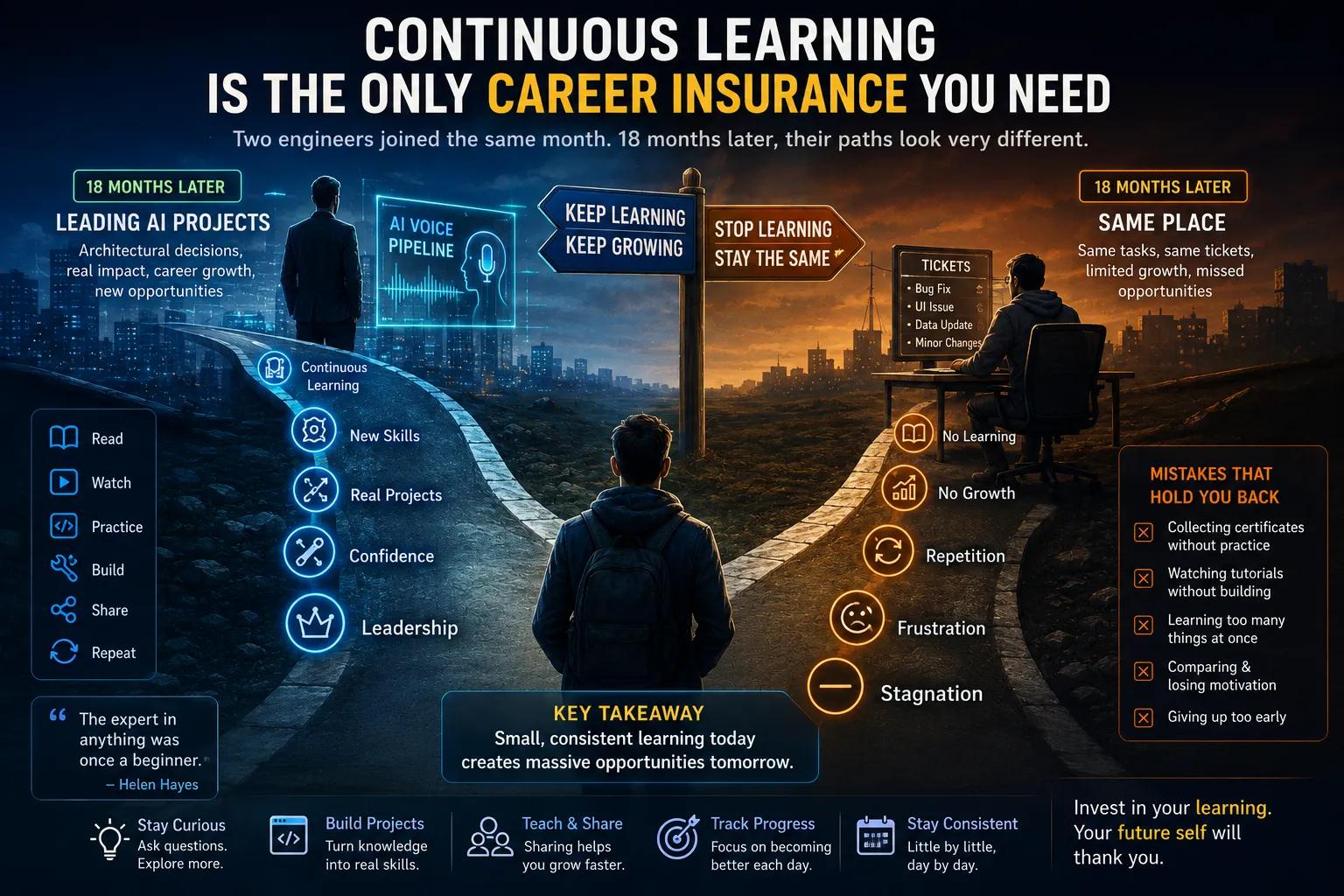
Two engineers joined BytezTech within the same month a couple of years back, with nearly identical backgrounds same general experience level, same rough starting skill set. Eighteen months later, one of them is leading our Aria voice pipeline work, making real architectural calls on her own. The other is still handling roughly the same category of tickets she started with. The gap wasn't talent. It was that one of them treated every project as a chance to pick up something new, and the other treated the job as something you show up and execute, unchanged, month after month.
That gap is the entire argument for continuous learning, and it's a lot more visible from the hiring and promotion side than most people realize from the outside.
The Workplace Is Moving Faster Than It Used To
Technology used to shift meaningfully every few years. Now it's closer to every few months new models, new platforms, new tools, new ways of doing the same job that were considered standard practice a year ago. Professionals who keep learning adapt to that without much friction. The ones who stop tend to fall behind quietly, often without noticing until the gap is already significant. This isn't about chasing every trend that shows up it's about staying close enough to current that a real shift doesn't catch you flat-footed.
Why Experience Alone Eventually Plateaus
Experience is genuinely valuable, but it has a ceiling if it's not paired with ongoing learning. The engineer leading our Aria work now didn't get there through more years on the job than her colleague they started the same month. She got there by treating the AI and automation work she picked up along the way as an actual expansion of her skill set, not just a task to complete and move past. Experience plus learning compounds. Experience alone plateaus.
Learning Doesn't Require Hours Every Day
Thirty to sixty minutes, a few times a week, is genuinely enough over time reading something relevant, working through a tutorial, building a small side project, practicing a new tool, listening to something useful during a commute, taking a short course, writing up what you just learned. Small and consistent beats occasional and intense almost every time we've watched this play out on our own team.
Build a Skill Stack, Not a Scattered Pile of Unrelated Ones
The Developer Stack
The Marketer Stack
The engineer who moved ahead didn't learn randomly she stacked Python with AI fundamentals, cloud deployment, and enough communication skill to actually explain her architectural decisions to non-technical stakeholders. A marketer might stack SEO with content strategy, AI tools, analytics, and copywriting. The combination is what makes someone hard to replace any single skill in that stack is replaceable on its own; the specific combination usually isn't.
Build Things Don't Just Consume Information
Reading builds knowledge. Building builds actual confidence and something concrete to point to. Worth trying: a portfolio site, an AI chatbot, an expense tracker, a blog platform, a task manager, a resume builder, a business dashboard, a workflow automation tool. Every finished project becomes real evidence the next time a promotion, a new project, or a job application is on the table which is exactly what separated the two engineers from the opening story once real opportunities came up.
Make Learning a Routine Instead of an Occasional Effort
A Simple Weekly Learning Shape
Read something relevant (article, newsletter)
Work through a targeted tutorial
Practice a specific new tool or skill
Spend real time on a personal project
Share what you learned this week
Review progress & set the next target
Rest & mentally reset
Inconsistency is the actual obstacle for most people, not a lack of available resources. Learning gets dramatically easier once it stops being a decision you make fresh every day and becomes a habit that just happens.
Teaching Is One of the Fastest Ways to Actually Learn
Writing a short post, publishing on LinkedIn, recording a quick tutorial, speaking at a local meetup, helping someone else work through a problem all of this forces a level of clarity that passive learning never does. You don't need to be the top expert in a room to be useful this way. You just need to be a step or two ahead of whoever you're helping.
Stay Genuinely Curious
Curiosity tends to create real opportunities before formal qualifications ever do. Ask questions that aren't strictly necessary for the task in front of you. Try a new tool before it's fully mainstream. Poke into an adjacent field out of interest, not obligation. The engineer who moved ahead started exploring automation tools on her own time, well before it became a formal part of her role by the time it mattered for a project, she was already the person with hands-on experience.
Mistakes That Quietly Undercut This
None of these are dramatic failures they're just quiet ways momentum stalls out.
Build an Actual Personal Learning Plan
A few honest questions worth answering: which skill would genuinely move your career forward the most right now, what specific project could you build with it, which community or group could support that learning, and what's the actual next thing to focus on once this one's done. A real plan, even a loose one, makes learning noticeably more focused than a vague, ongoing intention to "learn more" someday.
The Future Consistently Rewards Adaptability
Nobody can predict every technology shift coming over the next decade with real precision. What's much more predictable is that the people who kept learning through each shift will handle the next one better than the people who didn't. Technology changes, industries evolve, markets shift the constant advantage across all of it is the habit of continuing to learn rather than any single skill learned once and left alone.
Final Thoughts
Continuous learning was never really about collecting certificates or chasing whatever's trending this month. It's a mindset that compounds quietly over years, the same way it did for the engineer now leading real architectural decisions on our team not because she started with more talent, but because she never really stopped treating her role as something to keep growing into.
Start with one skill, one project, one habit this week. The gap between the two engineers from this article's opening didn't appear overnight. It built up, one small consistent choice at a time, over eighteen months and it's still building for both of them, in opposite directions.
FAQ
How much time does continuous learning actually require to make a real difference?
Thirty to sixty minutes a few times a week, done consistently, is enough to create a meaningful gap over a year or two the engineer from this article's story didn't dedicate hours daily, just consistent, deliberate time.
Is it better to go deep on one skill or learn several at once?
A focused, complementary skill stack a few related skills that reinforce each other tends to outperform either a single narrow skill or a scattered, unrelated pile of them.
What's the fastest way to tell if continuous learning is actually working?
Track what you can build or explain now that you couldn't six months ago. If that list isn't growing, the learning isn't translating into real skill yet.
Is continuous learning still necessary once you're experienced in your field?
Especially then. Experience without ongoing learning is exactly what plateaus the gap between the two engineers in this article widened specifically because one treated her existing experience as a finish line and the other didn't.
Written by Chintan Poriya, Marketing Head.
Read More in Learning & Upskilling
How to Learn AI in 30 Days: The Exact Roadmap We Used to Onboard a Non-Technical Hire
We gave a marketing hire with zero AI experience 30 days before she touched a live campaign. Here's the exact day-by-day roadmap and what actually happened when she used it.
Read article →
Learn AI with NVIDIA DLI: What Actually Changed When We Used It on a Real Client Project
Our computer vision model ran at 2.3 frames per second with five days left on the contract. Here's how NVIDIA's Deep Learning Institute helped us fix it and whether it's worth your time in 2026.
Read article →