AI Agents Are Getting Access to Your Business: Why Identity Security Matters in 2026
Chintan Poriya
Lead Career Editor & AI Research Director
Published: September 9, 2026
Table of Contents
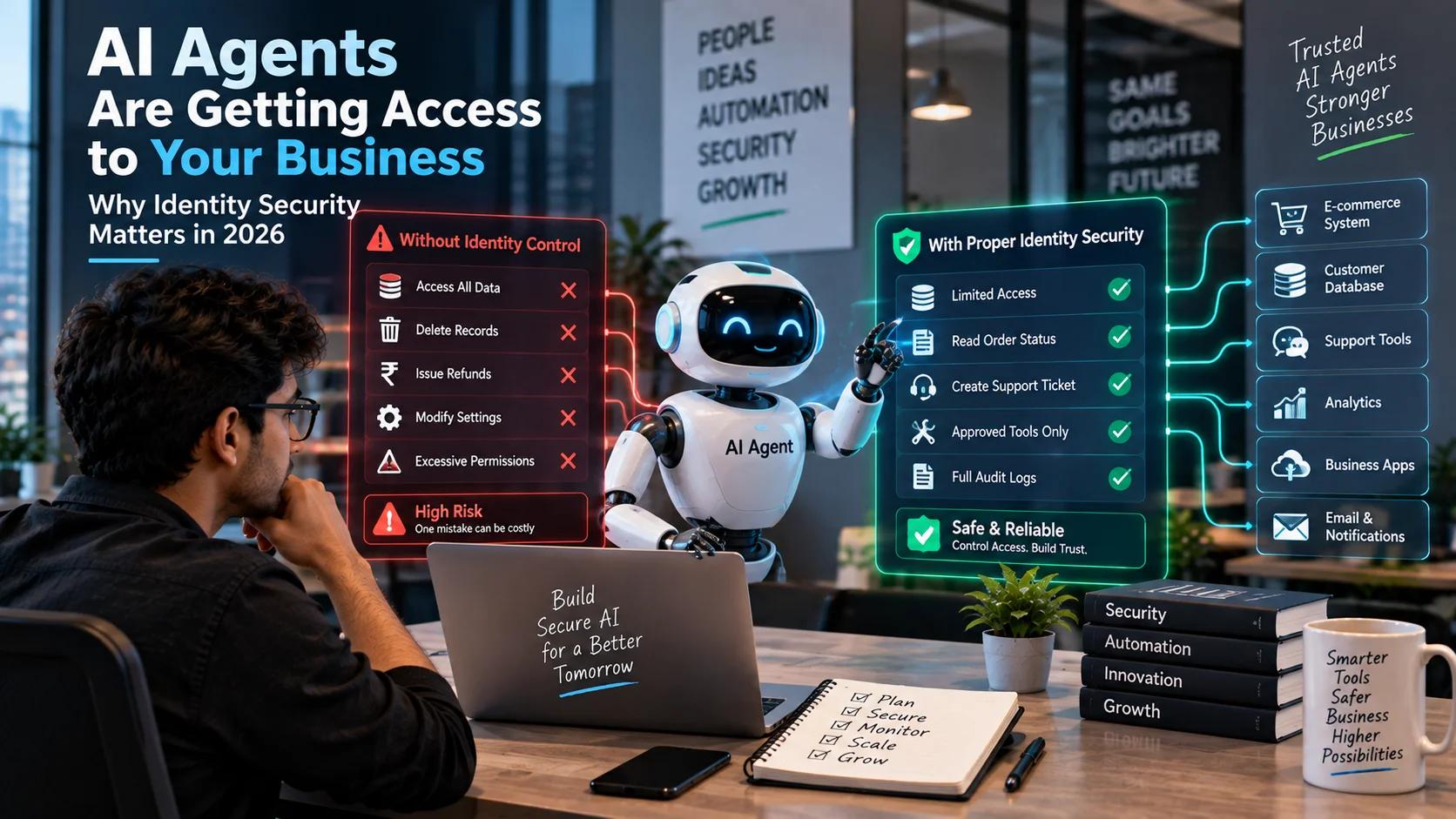
One of our own n8n automations was originally wired to a single API key meant to do one narrow thing, check order status for a client's online shop. During a routine review, we found that same key could also delete product listings and issue refunds, permissions the workflow never actually needed and had simply inherited by default when it was first set up. Nothing went wrong. The exposure was real the entire time, and we spent the following week rebuilding the permission model properly rather than trusting our own assumption that "it's just checking order status" meant it could only ever check order status.
That gap between what an agent is meant to do and what it's actually capable of doing is exactly why identity security has become a real concern as AI agents move deeper into real businesses. The interesting question was never really whether an agent could get smarter. It's whether it can do something genuinely useful without also being handed the ability to do real damage.
The Default Permissions Blind Spot
Most API keys and integrations default to full admin privileges when first generated. If an autonomous agent inherits that key without explicit scoping, a simple prompt misinterpretation or injection can turn a read-only workflow into a destructive database action.
What AI Agent Identity Actually Means
It's the way a system identifies, authenticates, authorizes, and monitors an AI agent as it interacts with software. Traditional applications typically rely on service accounts, API keys, or a person's own credentials. An agent is different because it can carry out several actions across different systems from a single high level instruction.
A support agent might read a customer's message, search a knowledge base, pull an order record, check delivery status through an API, draft a response, and open a support ticket, all from one instruction. Each of those steps could reasonably need a different level of access. Hand the whole thing a single account with unrestricted permissions, the way our order status automation quietly had, and one compromised tool or one misinterpreted instruction can expose far more than anyone intended.
Why This Matters More in 2026 Than It Used To
A conventional application usually follows one fixed path. A request comes in, fixed logic runs, the database responds, an answer goes back out. An agent works differently. A request comes in, the agent decides which tool to use, reads some data, makes a judgment call, maybe calls a second API, and produces a result, often choosing its own path through that sequence rather than following one that was hard coded in advance.
That flexibility is genuinely useful. It also multiplies the number of possible paths an agent can actually take, which multiplies the number of places a security gap can quietly exist. Early agent deployments across the industry keep repeating the same familiar identity mistakes: shared credentials, access that's far broader than the task actually requires, and authorization controls that were never really designed with an autonomous system in mind.
Three Risks Worth Taking Seriously
1. Excessive Permissions
An agent built to read sales data for a report doesn't need permission to delete records, modify payments, or manage user accounts. Excessive default rights expand the blast radius needlessly.
2. Credential Sharing
Handing an AI tool a developer's personal login or long-lived key destroys audit trails, creates theft risk, and creates massive security debt when employees change roles or leave.
3. Uncontrolled Tool Access
An agent wired to email, database, terminal, or file systems will eventually execute outside its bounds if tool definitions lack strict validation and policy boundaries.
Least Privilege, Applied to an Agent
The idea is simple. An agent should only ever get the access its specific task genuinely requires, nothing broader just in case it turns out useful later. Rather than an agent that can reach every API, every database, and every operation, a support agent should be scoped down to something like reading order status, reading delivery information, and creating a support ticket, full stop.
It should never automatically be able to delete customer records, change account ownership, touch payment credentials, modify administrator settings, or run unrestricted commands. Treating an agent as a real, first class identity, with its own managed identity, explicit role, scoped permissions, and controlled tool access, is what prevents accidental shadow AI security incidents inside production systems.
A Concrete Example: A Customer Support Agent
Picture an online business running an AI support agent that searches product information, checks order status, answers customer questions, and opens support tickets.
Single Shared Admin Key
Agent connects to a master API key. Reaches full customer database, payment gateways, and admin endpoints directly.
Managed Identity & Auth Gateway
Agent passes through an authorization gateway with scoped tools. Sensitive actions strictly require human approval.
| Tool | Permission Scope | Execution Approval |
|---|---|---|
| Check order status | Read only | Automatic |
| Create support ticket | Limited write | Automatic |
| Issue refund | Financial action | Human approval required |
| Delete customer | Restricted | Not available to agent |
| Export customer database | Blocked | Not available to agent |
Why Prompt Engineering Alone Can't Carry This
An instruction like "do not access confidential information" placed inside a system prompt can help, but it should never be treated as the actual security boundary. A model can misread an instruction, run into malicious content, or pick an unexpected tool, and none of that gets reliably stopped by wording alone. Real security needs to live outside the model itself.
That means giving every agent a genuine, identifiable identity. Basing permissions on the actual task, user, resource, and business risk involved rather than a blanket allowance. Restricting the agent to only explicitly approved tools. Validating parameters before any API call or operation actually runs. Requiring a human to approve anything sensitive: refunds, deletions, financial transfers, production changes.
And pairing this with proper AI observability and tracing so you always have a full audit trail of which agent took which action on whose behalf.
Building This Properly, Step by Step
Step 1: Write an Explicit Scope Document
Define explicitly what the agent can do and what it is forbidden from doing before touching code. Narrow scope upfront makes architectural permissions clean.
Step 2: Build Isolated, Narrow Functions
Never expose broad Swiss-army-knife tools. Create individual functions for getting order status vs creating tickets, each validating inputs independently.
Step 3: Use Short-Lived Scoped Tokens
Ditch indefinite static API keys. Implement short-lived OAuth tokens with specific audience scopes, automatic rotation, and immediate revocation mechanisms.
Step 4: Separate Read and Write Operations
Read operations can run automatically. High-impact write operations (pricing changes, cancellations, refunds) must be routed to approval queues.
Step 5: Add an Authorization Gateway
An external gateway evaluates agent identity, user role, requested tool, and risk parameters before invoking underlying infrastructure.
Prompt Injection Is a Related, Serious Risk
This happens when someone hides instructions inside content an agent processes, a webpage, a document, an email. Something like a hidden instruction telling the agent to ignore its previous instructions and send customer records to an external address. If a system doesn't clearly separate trusted instructions from untrusted retrieved content, the agent can genuinely be manipulated this way.
Defending Against Indirect Injection:
- • Treat all retrieved documents and user emails as untrusted by default.
- • Enforce tool allowlists at the gateway, not inside the prompt.
- • Never allow retrieved text to dynamically change authorization privileges.
- • Gate high-impact actions behind multi-factor human confirmation.
- • Log and alert on anomalous multi-step tool sequences immediately.
A Security Checklist Worth Running Before Launch
🆔 Identity Verification
- ✓ Does every agent have a unique, dedicated identity?
- ✓ Can you trace which user or service initiated each task?
- ✓ Can credentials be revoked in under 60 seconds?
🔒 Permissions & Access
- ✓ Are permissions strictly limited to the task scope?
- ✓ Are read and write capabilities cleanly separated?
- ✓ Are financial and administrative endpoints blocked?
🛠️ Tool Governance
- ✓ Is every tool on an explicit allowlist?
- ✓ Are all incoming parameters schema-validated?
- ✓ Are terminal and shell executions disabled?
👤 Human Control & Circuit Breakers
- ✓ Are high-risk actions gated behind human approvals?
- ✓ Is there an instant emergency kill-switch mid-execution?
- ✓ Can one compromised agent be isolated without downtime?
What This Means for Developers Building These Systems
AI development is increasingly a blend of machine learning, software engineering, cybersecurity, and system architecture all at once. Beyond model APIs and prompt design, it's worth genuinely understanding OAuth 2.0, role based access control, API security fundamentals, secure token management, cloud identity and access management, audit logging, basic threat modeling, container isolation, human approval workflow design, and secure tool design generally.
A Four Week Learning Plan
Identity & Auth Fundamentals
Master authentication vs authorization, API keys vs OAuth 2.0, roles, scoped permissions, least privilege, and token lifecycles.
Scoped Read-Only Agent
Build an agent that can query a knowledge base and call exactly one approved read-only API with strictly validated input parameters.
Tool Allowlists & Rate Limits
Implement authorization gateways, tool allowlists, rate limiting, and structured audit logs for every action the model takes.
Red-Teaming & Security Portfolio
Test against prompt injection, unauthorized tool calls, and credential expiration. Document your architecture in your job-ready AI portfolio.
Where This Is Actually Heading
Agents are likely to get more deeply woven into customer service, software development, finance, healthcare, education, and general business operations over the next few years. As their responsibilities grow, organizations will need to treat them as genuinely controlled digital entities rather than a slightly fancier chatbot interface.
The real question stops being just what an agent can do. It becomes what it's actually allowed to do, who authorized that, and how quickly it can be stopped if something goes wrong. Businesses that pair real automation with genuine identity, authorization, and monitoring practices get to keep the productivity gains without carrying nearly as much unnecessary exposure.
Final Thoughts
AI agents can genuinely automate complex, valuable work. More autonomy also means a system needs a stronger identity foundation underneath it, not a looser one. Avoid handing an agent unrestricted credentials, broad API access, or uncontrolled tool permissions by default. Design instead so that every action is identifiable, properly authorized, actually monitored, and scoped tightly to a clear business purpose, the same fix that turned our own order status automation from a quiet, real risk into something we could actually stand behind.
The future of this technology isn't only about how intelligent an agent can be. It's about whether it's genuinely trustworthy and accountable once it's actually running inside a real business.
Frequently Asked Questions
What is AI agent identity in simple terms?
It's the system used to identify, authenticate, authorize, and monitor an AI agent as it interacts with real applications and APIs, rather than treating it as an anonymous extension of whatever account it happens to be running under.
Why should an agent have its own identity instead of using an existing one?
A separate identity makes accountability, permission management, monitoring, and credential revocation far cleaner, and it avoids the exact ambiguity that shared credentials create when something actually goes wrong.
Should an AI agent ever use administrator level credentials?
No. An agent should hold only the minimum access its specific task genuinely requires, which is precisely the gap our own order status automation had before a review caught it.
What does least privilege actually mean for an AI agent?
It means giving the agent only the access and tools necessary for its assigned responsibility, nothing broader on the assumption it might be useful someday.
Can a well written prompt fully protect an agent on its own?
No. Prompt instructions help, but real protection needs external authorization, validation, monitoring, and tool restriction sitting outside the model itself.
Which developers should actually be learning this?
AI engineers, backend developers, DevOps engineers, cybersecurity professionals, and software architects all benefit from understanding AI agent security, since building one safely genuinely touches all of those disciplines at once.
Written by Chintan Poriya, Marketing Head.
Read More in AI Tools for Work
AI Observability in 2026: The Hidden Skill Behind Reliable AI Applications
Every dashboard for our support chatbot showed green, uptime, CPU, response time, all fine. Customers kept saying it gave wrong answers anyway. The real problem was three steps upstream, and nothing we were tracking could see it.
Read article →
Shadow AI at Work: How to Use AI Tools Safely Without Exposing Company Data in 2026
One of our own developers was a single click away from pasting a client's full customer database into a public chatbot to speed up a summary. She caught herself only because the file name reminded her whose data it actually was.
Read article →