AI Is Changing Hiring in 2026: How to Pass AI Resume Screening and Prove Your Skills
Chintan Poriya
Founder, AdvizeU
Published: October 07, 2026
Table of Contents
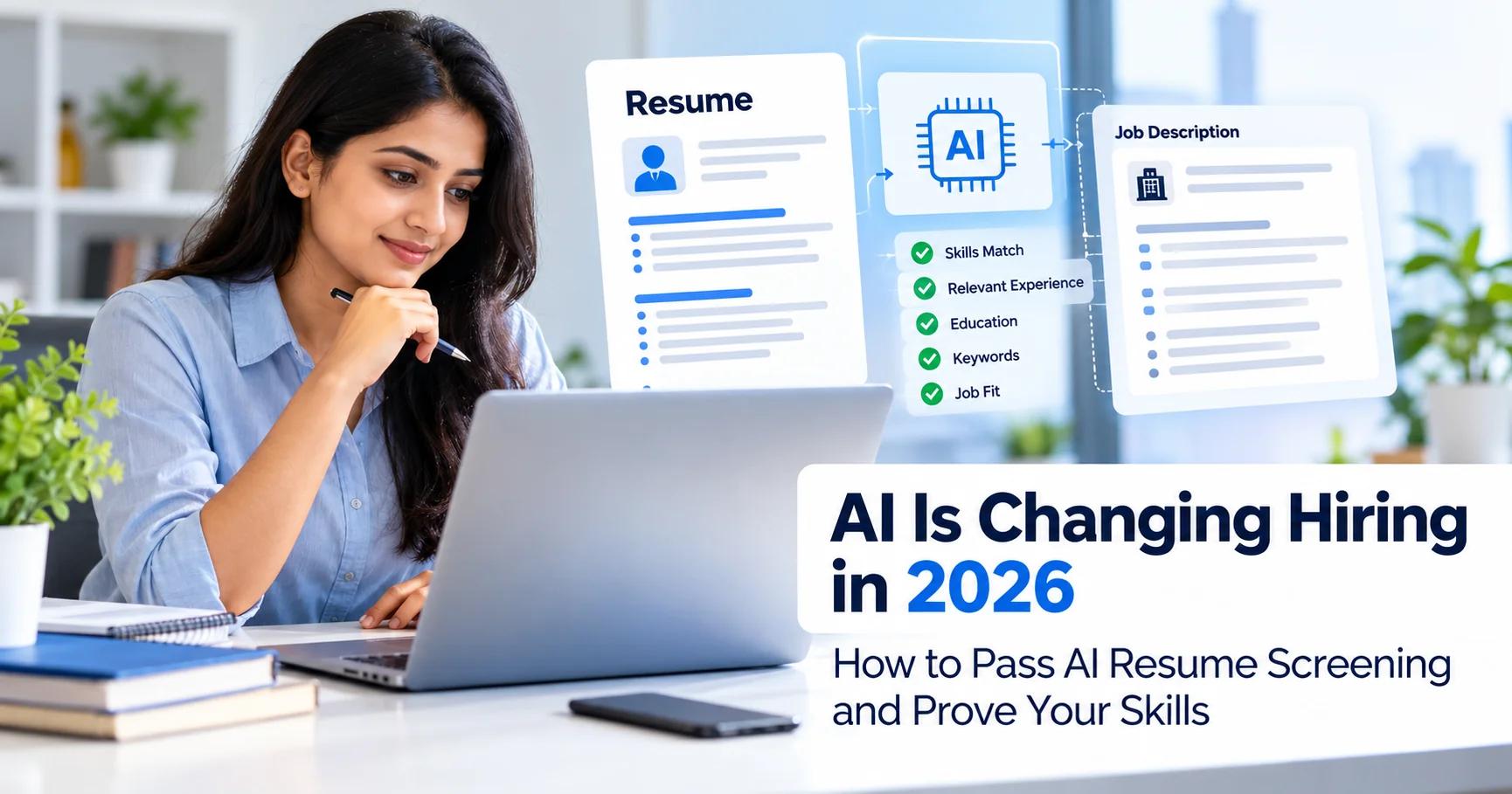
Finding a job in 2026 involves more than uploading a resume and waiting for a recruiter to respond. Many employers use applicant tracking systems, automated screening tools, and AI-assisted recruitment software to help manage applications and identify relevant candidates.
For students, fresh graduates, and experienced professionals, this raises an important question: how can you make your resume stand out when technology may help process it before a recruiter reviews it?
The answer is not to stuff your resume with keywords or let AI invent impressive achievements. It is to present your real skills clearly, connect your experience to the job requirements, and demonstrate what you can actually do.
In this guide, you will learn how AI-assisted hiring works, how to improve your resume, which mistakes to avoid, and how to use AI responsibly during your job search.
Why AI Resume Screening Matters in 2026
AI is becoming an increasingly important part of recruitment. The modern talent acquisition landscape increasingly blends automated filtering with human assessment to manage unprecedented application volumes.
Deloitte India 2026 Research Benchmark
Deloitte India's Campus Workforce Trends 2026 research, published on August 27, 2026, found that 86% of surveyed organizations reported that AI or agentic AI was transforming recruitment processes. The report also highlighted that 72% utilized AI specifically for resume screening.
These figures describe the organizations surveyed, not every employer in India. Nevertheless, they highlight why candidates should understand modern recruitment processes.
The important takeaway is that employers need more than polished applications. They need evidence that candidates have the skills required for the role.
A well-written resume should therefore do two things: communicate relevant qualifications clearly and provide credible evidence of your capabilities.
1. What Is AI Resume Screening?
AI resume screening refers to the use of automated technologies to help employers process or evaluate job applications. Different organizations use different systems, so it is important to understand three related concepts:
Applicant Tracking Systems (ATS)
These systems help employers collect applications, organize candidate profiles, track recruitment pipeline stages, and search for specific qualifications.
Resume Parsing
Parsing software automatically extracts structured fields such as education, employment history, skills, contact details, and dates from document text.
AI-Assisted Recruitment
Tools utilizing machine learning or language models to summarize applications, match relevant experience, and assess alignment with job descriptions.
Not every applicant tracking system uses generative AI, and not every employer automatically rejects candidates based on a software-generated score.
Your best strategy is to create a resume that is accurate, readable, relevant, and easy for both recruiters and software to interpret.
2. Read the Job Description Before Editing Your Resume
One resume may not communicate your suitability equally well for every position. Customizing it for each role helps employers find the information most relevant to their requirements.
Start by identifying the skills, responsibilities, qualifications, and experience mentioned in the job description.
For example, a junior Python developer position might require:
- Python programming
- FastAPI or Flask
- SQL databases
- REST API development
- Git and version control
- Debugging and testing
If you genuinely have these skills, make them visible in the appropriate sections of your resume.
“Worked on different programming projects.”
“Developed a REST API using Python and FastAPI, integrated PostgreSQL for data storage, and tested endpoints to validate application behavior.”
The second statement explains the work performed and the technologies used. If you have a verified outcome, include it. If you do not have measured results, describe your contribution accurately instead of inventing numbers.
Practical Tip: The Master Resume Strategy
Keep a master resume containing your complete career and project history, and derive a tailored version for each target role. This allows quick customization without repeatedly rewriting everything from scratch.
3. Use a Clear, ATS-Friendly Resume Format
A visually attractive resume can be useful, but complicated layouts sometimes make information harder for automated systems to extract. For most entry-level professional and technical positions, a straightforward format is a sensible starting point.
Use these standard sections:
- Name and professional contact information
- Professional summary
- Relevant skills
- Work experience or projects
- Education
- Relevant certifications and achievements
Choose clear headings, consistent formatting, and readable standard fonts. Avoid relying on decorative graphics, icons, or multi-column complex tables to communicate essential information. Keep all important details in the main document text.
Follow the employer's requested file format. If a PDF is accepted, use a text-based PDF rather than a scanned image. Before submitting, check that you can select and copy the resume's text in the correct reading order.
There is no universal format that guarantees success with every ATS. The objective is to reduce avoidable formatting errors and make your qualifications effortless to understand.
4. Write Resume Bullet Points That Demonstrate Your Skills
Recruiters need more than a list of responsibilities. They need to understand what you accomplished or contributed.
Action Verb + Task + Technology or Method + Result
Consider the progression across these three examples:
Responsible for database management.
Designed PostgreSQL tables and wrote SQL queries to support application data management.
Optimized a database query, reducing average execution time from 1.8 seconds to 0.7 seconds during testing.
Only include measured results when you can explain how they were obtained. For nontechnical roles, the same principle applies: describe the problem you addressed, the work you performed, and the outcome you achieved.
For freshers, academic projects, internships, volunteer work, and personal projects can demonstrate useful capabilities even without extensive employment history.
5. How Freshers Can Build a Strong Resume Without Experience
If you are applying for your first job, you may not have professional achievements to list. That does not mean your resume must be empty. Focus on evidence of what you can do:
- 🎓Academic projects: Explain the objective, your contribution, and the tools you used.
- 💻Personal projects: Build a useful application, website, dashboard, or research project related to your target role.
- 💼Internships: Describe the actual responsibilities and practical skills you developed.
- 🌐Open-source contributions: Include relevant contributions that you can discuss and explain in an interview.
- 📜Certifications: Add credible, verified certifications that support your chosen career direction.
For example, a fresher applying for a software role could describe a project that uses Python, FastAPI, and PostgreSQL. Explain its purpose, the endpoints or features you developed, and how you tested it. A candidate applying for a marketing role could present a content strategy, an analytics project, or a campaign case study.
Include a portfolio link when it contains relevant, accessible work. A small, well-documented project is often far more informative than a long list of unrelated courses.
6. How to Use AI to Improve Your Resume
AI tools can help you identify vague descriptions, improve grammar, organize information, and compare your existing skills with a job description. However, you should review every suggestion before using it.
Recommended Review Prompt to Test
After receiving the suggestions, compare them with your real experience. Do not automatically accept every recommendation. AI may misunderstand a requirement, add unsupported claims, or recommend keywords that do not fit your background.
Also consider privacy before uploading your resume. Remove unnecessary personal identifiers and confidential employer information, and review the AI service's data-handling practices.
The goal is to use AI as a writing and review assistant, not as a substitute for your judgment.
7. Common Resume Mistakes to Avoid
⚠️ Keyword stuffing
Repeating terms excessively does not demonstrate competence. Include relevant skills naturally in your summary, skills section, projects, and experience.
⚠️ Inventing achievements
False numbers, responsibilities, and certifications will damage your credibility during technical interviews and background checks.
⚠️ Sending the same resume everywhere
A generic resume may obscure the exact skills most relevant to a particular vacancy. Adjust emphasis for each application.
⚠️ Listing skills without evidence
A skills list is useful, but projects, code repositories, and work examples prove how you have applied those skills.
⚠️ Overdesigning the document
Complex multi-column layouts can confuse automated document parsers. Choose a clean format appropriate for ATS.
⚠️ Trusting online ATS scores too much
Third-party scoring tools do not replicate every proprietary recruitment algorithm. Treat suggestions as advisory feedback rather than an exact hiring prediction.
⚠️ Ignoring application instructions
Follow the requested document format and include any required portfolio, cover letter, or eligibility information.
8. A Practical Checklist Before Applying
Before submitting your resume, run through this practical pre-flight checklist:
- ✓ My resume is tailored to the specific position.
- ✓ My contact information (email, phone, LinkedIn/portfolio) is current.
- ✓ My relevant skills are highlighted and easy to locate.
- ✓ My project descriptions clearly explain my individual contribution.
- ✓ My achievements are accurate and verifiable.
- ✓ My document formatting is clean, consistent, and readable.
- ✓ All portfolio and GitHub links are active and accessible.
- ✓ I have performed a thorough spelling and grammar check.
- ✓ I can speak confidently to every claim in an interview.
- ✓ I have adhered to all application and file-format instructions.
These steps cannot guarantee an interview, but they help you avoid preventable mistakes and present your qualifications more effectively.
Conclusion: Clear Evidence Beats Manufactured Claims
AI-assisted hiring is changing how some organizations process applications, but a strong resume still depends on clear communication and credible evidence of your abilities.
Focus on a readable format, relevant skills, meaningful projects, and honest achievements. Use AI to improve clarity, not to manufacture qualifications.
The strongest application is one you can confidently explain and support with evidence during an interview.
Ready to Optimize Your Resume?
Use AdvizeU's free, privacy-first career tools to analyze your resume against real job descriptions and generate clear, impact-driven bullet points.
Frequently Asked Questions
Does every company use AI to screen resumes?
No. Recruitment practices vary. Some employers use applicant tracking systems and AI-assisted tools, while others rely on manual review or a combination of methods.
How can I make my resume ATS-friendly?
Use clear section headings, readable formatting, relevant terminology from the job description, and accurate descriptions of your experience. Follow the employer's file-format instructions.
Should I use AI to write my entire resume?
AI can help draft and edit your resume, but you should review every statement. Your final resume must accurately represent your skills, experience, and achievements.
Is a one-page resume always better?
No. A concise one-page resume can work well for freshers, but the appropriate length depends on your experience, profession, and the employer's requirements.
Can an ATS reject a qualified candidate?
Automated systems have limitations, and recruitment processes are not perfect. There is no universal rule that explains how every employer's system will handle a particular application.
What matters more: skills or a degree?
It depends on the role and employer. Some positions require specific qualifications, while others place substantial emphasis on practical skills, projects, experience, or professional certifications. Review the requirements for each vacancy.
Sources and Industry References
- 1.Deloitte India: Campus Workforce Trends 2026, published August 27, 2026. Deloitte India Press Release
- 2.Association of Chartered Certified Accountants (ACCA): Talent Trends India 2026. ACCA Global Talent Trends Report
Read More in Resume & Job Tips
The Job Search Has Changed: How to Build a Resume and Career Strategy That Works in 2026
The candidate we eventually hired wasn't the most experienced person who applied. She was the only one who could tell us exactly which version of her resume she'd sent and why. Here's the job search system that actually works in 2026, whatever field you're in.
Read article →
AI Skills Are the New Resume: Why Employers Care More About What You Can Build Than What You Know
A candidate with a master's in computer science went quiet when I asked what she'd built outside coursework. Another had no degree, but walked me through a live tool she'd deployed herself, bugs and all. Here's what actually shifted.
Read article →