AI Resume Mistakes That Get You Rejected (From Someone Who Reads 140 of These a Week)
Chintan Poriya
Lead Career Editor & AI Research Director
Published: March 11, 2026
Table of Contents
The "Leveraging Synergies" Epidemic
"Leveraging synergies to drive innovation..."
We opened a Python developer role last quarter and had 140 applications within ten days. Six of them not two or three, six used some version of the phrase "leveraging synergies to drive innovation" in the first line. Two used it word for word. That's not a coincidence; that's the same AI tool producing the same output for people who never bothered to change it before hitting submit.
None of those six got a callback. Not because AI touched their resume plenty of strong resumes we do call back clearly had AI help with wording but because nothing on the page told us anything real about the person behind it.
That's the actual problem with AI and resumes right now. It's not that recruiters are hunting for "AI-generated" content to reject on principle. It's that AI-generated content, left unedited, tends to say a whole lot of nothing very smoothly. Here's what we actually see on our end, and what to fix before it costs you an interview.
Why This Keeps Happening
AI is genuinely good at organizing information and cleaning up sentences. It is not good at knowing what you actually did, unless you tell it in detail first. Most rejected AI-assisted resumes we see have the same root cause: someone gave the tool a vague prompt, got a smooth-sounding paragraph back, and pasted it in without adding anything specific of their own.
We're not looking for perfectly polished. We're looking for true and relevant, in that order.
Mistake 1 The Summary Could Belong to Anyone
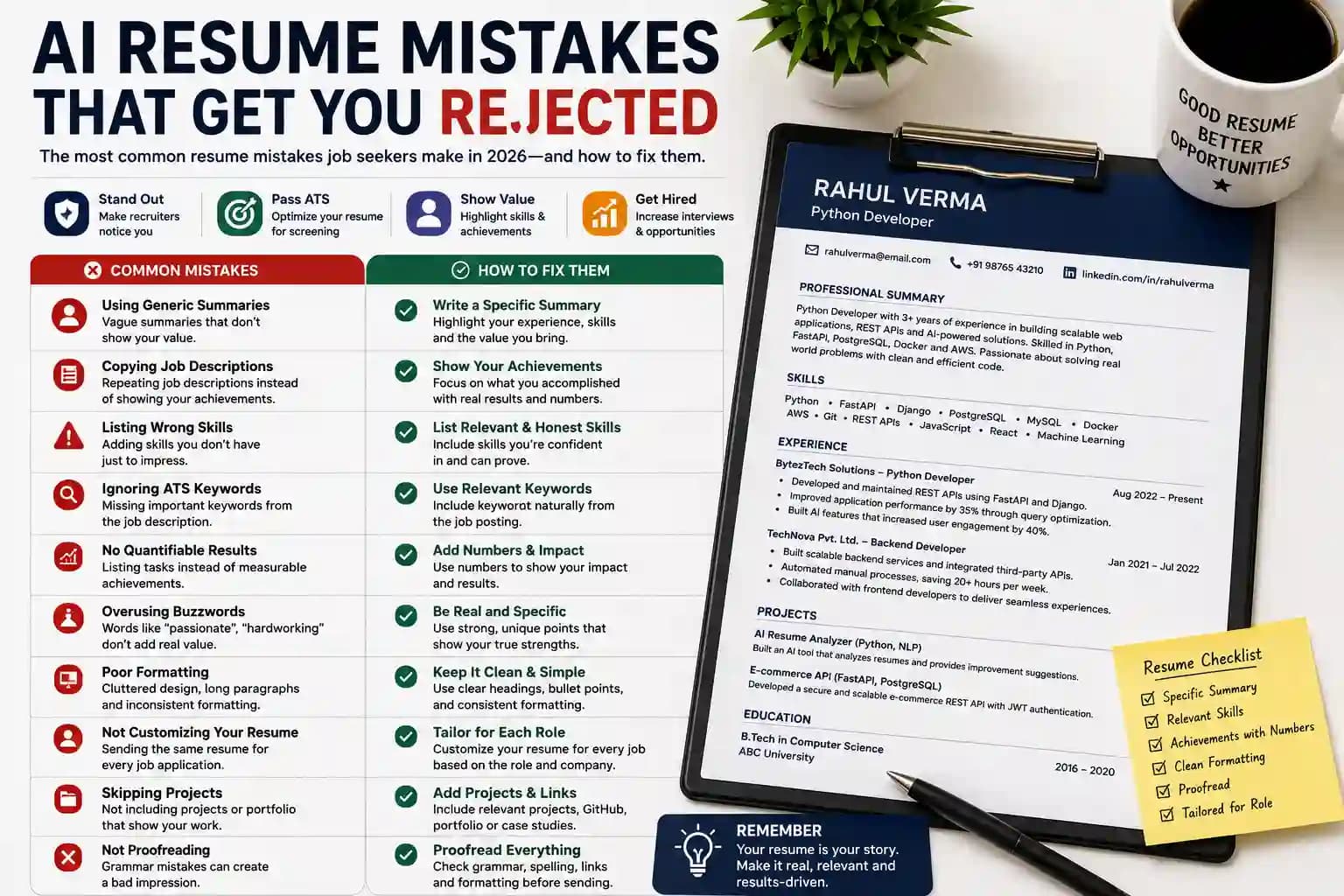
"Highly motivated professional with excellent communication skills seeking opportunities to contribute to organizational success" tells us nothing. We could swap that line onto any of the 140 applications and nobody would notice.
Generic AI Output
"Highly motivated professional with excellent communication skills seeking opportunities to contribute to organizational success."
Specific & Real
"Python developer with 3 years building AI-powered web apps on FastAPI and PostgreSQL, currently maintaining a production system handling several thousand requests a day."
That's one sentence, and it already tells us more than most full summaries.
Mistake 2 Restating the Job Posting Back at Us
We wrote the job description. Reading it back to us in different words doesn't tell us anything about you it tells us you can paraphrase. Tell us what you actually did in your last role, in your own specifics, not a rewording of what we're hoping to find.
Mistake 3 Listing Skills You Can't Actually Talk About
We ask follow-up questions. Every time. A candidate listed Kubernetes on their resume last month, and when we asked what a pod actually was, there was a long pause and then "I've read about it." That resume didn't survive the call. If AI suggested adding a trending skill you haven't used, take it back off the ten seconds it takes to remove costs you a lot less than that pause in an interview.
Mistake 4 Missing the Keywords That Actually Match the Role
This one goes the other direction plenty of resumes get filtered out simply because the actual skills used in daily work never show up in searchable text. If you use FastAPI daily but only wrote "backend development," an ATS scan and a skimming recruiter both miss it. Match your actual language to the role's actual language. Don't invent it just don't hide it either.
Mistake 5 Responsibilities Instead of Results
"Managed customer support" is a job description, not an achievement. "Managed support for 500+ monthly inquiries, cut average response time by 30%" is a result. We can't verify every number on a resume, but a specific, plausible number reads completely differently than a vague duty statement and it's usually the first thing that comes up in the actual interview conversation.
Mistake 6 Buzzwords Standing in for Evidence
Innovative. Dynamic. Passionate. Hardworking. Every one of these shows up dozens of times across a single hiring round, and none of them do any work. Show us the innovative thing you built instead of telling us you're an innovative person.
Mistake 7 Formatting That Fights the Reader (or the ATS)
We've had resumes come through with tables and multi-column layouts that scrambled into unreadable text once they hit our ATS. Clear headings, consistent font, simple bullet points, real spacing. Save the design creativity for a portfolio site the resume's job is to be scanned fast, by a person and a machine.
Mistake 8 One Resume Sent to Every Role
We can tell within about ten seconds when a resume wasn't written for this specific role the summary, the highlighted skills, none of it lines up with what we posted. Adjust the summary, reorder the relevant skills to the top, and swap in the project that's most relevant to the actual opening. It's fifteen minutes of work per application, and it shows.
Mistake 9 Leaving Out the Projects
Certifications tell us you finished a course. Projects tell us you can actually build something. A candidate's personal project even a rough one, even one built over a single weekend usually tells us more in two minutes of conversation than a page of certifications does. Include personal builds, freelance work, open-source contributions, and links people can actually click.
Mistake 10 Skipping the Proofread
AI-assisted writing still produces awkward phrasing and the occasional flatly wrong detail a wrong month, a role title that doesn't match LinkedIn, a broken portfolio link. We've had resumes list a phone number with a digit missing. Read it once, out loud, before you send it. It catches more than you'd expect.
Where AI Actually Helps vs. Where It Backfires
Use AI For
Tightening a wordy bullet point
Suggesting stronger action verbs
Catching grammar and awkward phrasing
Organizing sections and structure
Matching phrasing to a job posting's language
Don't Use AI For
Inventing an achievement you didn't have
Adding certifications you don't hold
Listing skills you can't discuss in an interview
Writing your entire resume with zero personal input
Copying the job posting itself into your resume
A Quick Checklist Before You Hit Submit
If all seven are genuinely yes, it's ready.
What Actually Moves the Needle in 2026
Beyond the resume itself: a LinkedIn profile that matches what's on the resume (mismatches are one of the fastest ways to raise a flag), a small portfolio or GitHub with real projects, and application language that's clearly written for this role rather than recycled across fifty others. None of this needs to be elaborate it needs to be specific and genuinely yours.
Final Thoughts
AI genuinely makes resume writing faster and, when used well, better. The mistake isn't using it it's stopping at the first smooth draft it hands back instead of pushing further with your own real detail. We don't reject resumes for having AI's fingerprints on the wording. We reject them when there's nothing underneath the wording to actually talk about.
A resume that sounds a little rougher but tells us something true and specific will beat a polished, generic one in our hiring process every time. That's not a guess it's what we've watched happen across every hiring round this year.
FAQ
Will recruiters reject my resume just for using AI to help write it?
No. Most strong resumes we approve had some AI assistance with wording or structure. What gets rejected is content that stays generic or inaccurate after that assistance, not the fact that a tool was involved.
Should I remove a skill entirely if I only have basic exposure to it?
Not necessarily just be honest about your level. "Familiar with Kubernetes basics" survives a follow-up question. Listing it as a core skill when you can't explain it does not.
How many versions of my resume should I actually keep for different roles?
One strong base version, then a tailored pass for each application updated summary, reordered skills, matching project highlighted. That's usually a 10-15 minute edit, not a full rewrite each time.
Do projects really matter more than certifications?
In our hiring process, yes, generally. A certification shows you completed a course. A project shows you can build something and explain the decisions behind it that's closer to what the actual job requires. For example, learning through certifications is great, but applying it matters more.
Written by Chintan Poriya, Marketing Head.
Read More in Resume & Job Tips
The Job Search Has Changed: How to Build a Resume and Career Strategy That Works in 2026
The candidate we eventually hired wasn't the most experienced person who applied. She was the only one who could tell us exactly which version of her resume she'd sent and why. Here's the job search system that actually works in 2026, whatever field you're in.
Read article →
AI Skills Are the New Resume: Why Employers Care More About What You Can Build Than What You Know
A candidate with a master's in computer science went quiet when I asked what she'd built outside coursework. Another had no degree, but walked me through a live tool she'd deployed herself, bugs and all. Here's what actually shifted.
Read article →