The Job Search Has Changed: How to Build a Resume and Career Strategy That Works in 2026
Chintan Poriya
Lead Career Editor & AI Research Director
Published: September 23, 2026
Table of Contents
The person we eventually hired for a content role wasn't the most experienced candidate who applied. She was the only one who could tell us, without hesitation, which version of her resume she'd sent us and exactly why she'd tailored it that way. A couple of the more experienced applicants had stronger backgrounds on paper and genuinely couldn't explain what made their application specific to us at all, beyond swapping the company name into a template.
Everything in this article applies whether you're chasing a technical role, a marketing job, an operations position, or something else entirely. The specific skills change by field. The underlying system—how you position your experience, how you research a role before applying, how you prepare to actually talk about your work—does not.
Finding a job in 2026 can genuinely feel exhausting. You apply, customize a resume, complete an assessment, sit through interviews, and sometimes hear nothing back at all. The problem is rarely a lack of ability. It's usually how experience gets presented, how opportunities get chosen, how preparation happens, and how the whole search gets managed day to day.
The Specificity Advantage
In a market crowded with generic AI-generated resumes, employers remember candidates who demonstrate intentionality. When you can articulate why a specific version of your experience fits an exact role, you immediately outrank applicants with twice the years of experience who copy-pasted a template.
What's Actually Changing in Hiring Right Now
Recruitment increasingly runs through applicant tracking systems and AI assisted tools on the employer side, while candidates increasingly use AI to write resumes, generate applications, and prepare for interviews on their own side. That's a more complicated environment for everyone involved.
There's real concern in current hiring research about automated systems rejecting genuinely qualified candidates before a human ever sees the application, and plenty of reporting describing longer, harder job searches across several markets, with candidates making real compromises along the way.
None of this means every employer runs the same process. It does mean preparing for both automated screening and an actual human conversation is worth taking seriously, regardless of what field you're in.
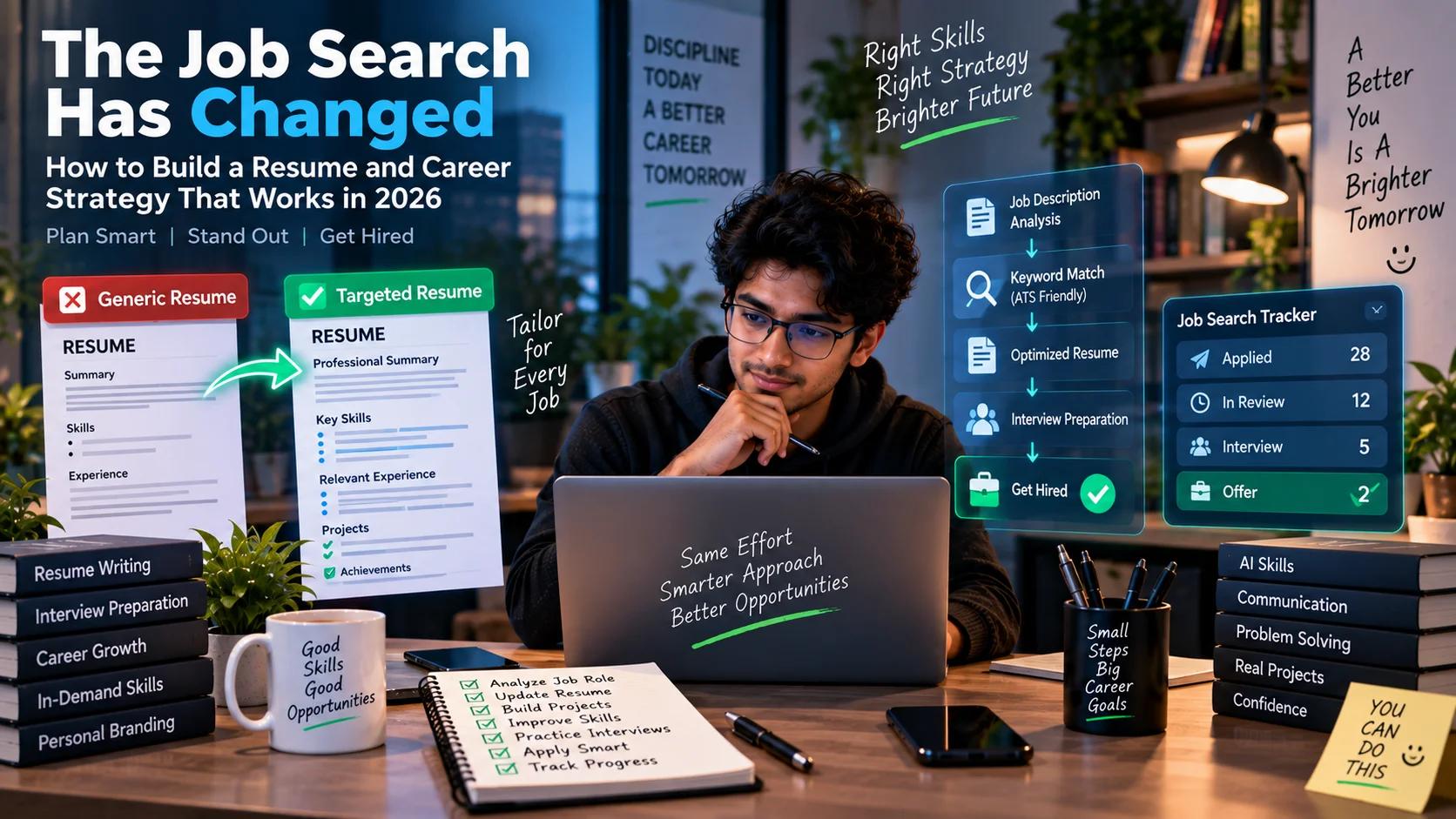
Stop Sending the Same Resume to Every Application
This is one of the most common mistakes across every field, not just technical ones. Someone might apply for a handful of adjacent roles, say a Python developer position, an AI or ML role, a backend role, a data analyst role, and an automation focused role, or in a different field, a content marketing role, a brand role, and a communications role. These overlap in real ways without being identical, and each deserves a different emphasis.
A backend focused resume leans on API work, database design, authentication, testing, and deployment. An AI or ML focused version leans on model work, data preprocessing, evaluation, and specific libraries. A marketing focused resume for one role might lean on campaign strategy and analytics, while a version for a more creative role leans harder on the actual content produced. The underlying experience can stay the same. The emphasis should shift with the role.
The Generic "One-Size" Resume
Sends the identical PDF to 50 companies with generic job duty bullets.
- ✕ Filtered out by ATS keyword mismatches
- ✕ Fails to answer why you want this exact role
- ✕ Stumbles when asked why the application was sent
The Targeted Role Resume
One master resume that branches into 2-3 tailored role profiles.
- ✓ Aligns cleanly with verified job requirements
- ✓ Highlights relevant projects and tools first
- ✓ Delivers confident, specific interview answers
A practical structure: keep one master resume containing your complete, accurate experience, then build a targeted resume customized for a specific role, and specialized versions for closely related paths beyond that. The master resume feeds into a Python developer version, an AI or ML engineer version, a backend developer version, or whatever the equivalent branching looks like in your own field. Never invent experience or add a skill you can't actually demonstrate. Customization should sharpen relevance, not misrepresent the background underneath it.
Understand What ATS Screening Actually Does
An applicant tracking system helps an organization manage applications, storing them, organizing them, tracking interview stages, and sometimes supporting screening decisions, though the exact configuration varies enormously by employer and software. There's no single universal score that determines whether any resume passes. Discover how to format your document cleanly with our guide to beating ATS resume filters.
⚙️ The ATS Formatting Blueprint
What Consistently Helps
- ✓ Standard section headings (Experience, Education, Skills)
- ✓ Clear, conventional job titles and chronological dates
- ✓ Relevant keywords pulled honestly from the role description
- ✓ Single-column or clean standard layout with standard fonts
What Consistently Hurts
- ✕ Complex multi-column tables and floating text boxes
- ✕ Graphic skill rating bars (e.g. "Python: 80%")
- ✕ Text embedded inside raster images or canvas graphics
- ✕ Critical contact or skill details buried in headers/footers
A clean resume is easier for both software and a human reader to interpret. None of this guarantees an interview on its own. Your actual qualifications, relevance, experience, the competition for that specific role, and the employer's own requirements all still matter.
Treat the Job Description as Research, Not Just a Trigger to Apply
Plenty of people read a title and start applying immediately. A better approach reads the actual description first and decides whether the role genuinely fits. Worth identifying specifically: the core responsibilities you'd actually perform day to day, the skills explicitly required, the skills that are useful but not mandatory, whether the company's expecting entry level, intermediate, or senior experience, and the actual business context, the product, industry, or customer you'd be working around.
A technical posting for a Python backend role might mention Python, FastAPI, REST APIs, PostgreSQL, Docker, Git, testing, and cloud deployment. Comparing each requirement against your actual evidence—a project or role where you used it, a specific implementation, a documented test case, real repository history—makes the gaps and the strengths equally obvious before you spend time on an application that was never a real fit.
Write Bullets That Explain What You Actually Contributed
A resume shouldn't just describe what you were assigned. It should explain what you actually did. "Worked on backend development using Python" is broad enough to mean almost anything. "Developed REST APIs using Python and FastAPI, integrated database operations, and implemented request validation for a backend application" says considerably more.
Action Verb + Concrete Work + Technology + Verified Result
"Responsible for database management and writing reports."
"Built an automated reporting workflow using Python and PostgreSQL to reduce repetitive data processing steps during internal testing."
Only include results you can actually verify. Never invent a percentage improvement, a revenue figure, a performance metric, a scope of team responsibility, or a client outcome you can't back up. Specific and honest consistently beats impressive sounding and exaggerated, and it's exactly what separated the candidate we hired from the applicants who couldn't explain their own claims when asked.
Don't Let AI Write Your Entire Professional Identity
AI genuinely helps with resume structure, grammar, keyword identification, analyzing a job description, interview practice, cover letter drafting, and sharpening a weak bullet point. Letting it generate a complete resume without real personal review tends to produce skills you don't actually possess, technical descriptions that are subtly wrong, generic phrasing, repeated language, unrealistic sounding achievements, and experience that reads disconnected from your actual work.
Check our breakdown of common traps in AI resume mistakes that get you rejected.
A workable AI assisted workflow: collect your real experience first, draft the resume yourself, use AI specifically for structure and clarity, verify every single statement it touched, customize for the actual job, and do one final human review before it goes anywhere. AI works well as an assistant here. It doesn't work as a replacement for your own professional experience.
Build a Portfolio of Real Evidence, Not Just a Resume
A resume explains your experience. A portfolio proves it, and this applies well beyond software roles, into design, marketing, data work, and plenty of creative fields too. For a comprehensive roadmap, read our guide on building a job-ready portfolio.
📁 The 5 Elements of a High-Signal Project Case Study
"Developed an AI chatbot" says little. "Built a customer support chatbot using a retrieval augmented pipeline, implemented document retrieval, response generation, and fallback handling, evaluated responses against a set of test questions, and documented known limitations" says considerably more, because it shows real architecture and a genuine personal contribution without an unsupported claim anywhere in it. The same principle holds for a marketing campaign, a design project, or a data analysis: explain the actual thinking and the real outcome, not just the finished artifact. A smaller project you can explain clearly beats a large one you can't actually walk someone through.
Apply With an Actual System Instead of Random Applications
Applying randomly burns real time without teaching you anything about what's working. A simple tracker helps, recording the company name, job title, application date, the listing itself, required skills, which resume version was used, application status, interview stage, a follow up date, and the reason for rejection when you actually know it.
The point of tracking isn't pressuring yourself to apply more. It's spotting real patterns: Are the roles you're applying to requiring skills you genuinely don't have yet? Are applications progressing but interviews consistently falling apart at a specific stage? Are your resumes too generic across the board? Are you relying almost entirely on one channel? Are you spending real time on listings that were never a strong fit to begin with? Answers to these questions matter far more than the raw number of applications sent out.
Prepare for Interviews With Actual Evidence, Not Memorized Lines
Interview preparation should go past rehearsing generic answers. Employers are generally evaluating real knowledge, problem solving, communication, actual project experience, collaboration, adaptability, and genuine understanding of the role, whatever field that role sits in.
Prepare four or five real project stories, each covering the actual problem you were solving, how you approached designing a solution, what you personally contributed versus what the team did, a genuine difficulty you ran into, and what you actually delivered, tested, or learned from it.
For a question like "tell me about a problem you faced," a strong answer covers the original issue, how you investigated it, the alternatives you weighed, what you actually changed, how you verified the fix worked, and what you'd do differently next time.
Never claim credit for something you only observed or assisted with. Being precise about your actual role is exactly the kind of specificity that made the difference in our own hiring decision.
Prepare for AI Assisted Hiring Without Losing Anything Genuine
AI shows up in parts of recruitment now: application management, screening support, scheduling, and assessment workflows, though exactly how much varies by employer.
Keep your resume accurate, keep LinkedIn consistent with what you're actually claiming in an application, be ready to explain every skill you've listed under real questioning, practice technical or role specific tasks without leaning entirely on AI to get through them, ask genuine questions about the assessment process when it's unclear, and follow whatever independent work rules an employer actually states rather than working around them. AI can help you prepare. Your actual skill still needs to hold up the claims sitting in your application once someone starts asking follow up questions.
Treat LinkedIn as Real Professional Evidence, Not a Digital Business Card
A headline like "Software Developer" says far less than "Python Developer | FastAPI | AI/ML Integration | Backend APIs | Automation." The same principle applies in any field: specificity beats a generic title every time.
LinkedIn Profile Optimization Checklist
- About Section: Explain your actual professional focus, what you genuinely enjoy solving, your proven strengths, and what roles you are actively targeting.
- Featured Section: Pin live repositories, portfolio links, architectural case studies, demo videos, and verified certifications.
- Activity & Posts: Share real project lessons, clear breakdowns of technical challenges, and honest implementation learnings—not generic motivational quotes.
Networking Is Learning, Not Just Asking for a Job
Real networking teaches you about roles, industries, and expectations you couldn't learn any other way, though it never guarantees a job on its own. Worth doing: connecting with people already in the kind of role you want, asking specific questions about how they actually got there, participating in relevant communities, attending genuinely useful events or webinars, sharing real project knowledge, and maintaining relationships over time rather than only reaching out when you need something.
A message like: "I'm developing my skills in this area and exploring roles in it. I came across your background and found your experience genuinely interesting. I'd appreciate learning what's been most useful in your own role" reads completely differently than an immediate ask for a referral with no context behind it at all.
Watch Carefully for Fake Listings and Recruitment Scams
A difficult job market makes people more vulnerable to fraudulent opportunities, and current reporting has flagged a real rise in fake employers, AI generated listings, company impersonation, phishing, and misleading remote work offers.
🚨 Critical Recruitment Red Flags
Before accepting anything, verify the company's actual website, the recruiter's real identity on LinkedIn, the official email domain, the job description itself, the interview process, the employment terms, and the salary and payment conditions. Never share a password, an OTP, or unnecessary identity documents with a contact that hasn't actually been verified.
Build Skills Around Real Requirements, Not Every Trend
Learning every new technology or trend isn't a realistic strategy in any field. Choose based on the roles you're actually pursuing:
Backend Engineering
Python/Node, REST APIs, SQL databases, OAuth/Auth, unit testing, Git, Docker, and containerized cloud deployment.
AI & Machine Learning
Python, data preprocessing, ML fundamentals, evaluation metrics, API deployment, Vector DBs, RAG pipelines, and monitoring.
Data Analysis
Spreadsheets, SQL querying, data cleaning, statistics, dashboard visualization (Tableau/PowerBI), and clear executive reporting.
Marketing & Growth
Campaign architecture, Google Analytics/attribution, content strategy, audience research, and conversion funnel testing.
The exact list should come from actually reviewing current job descriptions in your specific target market, not a generic "learn everything" list.
A Four Week Job Search Improvement Plan
Role Analysis & Honest Gap Audit
Choose one primary target role, review ten real job descriptions for it, identify which skill requirements keep showing up repeatedly, review your existing resume honestly, and list your genuine strengths and gaps side by side.
Targeted Resume & LinkedIn Refresh
Build a genuinely targeted resume, rewrite any unclear bullet points, add two or three real projects if you have them, update LinkedIn to match, and prepare a clear professional introduction you can say out loud without stumbling.
Systematic Applications & Story Rehearsal
Start applying and practicing in parallel, tracking every application properly, preparing both technical and behavioral questions relevant to the role, practicing explaining your projects clearly, and asking a real professional for honest feedback wherever that's possible.
Metrics Review & Strategic Adjustment
Review what's actually happened: the number of relevant applications sent, the response rate, interview invitations, any repeated rejection reasons you can identify, skill gaps that keep coming up, resume feedback received, and how interviews actually went, then adjust the whole approach based on that real evidence.
A month like this can't guarantee an offer. It reliably produces a far more structured process than applying randomly ever does, in any field.
Mistakes Worth Avoiding
- ✕Listing unprovable skills: Adding keywords you cannot defend under in-depth follow-up questioning.
- ✕Generic responsibility statements: Describing what you were assigned instead of what you actually built or fixed.
- ✕Applying without reading the JD: Wasting application energy on roles with incompatible requirements.
- ✕Unvetted AI resume generation: Relying blindly on ChatGPT output without rigorous fact-checking and personal voice.
- ✕Skipping interview evidence preparation: Assuming a strong resume eliminates the need to prepare specific project stories.
- ✕Single-channel dependency: Relying exclusively on Easy Apply instead of company career portals, networks, and referrals.
- ✕Giving up after initial rejections: Abandoning the search rather than auditing application metrics and refining.
Final Thoughts
Finding a job in 2026 takes patience, real preparation, and a more structured approach than applying everywhere and hoping something sticks. A resume should clearly communicate genuinely relevant experience. A portfolio should back it up with real evidence. Applications should be customized for roles that actually fit. Interview preparation should focus on explaining your real work clearly, whatever field that work happens to be in.
AI can genuinely help with research, drafting, and preparation. It can't replace the responsibility of providing accurate information and actually building the skill behind it. A better job search was never about applying everywhere. It's about understanding the market you're actually in, presenting your ability clearly, and adjusting based on real feedback, the same system that put the candidate we hired ahead of applicants with stronger resumes but no real answer for why they'd sent us that specific version of it.
Frequently Asked Questions
Why does finding a job feel so difficult right now?
Conditions vary a lot by industry, location, experience level, and role, but competition, longer hiring timelines, and shifting skill requirements are genuinely making the search harder in a lot of markets right now.
Should I really maintain multiple versions of my resume?
Yes. Keep one complete, accurate master resume, then build targeted versions for the specific roles or closely related paths you're actually pursuing.
Can AI help build a resume that gets past automated screening?
It can help with keywords, structure, and clarity, but every claim still needs to be verified, and nothing should be added that you can't actually demonstrate under a real follow up question.
Does a strong ATS friendly format guarantee an interview?
No. ATS systems vary widely, and the actual hiring decision still involves qualifications, recruiter review, assessments, interviews, and everything else that goes into evaluating a real candidate.
How many applications should I actually send out each day?
There's no universal number. Fewer, genuinely relevant applications you can prepare properly consistently outperform a high volume of generic ones.
What should I do if interviews just aren't coming through at all?
Review the target roles themselves, how relevant the resume actually is, application quality, the portfolio behind it, and overall skill alignment, get real feedback wherever you can, and adjust from there rather than assuming the market alone is the whole problem.
Do people early in their career need real projects if they don't have much professional experience yet?
Yes, genuinely relevant projects are often the clearest way to demonstrate practical skill and problem solving when a formal work history is still thin.
Written by Chintan Poriya, CEO, BytezTech, based on a real hiring decision that came down to resume specificity over raw experience.
Read More in Resume & Job Tips
AI Skills Are the New Resume: Why Employers Care More About What You Can Build Than What You Know
A candidate with a master's in computer science went quiet when I asked what she'd built outside coursework. Another had no degree, but walked me through a live tool she'd deployed herself, bugs and all. Here's what actually shifted.
Read article →
AI Resume Mistakes That Get You Rejected (From Someone Who Reads 140 of These a Week)
Six resumes in one hiring round used the exact phrase "leveraging synergies to drive innovation." Here's what actually gets AI-assisted resumes rejected and how to fix it before you apply.
Read article →