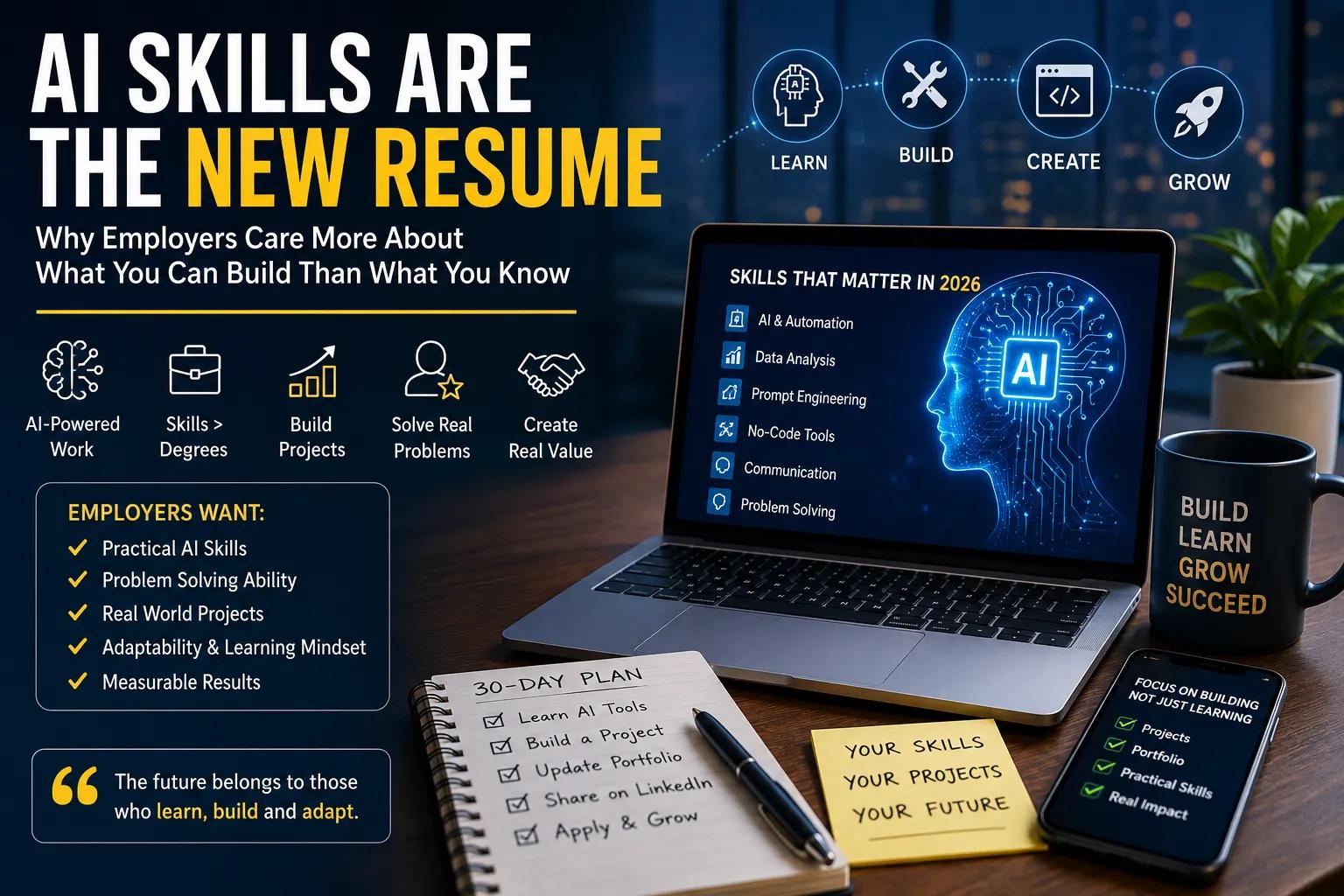
AI Skills Are the New Resume: Why Employers Care More About What You Can Build Than What You Know
Chintan Poriya
Lead Career Editor & AI Research Director
Published: June 17, 2026
Table of Contents
A candidate we interviewed last year had a master's in computer science and a resume that read almost too well every line polished, every keyword present. When I asked her to walk me through something she'd built outside of coursework, she went quiet for a long moment and then described a class project from two years earlier, in general terms, without much detail. Another candidate that same week had no degree at all two years into a program before she left but had a document search tool live on a hosted server that she walked me through in real depth: what broke during deployment, what she'd changed since, what she'd do differently next time.
We hired the second candidate. Not because degrees don't matter they still carry real weight in plenty of contexts but because she could actually show us something real, in detail, under questioning. That's the entire shift this article is about.
The Resume Alone Doesn't Carry the Weight It Used To
It's still a real, useful document. It's stopped being the whole story. Instead of asking only which degree someone holds or how many years they've logged, hiring conversations increasingly ask what someone has actually built, whether they can move a metric, how they actually use AI in daily work, whether they can solve a genuinely messy problem. A portfolio carries close to the same weight as the resume now, sometimes more, depending on the role.
AI Use Stopped Being Impressive on Its Own
A few years ago, mentioning AI tools in an interview signaled something. Now it doesn't nearly everyone uses AI in some form, so the fact of using it stopped being the differentiator. What differentiates now is whether it's actually producing measurable results: faster turnaround, better output quality, real business impact. Using AI isn't the edge anymore. Using it well, and being able to show the results, is.
Businesses Hire Outcomes, Not Tools
Nobody's hiring "a person who knows ChatGPT." They're hiring a marketer whose campaigns perform better because of how she's using AI, a developer who ships fixes faster because of it, a designer producing stronger concepts in less time, a recruiter screening more efficiently without missing good candidates. The specific tool matters far less than whether the outcome actually moved.
Build Instead of Just Collecting Certificates
We've written elsewhere about a candidate who showed up with 34 certificates and lost the role to someone with three plus real projects this is the same pattern from a different angle. Certificates prove you finished a course. Projects prove you can actually do the thing. Worth building: an AI resume tool, a support chatbot, a sales dashboard, a finance tracker, a meeting assistant, a portfolio site, an automation tool, a document search app anything that shows initiative and gets finished, not just started. (See more on free certifications that actually help).
Human Skills Are Getting More Valuable, Not Less
The candidate we hired wasn't just technically capable she communicated clearly, owned the mistakes in her project without deflecting, and thought out loud in a way that made her reasoning visible. AI can generate options quickly. Deciding which option actually solves the real problem is still an entirely human skill, and it's the one that increasingly separates a good hire from a merely competent one.
Stop Asking If AI Will Replace You Start Asking How It Helps You Work
The more useful question isn't whether a role survives AI adoption. It's how AI can be folded into the actual work: drafting, summarizing research, organizing meetings, building presentations, brainstorming, analyzing data, automating the repetitive parts. Professionals who do this well consistently free up more time for the strategic and creative work that's harder to automate in the first place.
Skills-Based Hiring Is Becoming the Default, Not the Exception
More organizations are leaning on technical assessments, portfolio reviews, practical assignments, real problem-solving exercises, GitHub activity, freelance history, and open-source contributions actual demonstrated ability rather than a claimed skill list. Being able to prove a skill under real conditions is becoming worth more than simply listing it.
Build a Career Portfolio, Not Just a Resume
Think beyond the single document: a personal site, an active LinkedIn profile, real GitHub projects, technical writing if that's your area, case studies from past work, relevant certifications, freelance history, and finished project demonstrations people can actually click through. Every piece adds a little more credibility than the last one alone would. Learn how to build your personal brand.
Five Habits That Keep This From Going Stale
Learn something every week.
The tools and techniques shift fast enough that standing still for a few months is enough to fall noticeably behind.
Build something every month.
Doesn't need to be large small, finished projects accumulate into real, demonstrable experience faster than people expect.
Share what you're learning.
A blog post, a short tutorial, a genuinely useful LinkedIn post this builds credibility while reinforcing your own understanding at the same time.
Stay curious about new tools.
Experimenting early, before something's fully mainstream, is where a lot of the real advantage comes from.
Focus on solving real problems, not collecting tools.
Businesses pay for results. A long list of software you've touched, with nothing built from it, doesn't move that needle on its own.
Mistakes That Quietly Slow This Down
Leaning entirely on certificates without ever building anything from them. Skipping practical projects altogether. Ignoring AI tools out of discomfort or inertia. Copying AI-generated work without actually understanding what it's doing this is the fastest way to freeze up under a follow-up question, exactly like what happened with the first candidate in this article's opening. Letting a portfolio go stale for months at a time. And learning continuously without ever actually applying any of it knowledge that never turns into something built doesn't show up in an interview the way people hope it will. Be mindful of these AI resume mistakes.
A 30-Day Career Upgrade Plan
Week 1
Learn
Pick one genuinely in-demand skill and complete a real introductory course in it.
Week 2
Build
Build a small project using what you just learned. Small enough to actually finish within the week.
Week 3
Publish
Publish it GitHub, a portfolio site, wherever fits so it's actually visible to someone evaluating you later.
Week 4
Share
Share it on LinkedIn, ask for honest feedback, and improve it based on what comes back.
Repeat this monthly, and a year from now the portfolio tells a real story of consistent growth closer to what the candidate we hired had built for herself, one project at a time, well before she ever walked into our interview.
Final Thoughts
Hiring is shifting from measuring what someone knows toward evaluating what they can actually do with it. Degrees and certifications still matter they're part of the story, not the whole thing anymore. What increasingly decides a close call between two candidates is the ability to point to something real, explain the reasoning behind it clearly, and own what went wrong along the way.
Start building. Start sharing what you build. The candidates who stand out going forward won't be the ones who know the most in the abstract they'll be the ones who can consistently turn what they know into something finished and real.
FAQ
Does this mean degrees and certifications don't matter anymore?
No, they still carry real weight, especially for certain roles and industries. What's changed is that they're no longer sufficient on their own a portfolio backing them up now matters nearly as much.
How many projects should be in a career portfolio to be taken seriously?
Three to five strong, finished, well-explained projects tend to matter more than a much longer list of shallow ones. Depth and clear explanation beat volume.
Is it risky to bring up AI tools in an interview, given how common their use has become?
Not at all the risk isn't mentioning AI use, it's not being able to explain the actual outcome it produced. Specificity about results is what separates a strong answer from a generic one.
What's the fastest way to start building a stronger portfolio if I'm starting from nothing?
Follow the 30-day plan above with one specific skill and one small project. A single finished, well-documented project is worth more immediately than weeks of unstructured learning with nothing to show for it.
Written by Chintan Poriya, Marketing Head.
Read More in Resume & Job Tips
The Job Search Has Changed: How to Build a Resume and Career Strategy That Works in 2026
The candidate we eventually hired wasn't the most experienced person who applied. She was the only one who could tell us exactly which version of her resume she'd sent and why. Here's the job search system that actually works in 2026, whatever field you're in.
Read article →
AI Resume Mistakes That Get You Rejected (From Someone Who Reads 140 of These a Week)
Six resumes in one hiring round used the exact phrase "leveraging synergies to drive innovation." Here's what actually gets AI-assisted resumes rejected and how to fix it before you apply.
Read article →