AI Won't Replace You - But Someone Using AI Might
Chintan Poriya
Lead Career Editor & AI Research Director
Published: June 10, 2026
Table of Contents
When a QA contractor's engagement with us ended last year, we didn't backfill the role. Not because the work stopped mattering it didn't. One of our existing engineers picked it up, using AI-assisted test generation to cover roughly the same ground in roughly the same time she'd previously spent on her own work alone. Nobody lost a job to AI in that story. A role simply didn't get refilled, because one person with the right AI fluency did the work of what used to take two.
That's the actual shape of this shift, and it's a lot less dramatic and a lot more common than the "AI is coming for your job" headlines suggest. The risk was never really the technology. It was the colleague two desks over who learned to use it well before everyone else did.
AI Is Changing Jobs, Not Erasing Them
Every major technology shift has reshaped work without eliminating it outright. The internet changed how people communicated. Cloud computing changed how software got built and shipped. Smartphones changed how business happened, full stop. AI is doing the same thing to productivity automating the repetitive parts of a role while leaving the decision-making, communication, and strategic thinking mostly intact, and mostly more valuable than before.
The Professionals Actually Pulling Ahead Right Now
It's rarely the AI specialists. It's the developers using AI to write and review code faster, the designers generating concepts more quickly, the writers who lean on it for research and a first editing pass, the marketers building campaigns with it, the analysts summarizing large datasets in minutes instead of hours. Their underlying expertise is still what makes the output good AI just removes a chunk of the friction between having a good idea and getting it onto the page.
AI Literacy Is Turning Into a Baseline Expectation
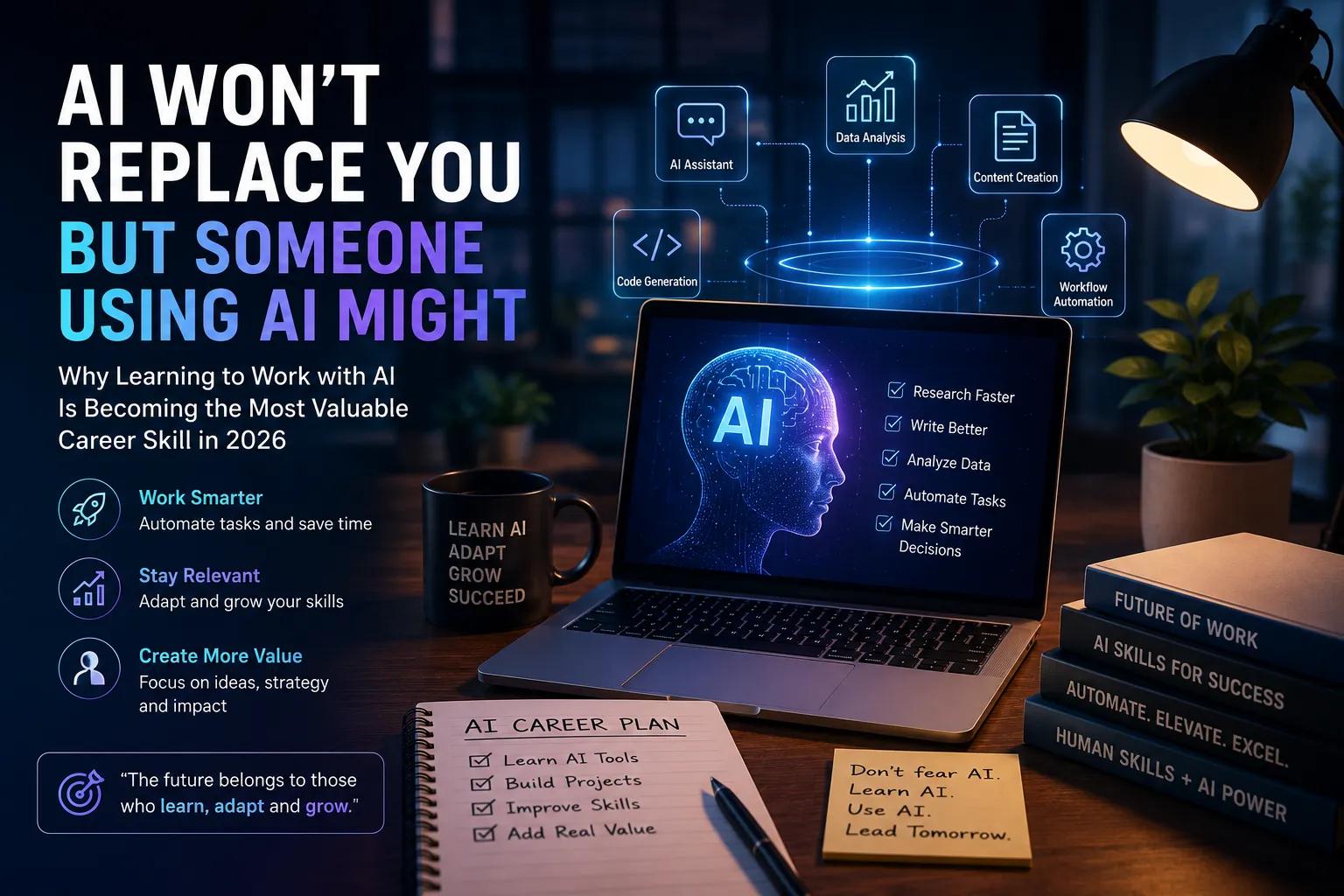
The same way basic digital literacy became assumed rather than optional over the past couple of decades, AI literacy is heading the same direction. Increasingly, that means understanding AI-assisted research, writing effective prompts, generating content responsibly, automating parts of a workflow, collaborating with AI tools day to day, and knowing where the responsible-use line actually sits. We're not hiring for "knows AI" as a checkbox skill we're noticing it show up naturally in how efficiently someone works once they're actually on the job.
What We're Actually Looking For (It's Not What You'd Guess)
Most candidates assume they need to become machine learning engineers to be competitive. They don't. What actually moves the needle: saving real time with AI, improving the quality of the output, automating the repetitive parts, picking up new tools quickly, thinking critically about what comes back, and verifying anything that matters before it ships. Knowing how to ask a sharp, specific question of an AI tool is worth more than knowing the name of every tool on the market.
Human Skills Are Getting More Valuable, Not Less
This is the part that surprises people. As AI gets better at generating options, the actual human judgment about which option is worth pursuing becomes the scarcer, more valuable skill. Communication, leadership, creativity, critical thinking, emotional intelligence, problem-solving, real collaboration none of this is going away. If anything, it's what separates someone who's just fast with AI from someone who's actually good with it.
Building AI Into a Normal Workday
This works best woven into the actual rhythm of a day rather than treated as a separate tool you visit occasionally. Mornings: prioritizing the day, summarizing overnight email, organizing meetings. Through the day: research, first drafts, data analysis, brainstorming. End of day: summarizing progress, planning tomorrow, organizing notes. This is close to what our QA engineer's day actually looks like now AI threaded through the parts that don't need her full attention, freeing up the parts that do.
Build Something That Actually Proves You Can Do This
Employers increasingly care about demonstrated experience over claimed familiarity. Real project ideas worth trying: an AI resume builder, a customer support chatbot, a study assistant, a content generator, a meeting notes tool, a portfolio site, a document search assistant, an email drafting tool. A finished project, however small, shows initiative in a way a certificate never quite manages on its own.
Mistakes That Actively Hurt Job Seekers Here
Ignoring AI completely and hoping it stays irrelevant to your field it won't, in most fields. Relying on AI output without ever verifying it. Using AI to inflate experience you don't actually have, which tends to surface the moment a follow-up question lands. Learning tools without ever applying them to anything real. And skipping practical projects entirely, staying in "reading about it" mode indefinitely. AI is supposed to strengthen your actual thinking, not stand in for it.
A 30-Day Plan to Close This Gap
Week 1
Learn & Explore
Learn prompt engineering properly and explore a handful of popular AI tools to see what actually fits your work.
Week 2
Apply to Daily Tasks
Apply AI to real daily tasks writing, research, organization instead of practicing in isolation from your actual job.
Week 3
Build a Project
Build one simple AI-powered project, start to finish.
Week 4
Update Portfolio
Update LinkedIn, your portfolio, and your resume to actually reflect what you built and learned.
Consistent effort across the month beats a single intense weekend trying to absorb everything at once. Want more details? Check out how to learn AI in 30 days.
The Professionals Who Actually Pull Ahead From Here
Every generation gets one of these shifts. This is ours. The professionals with a real advantage over the next several years won't be the ones who memorized the most tool names they'll be the ones who kept learning, adapted their workflow, and paired AI with the human skills that were already valuable before any of this started. AI isn't replacing ambition, curiosity, or judgment. It's amplifying whoever already has those, and leaving everyone else to catch up. Becoming an AI power user is a continuous journey.
Final Thoughts
The real competitive threat was never the technology itself it was the colleague, the competitor, or the candidate who learned to use it well before you did. That's exactly what happened when our QA role didn't get backfilled: not a job lost to AI, but a job quietly absorbed by someone who'd already built the skill to make that possible.
Don't wait until AI fluency becomes an explicit requirement on a job posting. Start now learn the tools, build something real with them, and let your existing expertise do what it's always done, just with less friction between you and the output.
FAQ
Will AI eventually replace most jobs, or is that overstated?
For most roles, the more accurate framing is redesign rather than replacement the repetitive parts get automated, and the judgment, communication, and strategic parts become relatively more valuable, not less.
Do I need technical skills to stay competitive as AI adoption grows?
Not necessarily deep technical skills. Prompt literacy, critical evaluation of AI output, and knowing how to fold AI into your existing workflow matter more for most roles than actual model-building knowledge.
What's the fastest way to demonstrate AI skills to a potential employer?
A finished project even a small one beats a certificate every time. Something you built, can explain clearly, and can point to directly shows far more than a course completion badge.
Is it too late to start building AI literacy if I've barely touched these tools so far?
No. The 30-day plan above is built for exactly that starting point real, consistent practice over a month closes most of this gap faster than people expect going in.
Written by Chintan Poriya, Marketing Head.
Read More in AI Tools for Work
AI Agents Are Getting Access to Your Business: Why Identity Security Matters in 2026
One of our own automations was wired to a single API key meant only to check order status. A routine review found that same key could also delete listings and issue refunds. Nothing went wrong, but it easily could have.
Read article →
AI Observability in 2026: The Hidden Skill Behind Reliable AI Applications
Every dashboard for our support chatbot showed green, uptime, CPU, response time, all fine. Customers kept saying it gave wrong answers anyway. The real problem was three steps upstream, and nothing we were tracking could see it.
Read article →