How to Use ChatGPT for Interview Preparation (The Method Behind a Candidate's Second-Chance Turnaround)
Chintan Poriya
Lead Career Editor & AI Research Director
Published: December 31, 2025
Table of Contents
We interviewed a candidate for a data role last year who clearly knew the material but fell apart under the actual pressure of the interview long pauses, answers that trailed off halfway through, no structure to how she explained her past projects. We said no at the time. She asked if she could try again in two weeks once she'd had more practice. We said yes, mostly out of curiosity about whether two weeks would actually change anything.
It did. The second interview was a different conversation entirely same knowledge, same experience, but answers that were structured, confident, and specific. When I asked what changed, she said she'd spent every evening running mock interviews with ChatGPT, question by question, with feedback after each one. We hired her.
That's the actual case for using ChatGPT this way. Not as a script generator, but as a practice partner that doesn't get tired of running the same question fifteen different ways until your answer actually lands.
Why This Works Better Than Reading a List of Questions
Reading common interview questions online tells you what might get asked. It doesn't tell you how your specific answer sounds, whether it's too long, too vague, or missing the part that actually demonstrates the skill being tested. ChatGPT can simulate the back-and-forth of a real interview and give you feedback on your actual answer, not a generic one and it'll do it as many times as you need without getting impatient.
1Tell It Exactly What Role You're Preparing For
Vague preparation gets vague questions. Be specific: Python Developer, AI Engineer, Data Analyst, Product Manager whatever the actual role is. The more specific you are, the closer the practice questions land to what you'll actually face.
2Turn It Into a Real Mock Interviewer
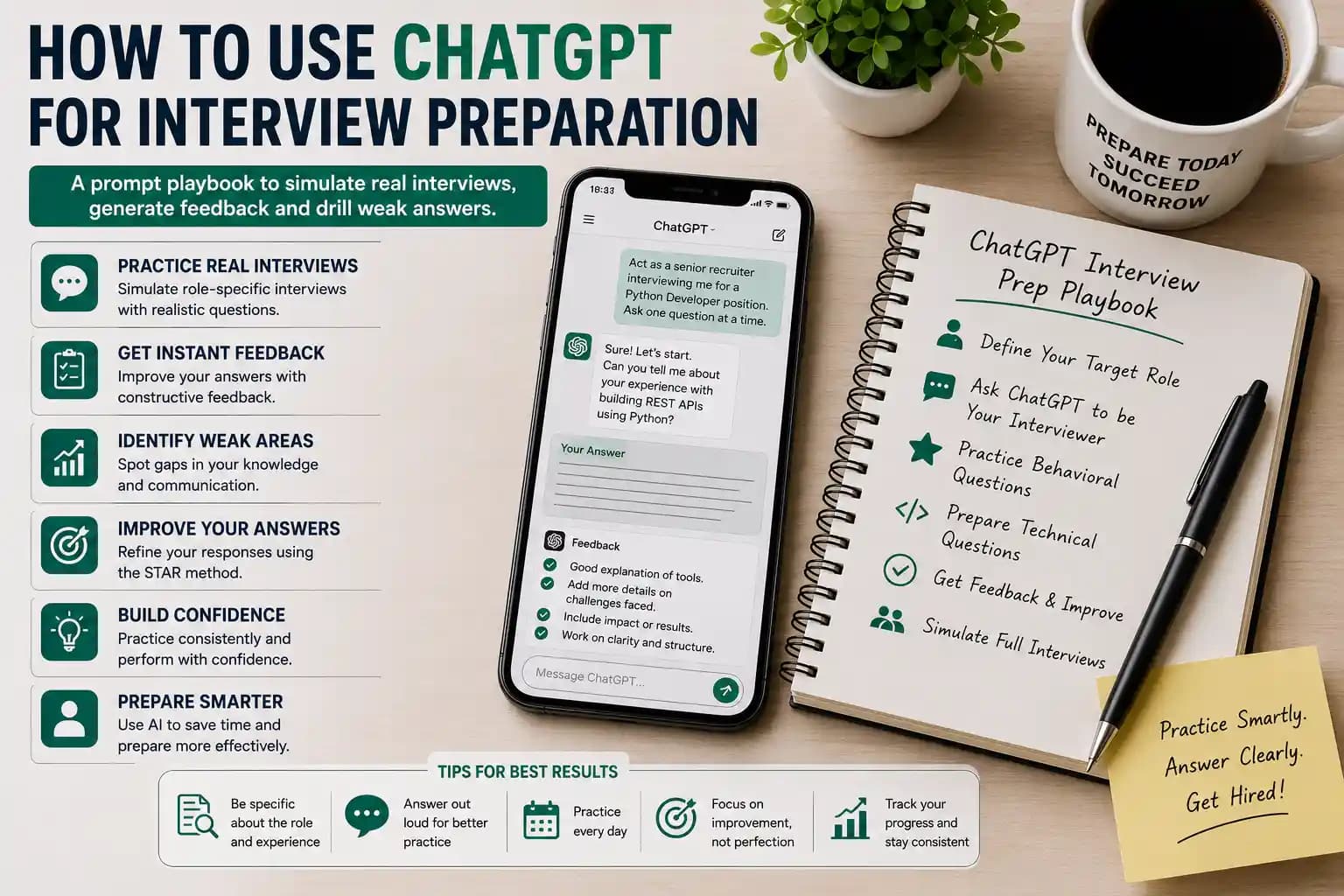
This is the core of the method. Use a prompt like: "Act as a senior recruiter interviewing me for a Python Developer position. Ask one question at a time. Wait for my answer before asking the next. After each answer, give constructive feedback and suggest improvements." That "one question at a time, wait for my answer" instruction matters more than it looks without it, you'll get a wall of ten questions dumped at once instead of something that feels like an actual conversation.
3Work Through Behavioral Questions Specifically
Tell me about yourself. Why this company? Describe a challenging project. A time you solved a hard problem. How you handle deadlines. A conflict you resolved. Your biggest professional achievement. These come up in nearly every interview, technical or not, and they're exactly the kind of question that falls apart under pressure without practice which is what happened in the story above.
4Get Role-Specific Technical Questions
For a technical role, ask for practice questions tied to your actual stack Python fundamentals, OOP, REST APIs, FastAPI, SQL, Git, Docker, system design, whatever applies. You can specify your experience level too, so the questions match where you actually are instead of either boring you or overwhelming you.
5Ask It to Actually Evaluate You
After each answer, prompt something like: "Evaluate my answer like a hiring manager. Score it out of 10, explain what worked, point out weak spots, and rewrite it stronger." This is the step most people skip, and it's the one that actually improves your answers instead of just repeating the same version each time.
6Learn the STAR Structure
Situation, Task, Action, Result. Most recruiters expect behavioral answers shaped this way, whether they say so explicitly or not. Ask ChatGPT to take your rough answer and rebuild it in STAR format the difference between a rambling story and a structured one is usually exactly this framework.
7Practice the Follow-Up, Not Just the First Answer
Real interviews rarely stop after one response. Ask ChatGPT to push back: why that approach specifically, what you'd do differently now, what you actually learned, how the rest of the team contributed. This is where a lot of otherwise-solid candidates get caught off guard the first answer was rehearsed, the follow-up wasn't.
8Run a Full Simulated Interview
Once individual questions feel solid, ask for the complete version: "Conduct a 45-minute mock interview for a Machine Learning Engineer role technical questions, behavioral questions, follow-ups, and a final evaluation with specific suggestions." This is the closest you'll get to the real thing without an actual interviewer on the other end, and it's exactly the kind of practice that closed the gap for the candidate in this article's opener.
Prompts Worth Saving
Mock interview
"Act as a recruiter and conduct a realistic interview for a [specific role]."
Technical practice
"Generate 30 [language/skill] interview questions with detailed answers."
Behavioral practice
"Ask me behavioral interview questions one at a time and give feedback after each."
Resume-based
"Review my resume and generate interview questions based on my actual experience."
Company-specific
"Interview me as if you work at a product-based technology company."
Answer polishing
"Rewrite my answer to sound more confident and structured, without changing the content."
HR round practice
"Run a complete HR interview with realistic follow-up questions."
Mistakes That Cost Candidates the Offer
What to Avoid
Memorized, scripted-sounding answers are usually easy to spot and read as rehearsed rather than genuine.
Speaking too fast under nerves.
Vague answers that never land on a specific example.
Achievements mentioned without any real explanation of the impact.
Showing up without having researched the company at all.
Speaking negatively about a past employer this one comes up more than people expect, and it rarely lands well.
Forgetting to ask any questions at the end, which reads as disengagement even when it isn't.
Getting the Most Out of Practice Sessions
Practice in short, consistent sessions 20 to 30 minutes daily beats one long cram session the night before. Answer out loud, not by typing; the muscle you're building is speaking under pressure, not writing well. Record yourself occasionally and actually listen back it's uncomfortable and useful in roughly equal measure. Focus your remaining time on the answers that are weakest, not the ones you're already confident in.
And treat ChatGPT as a coach pushing you toward better answers, not a source of a script to memorize word for word the moment it becomes memorization, the authenticity that actually gets you hired disappears.
Before You Walk In
- Review the job description one more time.
- Know the company and what it actually makes or does.
- Practice your opening introduction until it's smooth without sounding rehearsed.
- Have two or three STAR-structured examples ready to adapt to different questions.
- Test your connection ahead of time for virtual interviews.
- Dress appropriately.
- Have your resume and portfolio easy to reference.
- Prepare a few genuine questions for the interviewer not for show, but because the answers actually help you decide if the role is right too.
Final Thoughts
Interview success isn't about having a perfect scripted answer for every possible question. It's about being able to talk clearly about your actual experience, under real pressure, without losing the thread. ChatGPT is useful here specifically because it can simulate that pressure repeatedly, in private, with feedback that gets more specific every time you use it.
The candidate from this article's opening didn't gain new skills in those two weeks. She gained the ability to actually communicate the skills she already had. That gap between knowing something and being able to explain it clearly under pressure is exactly what this kind of practice closes.
FAQ
How many practice sessions does it actually take before this makes a difference?
It varies, but the candidate in this article saw a real shift in about two weeks of consistent daily practice. Even a handful of focused sessions before a specific interview tends to help more than none at all.
Should I memorize the answers ChatGPT helps me write?
No memorize the structure, not the exact wording. Answers that sound read from a script are usually easy for an interviewer to spot, and they read as less genuine than a slightly rougher, real answer.
Is this useful for non-technical roles too, or mainly for technical interviews?
It works well for both. The behavioral question practice and STAR-method structuring apply just as much to marketing, HR, or management interviews as to technical ones.
What's the biggest mistake people make when practicing this way?
Skipping the feedback step. Running through questions without asking for an honest evaluation each time means you keep repeating the same weak spots instead of actually improving them.
Written by Chintan Poriya, Marketing Head.
Read More in AI Tools for Work
AI Agents Are Getting Access to Your Business: Why Identity Security Matters in 2026
One of our own automations was wired to a single API key meant only to check order status. A routine review found that same key could also delete listings and issue refunds. Nothing went wrong, but it easily could have.
Read article →
AI Observability in 2026: The Hidden Skill Behind Reliable AI Applications
Every dashboard for our support chatbot showed green, uptime, CPU, response time, all fine. Customers kept saying it gave wrong answers anyway. The real problem was three steps upstream, and nothing we were tracking could see it.
Read article →