How to Write a Cold Email to a Hiring Manager (The One I Actually Replied to in Under an Hour)
Chintan Poriya
Lead Career Editor & AI Research Director
Published: December 10, 2025
Table of Contents
I get a handful of cold emails a month at BytezTech, and most of them get maybe ten seconds of my attention before they're deleted generic greeting, generic pitch, resume attached, nothing that tells me this person actually looked at what we do. One email a few months back got a reply from me within the hour. It opened by referencing our NVIDIA Inception membership specifically, mentioned a piece we'd published on AdvizeU about AI agents, and connected both to a concrete idea for how the sender's automation background could fit our actual work.
That's three sentences of real research (which you can also scaffold using our free AI Cover Letter & Outreach Generator), and it did more than a perfectly formatted resume ever could have.
That's the entire difference between a cold email that works and one that doesn't. Not length, not polish specificity. Here's how to actually write one.
Why This Still Works When Most People Skip It
Job portals put you in a pile with hundreds of other applicants competing on keyword matches. A genuinely well-researched cold email skips that pile entirely and starts an actual conversation. It's not a request for a job it's an introduction, and the ones that land are the ones that read like they were written for one specific person at one specific company, not blasted to fifty inboxes with a find-and-replace on the company name.
Do the Research First
Before writing a word, spend ten minutes on the company's actual products, the specific role, whatever you can find about the hiring manager's background, recent company news, and the skills the job description actually emphasizes. This is the step that separates the email I replied to from the ninety I didn't the research shows up in the first two sentences, and it's obvious when it's missing.
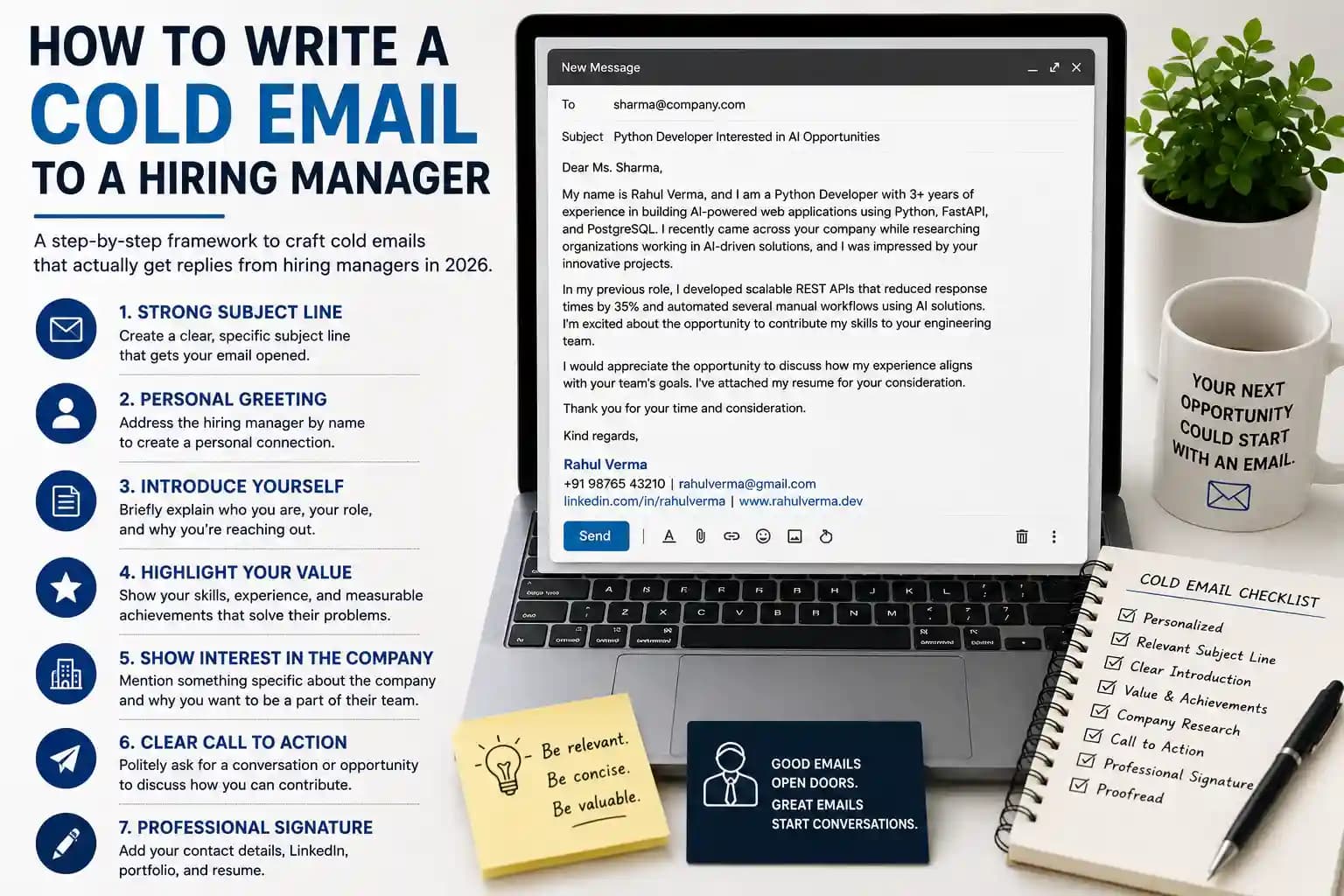
1A Subject Line That Actually Gets Opened
Keep it short, specific, and honest about what it is: "Application for Python Developer Position," "AI Engineer Interested in Your Team's Work," "Experienced Front-End Developer, Referred by [Name]." Skip anything that reads as pressure or desperation "Urgent," "Please Read," "Need Job" those get deleted faster than a blank subject line would.
2Use an Actual Name if You Have One
"Dear Ms. Sharma" or "Hello Mr. Patel" beats "Dear Hiring Manager," which beats an overly casual "Hi Friend" every time. If you genuinely can't find a name after a reasonable search, "Dear Hiring Manager" is a fine fallback just don't skip the search step to get there faster.
3Introduce Yourself in Two Sentences, Not Ten
Who you are, what you do, and why you're reaching out to this company specifically. Something like: "I'm a Python developer with three years building AI-powered web apps using FastAPI and PostgreSQL. I came across BytezTech's work on GPU-accelerated computer vision and wanted to reach out directly." That's specific enough to prove you're not copy-pasting the same email everywhere.
4Show Value, Not Just a Skills List
Don't list every technology you've touched explain what you actually did with it. "I built REST APIs that cut response times by 35% and automated several manual workflows using AI" tells me something real. A skills list tells me nothing I couldn't get from a resume, and I already have a resume attached to the same email.
5Connect Your Interest to Something Real
This is where the email that got my reply pulled ahead it referenced our NVIDIA Inception status and a specific article we'd written, not a generic "I'm impressed by your innovative work" line that could apply to literally any company in the sector. Mention something specific: a product, a piece of content, a technology focus, a recent announcement.
6End With an Easy Next Step
Something simple: "I'd appreciate the chance to discuss how my experience might fit your team happy to find time that works for you." Make it low-effort for the recipient to say yes, not a demand for an immediate decision.
7Close With a Complete Signature
Full name, phone number, email, LinkedIn, portfolio site, and GitHub if the role is technical. A complete signature means I don't have to go hunting for basic information if I want to follow up and honestly, a missing LinkedIn link has cost more than one candidate a second look from me.
A Full Example
Subject: AI Engineer Interested in Your Computer Vision Work
Dear Hiring Manager,
My name is Priya Sharma, and I'm an AI/ML engineer with two years of experience building computer vision pipelines using PyTorch and OpenCV. I came across BytezTech's work on GPU-accelerated inspection systems and was specifically interested in how you're approaching real-time defect detection.
In my last role, I optimized a model's inference speed by roughly 6x using TensorRT, which cut processing time enough to move a client's system from batch analysis to real-time. I've also worked directly with FastAPI and Docker for deployment.
I'd welcome the chance to talk about how my background might contribute to your team, and I'm happy to work around your schedule. My resume is attached for more detail.
Thank you for your time.
Best regards,
Priya Sharma
Phone: +91 XXXXX XXXXX
Email: priya@example.com
LinkedIn: linkedin.com/in/priyasharma
GitHub: github.com/priyasharma
Notice what's doing the work here: a specific technical detail (the 6x inference improvement), a specific reference to the company's actual work, and a low-pressure close. That combination is what gets a reply.
Following Up Without Being Annoying
If there's no response after 5 to 7 business days, one short, polite follow-up is reasonable. Something like: "Hi Ms. Sharma, following up on my note from last week about opportunities on your team still very interested, and happy to share more if useful." Keep it brief. A second unanswered follow-up after that is usually a sign to move on rather than push again.
What Kills a Cold Email Before It's Even Finished
What to Avoid
Sending the exact same message to a dozen companies with only the name swapped it reads as generic even when the sender thinks it doesn't.
Writing something long enough to need scrolling.
Making the whole email about what you want instead of what you can offer.
Casual language that reads as underprepared.
Typos, which land worse in a cold outreach than almost anywhere else because there's no existing relationship to soften the impression.
Forgetting the resume attachment entirely it happens more often than you'd think.
Following up three times in a week, which moves from persistent to irritating fast.
What Actually Improves Your Reply Rate
- Personalize every single email no exceptions, even when you're sending several in a week.
- Keep it under roughly 250 words; the ones I actually finish reading are almost always shorter than the ones I don't.
- Lead with a measurable achievement instead of a general claim.
- Do the company research before writing a word.
- End with a clear, low-effort next step.
- Use a professional email address, not the handle you made at seventeen.
- Proofread once before sending reading it out loud catches more than a silent scan.
Final Thoughts
Cold emailing works because most people skip the parts that actually take effort the research, the specificity, the restraint to keep it short. That's exactly why the emails that do put in that effort stand out enough to get a reply within the hour instead of a silent delete.
You don't need to send fifty of these. You need to send five genuinely well-researched ones aimed at companies you'd actually want to work for. That ratio fewer emails, more thought per email is what actually moves the needle.
FAQ
How long should a cold email actually be?
Under 250 words is a reasonable target. Long enough to make a real case, short enough that it gets read in full rather than skimmed and set aside.
Should I attach my resume to a cold email, or just include a LinkedIn link?
Attach the resume. It's the expected format, and skipping it forces the reader to ask for something they'd rather have upfront.
How many cold emails should I send before assuming this approach isn't working?
Five to ten genuinely personalized emails, spread over a few weeks, is a fair test. If none get a response, the issue is more likely the personalization or targeting than the strategy itself.
Is it okay to cold email a hiring manager even if there's no open position listed?
Yes some of the most useful cold emails land before a role is formally posted. Frame it as introducing yourself and expressing interest rather than applying for a specific listing.
Written by Chintan Poriya, Marketing Head.
Read More in Career Advice
From AI Learner to AI Professional: How to Build a Job Ready Portfolio in 2026
One candidate's portfolio said "built a RAG chatbot" and nothing else. Another explained exactly why she chunked documents the way she did and what she measured to pick her embedding model. We hired the second one before the interview even ended.
Read article →
The IT Hiring Reset: Why Companies Are Hiring Again, But Only for AI Ready Professionals
We paused hiring for almost eighteen months. When we reopened a role this year, we didn't ask candidates whether they could write clean code. We asked them to walk us through an AI assisted debugging session they had actually done.
Read article →