The IT Hiring Reset: Why Companies Are Hiring Again, But Only for AI Ready Professionals
Chintan Poriya
Lead Career Editor & AI Research Director
Published: August 5, 2026
Table of Contents
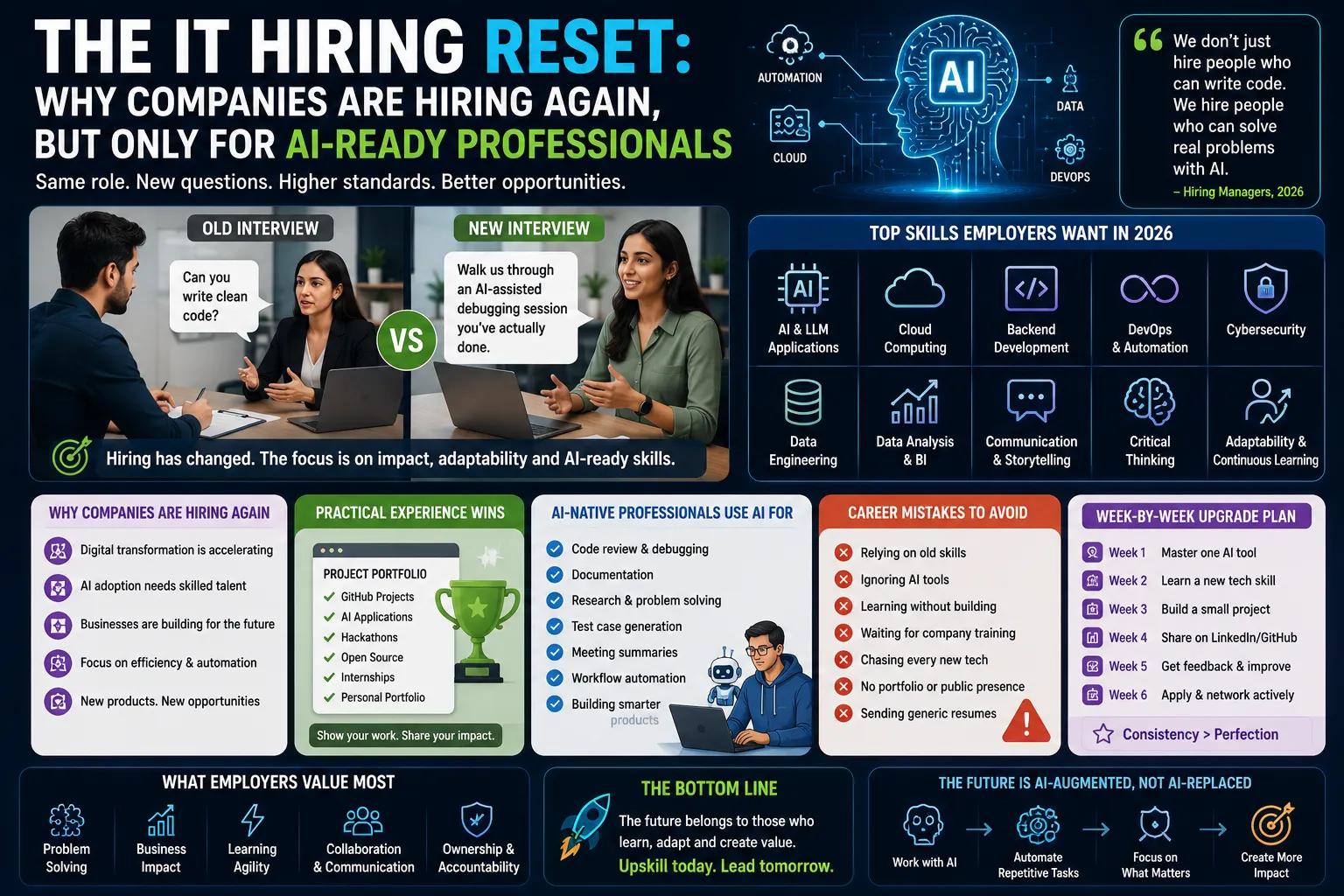
We paused most hiring at BytezTech for close to eighteen months. Budgets tightened, projects got more selective, and headcount stayed flat while the team focused on getting more out of the people already there. When we reopened a technical role earlier this year, the interview looked noticeably different from the ones we ran before that pause. We didn't spend much time asking whether a candidate could write clean code. We asked them to walk us through an AI assisted debugging session they had actually done, start to finish, including what went wrong along the way.
That single shift in the question tells you most of what's happening across IT hiring right now. Companies are hiring again. The bar for who gets hired has moved.
Hiring Broadly & Theoretically
- • Testing syntax and standalone algorithm memorization.
- • Evaluating candidates based heavily on degrees and certifications.
- • Large graduate intakes with a relatively loose bar for entry.
- • Asking candidates to write clean boilerplate code from scratch on a whiteboard.
Hiring Selectively for Outcomes
- ✓ Walking through live, AI assisted debugging sessions start to finish.
- ✓ Evaluating demonstrable GitHub projects and real working prototypes.
- ✓ Measuring ability to solve actual business problems and automate workflows.
- ✓ Expecting everyday fluency with AI assistants as a standard engineering tool.
From Hiring Broadly to Hiring Selectively
A few years back, plenty of technology companies hired aggressively and broadly, with large graduate intakes and a fairly loose bar for entry level roles. Hiring today looks more selective across the board. Instead of asking simply whether someone can write code, the real questions have shifted toward whether they can solve an actual business problem, work comfortably alongside AI, automate a real workflow, learn quickly when the ground shifts, and deliver something with a measurable result attached to it. That shift consistently rewards people who invest in ongoing upskilling rather than coasting on what already worked a few years ago.
AI Did Not Eliminate These Jobs. It Changed What They Actually Involve
One of the more persistent misconceptions is that AI is quietly replacing software careers wholesale. The real picture is more specific than that. Plenty of routine tasks are genuinely getting automated: boilerplate code, first pass documentation, basic testing support, initial research, straightforward code generation. At the same time, real demand keeps growing for people who can build genuine AI powered applications, design AI systems at an enterprise scale, integrate language models cleanly into an actual product, build cloud native software, secure AI applications properly, and optimize business workflows end to end. What companies actually need are people who know how to work alongside AI, not people trying to outcompete it directly.
Why Practical Experience Keeps Winning Over Theory
Employers increasingly weight demonstrable work well above theoretical knowledge alone. Candidates with real GitHub activity, working AI applications, hackathon experience, genuine open source contributions, internship work, or a personal portfolio consistently stand out more than candidates who lean entirely on a list of certifications. In the debugging conversation from this article's opening, the candidate who got the offer didn't win because of a credential. She won because she could walk through a real, messy debugging session in enough detail that it was obviously true experience, not a rehearsed answer.
The Skills Actually in Demand Right Now
Artificial intelligence and language model applications, meaning building genuine assistants, agents, and real business automation rather than a demo that never ships. Cloud computing across AWS, Azure, Google Cloud, Kubernetes, and Docker. Backend development in Python, Java, Node, Go, or FastAPI. DevOps covering CI/CD, infrastructure as code, monitoring, and automation. Cybersecurity, including identity management, cloud security, and secure development practices. Data engineering for building pipelines that analytics and AI systems can actually depend on. Nobody needs to master every item on that list. What matters more is a genuinely complementary stack rather than scattered exposure to all of it:
AI & LLM Applications
Building genuine assistants, autonomous agents, and end to end business workflow automations that ship to production.
Cloud Computing
Architecting scalable infrastructure across AWS, Azure, Google Cloud, Kubernetes, and containerized Docker environments.
Backend Development
Writing robust, high performance services and APIs in Python, Java, Node.js, Go, or high speed frameworks like FastAPI.
DevOps & Automation
Managing CI/CD deployment pipelines, infrastructure as code, automated system monitoring, and reliability engineering.
Cybersecurity
Implementing identity access management, cloud security governance, and secure software development lifecycles.
Data Engineering
Constructing clean, reliable data pipelines and storage architecture that advanced analytics and AI models depend on.
Companies Increasingly Expect AI Native Engineers, Not Occasional Users
Using AI once in a while is no longer treated as enough on its own. The expectation now leans toward AI being woven into everyday engineering work: code review, documentation, debugging, unit test generation, research, meeting summaries, and workflow automation. It has become part of the standard engineering toolkit rather than an optional extra someone reaches for occasionally. As more organizations transition toward AI native professionals, daily fluency with these assistants separates the engineers who ship at 10x speed from those who get bogged down in manual tasks.
Communication Has Quietly Become a Technical Skill
The strongest engineers we work with do not just ship working software. They can explain why a particular solution actually matters, what real business problem it solves, how it changes the customer's experience, and what measurable impact it produced. Technical skill opens the door to an opportunity. The ability to explain that skill clearly is often what accelerates a career once someone's already inside the door.
The Career Mistakes That Cost the Most Right Now
Leaning entirely on skills that were relevant a few years ago and never updating them. Ignoring AI tools out of discomfort or habit. Learning concepts without ever building anything real from them. Waiting for an employer to provide formal training instead of starting independently. Chasing every new technology that trends for a week instead of going deep on a few that genuinely matter. Having no public portfolio at all. And sending out generic, unpersonalized resumes that commit common AI resume mistakes to every posting. Small, consistent improvements each week tend to matter more here than any single large effort:
❌ Leaning on Outdated Skills
Relying exclusively on syntax and frameworks from years ago without adapting to modern architecture.
❌ Ignoring AI Tools
Avoiding AI assistants out of skepticism or habit instead of integrating them into daily engineering.
❌ Theory Without Building
Watching courses and hoarding credentials without ever deploying a functional working prototype.
❌ Waiting for Formal Training
Stalling professional growth until an employer explicitly assigns or pays for a learning program.
❌ Shiny Object Syndrome
Jumping between every weekly tech trend instead of building deep competency in a reliable core stack.
❌ Generic Application Blasts
Sending unpersonalized resumes with zero public portfolio links or demonstrable proof of outcome.
A Week by Week Career Upgrade Schedule
Twelve consistent weeks applied to a structured project produces something far closer to what actually gets noticed by hiring managers than months of scattered, unstructured reading ever did:
AI Tool Mastery
Pick one AI productivity tool and get genuinely comfortable with it rather than sampling several shallowly.
Cloud Fundamentals
Pick one cloud technology and work through its actual core infrastructure fundamentals.
Project Planning
Start planning a real portfolio quality project that combines both your AI tool and cloud stack.
Working Prototype
Begin building it, focusing on getting a working first version rather than a perfect one.
Decision Logging
Continue building, and start writing down your architectural decisions and trade offs as you go.
Core Completion
Finish the core features of the project to a genuinely usable, functional state.
Live Deployment
Deploy it somewhere real in the cloud rather than leaving it running only on a local machine.
GitHub Publication
Publish it properly on GitHub with clean code and a clear, honest, structured readme.
Profile Refresh
Update your LinkedIn and resume to actually reflect the technical depth of what you just built.
Case Study Writeup
Write a short case study or post explaining the exact business problem, approach, and result.
Targeted Applying
Start applying to selective roles, using the finished deployed project as real evidence rather than a claim.
Review & Iterate
Review what worked in the process and set your next target skill or expansion project to tackle.
Twelve consistent weeks like this produces something closer to what actually got noticed in that reopened role at BytezTech than months of scattered, unstructured learning ever did.
What the Next Few Years Are Likely to Look Like
Technology companies will keep investing heavily in AI, and they will also keep hiring. The real difference is that hiring will increasingly concentrate around people who combine genuine AI skill, solid software engineering, real business thinking, clear communication, and fast adaptability. Large companies appear to be gradually expanding hiring again after an extended slower stretch, particularly for AI capable, cybersecurity, and engineering roles where human judgment is still the deciding factor.
Final Thoughts
The IT industry is not shrinking. It is genuinely changing shape. The era of hiring largely on degrees and raw years of experience is giving way to a more selective approach built around practical skill, adaptability, and the ability to actually create measurable value. For professionals willing to meet that bar, this is real opportunity rather than a threat. It has simply moved, the same way it moved for the candidate who got the offer at BytezTech by walking through a real debugging session instead of listing credentials.
Invest in AI, cloud, automation, cybersecurity, and real projects, and keep sharpening communication and problem solving alongside all of it. The future in this field won't belong to whoever knows the most individual technologies. It will belong to whoever keeps learning, adapts quickly, and consistently solves problems that actually matter to the business in front of them.
FAQ
Is IT hiring genuinely recovering, or is this a temporary bounce?
Hiring is picking back up in a real, selective way rather than a broad rebound to previous hiring volumes. The bar for who gets hired has shifted meaningfully toward AI readiness and demonstrated project work.
Do I need deep AI expertise to be competitive in this hiring environment?
Not necessarily deep expertise. Genuine, practical comfort using AI in everyday engineering work, paired with solid core skills, covers what most roles are actually asking for right now.
How long does a plan like the twelve week schedule above realistically take to show results?
Twelve weeks is enough to produce one genuinely strong, portfolio ready project and update your public presence around it. Real hiring results after that depend on your specific field and how actively you apply once it's finished.
What matters more right now, certifications or a strong GitHub and portfolio?
A strong portfolio and real project history consistently carry more weight in current hiring conversations than certifications alone, though certifications still help as supporting evidence.
Written by Chintan Poriya, Marketing Head.
Read More in Career Advice
From AI Learner to AI Professional: How to Build a Job Ready Portfolio in 2026
One candidate's portfolio said "built a RAG chatbot" and nothing else. Another explained exactly why she chunked documents the way she did and what she measured to pick her embedding model. We hired the second one before the interview even ended.
Read article →
Upskilling in the AI Era: Why Continuous Learning Is the Career Advantage That Employers Reward in 2026
We gave every team member the same NVIDIA DLI course access and the same AI tool budget a year ago. One built an internal automation tool now running part of onboarding. Another let it sit unused. Here's the actual gap that opened up.
Read article →