AI Native Professionals Will Lead the Next Decade of Careers
Chintan Poriya
Lead Career Editor & AI Research Director
Published: July 8, 2026
Table of Contents
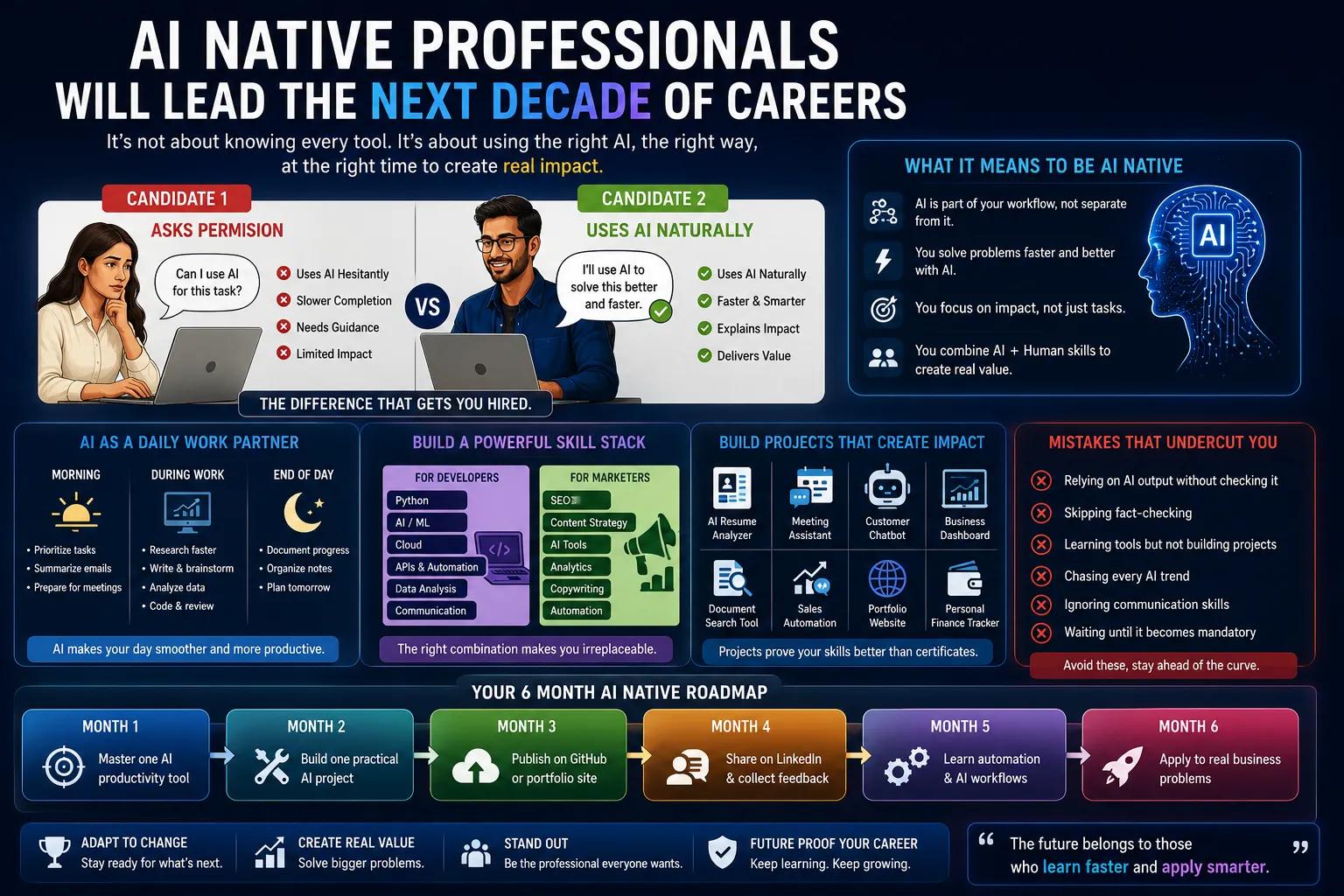
We interviewed two candidates for the same role last month. Both had similar experience on paper. During a small take home exercise, one candidate emailed to ask whether it was okay to use AI for part of the task. The other simply used it where it made sense, finished the work, and explained in the follow up conversation exactly which parts AI had helped with and why.
That single difference in mindset is most of what decided the hire.
We are moving rapidly out of the era where using AI was considered an unfair shortcut, and into an era where not using it is seen as a professional handicap. The debate over whether AI will replace human workers misses the actual shift happening right now: professionals who use AI natively are steadily replacing those who treat it as a novelty or a crutch.
Here is what that difference actually looks like in practice, why hiring managers are prioritizing it, and how to position yourself on the right side of the divide.
What Being AI Native Actually Means
Being AI native does not mean you know how to build a large language model from scratch, nor does it mean you paste every work task into ChatGPT and copy the output without reading it.
An AI native professional is someone who has integrated AI tools into their daily cognitive workflow so deeply that using them feels as automatic as using a search engine or a spreadsheet. They do not treat AI as a separate event ("now I am going to use AI for twenty minutes"). Instead, they weave AI assistance throughout their normal working day: drafting initial outlines, debugging logic, summarizing long documents, exploring alternative approaches to a problem, and accelerating repetitive formatting tasks.
The defining characteristic is discernment. An AI native worker knows when AI will save an hour, when it will introduce subtle errors, and when doing the work by hand is actually faster or better. Becoming an AI power user is a mindset first, and a technical skill second.
Hiring Is Shifting Around This Exact Quality
Two years ago, "prompt engineering" appeared on job descriptions as a distinct, specialized skill. Today, that phrase is vanishing from job postings not because the skill is dead, but because it is becoming an assumed baseline, much like listing "Microsoft Office" on a resume in 2010.
Hiring teams are no longer impressed by candidates who say they know how to prompt an AI. They are looking for candidates who can demonstrate that AI adoption has fundamentally multiplied their output and quality.
When we evaluate candidates today, we look for three practical indicators of this mindset:
- Workflow transparency: Can the candidate explain their actual working process, including which tools they use for which specific tasks?
- Critical evaluation: Can they describe a time when an AI tool gave them a confident but incorrect answer, and how they caught and corrected it?
- Self-directed upskilling: Have they built anything, automated anything, or solved a real problem using AI without being explicitly assigned to do so?
AI as a Daily Work Partner, Not a Separate App
The biggest mistake people make with AI tools is compartmentalizing them. They keep a chatbot tab open in the background and only switch to it when they are completely stuck.
AI native professionals build a continuous loop of collaboration throughout their day. To get the most out of these daily tools, mastering prompt engineering is an essential foundation. Here is what a typical daily AI workflow looks like in practice:
Morning Planning
Feeding rough notes and meeting agendas into an AI assistant to generate structured daily priorities, draft routine communications, and anticipate blocking issues before the day begins.
During Deep Work
Using AI as a soundboard for architectural decisions, generating boilerplate code or initial content drafts, translating complex concepts between departments, and running quick sanity checks on logic.
End of Day Review
Summarizing messy discussion threads into clear action items, formatting data for reporting, and documenting work done so future handoffs are seamless.
Notice that none of these steps involve AI making final decisions or replacing human judgment. The AI handles the friction of getting started, organizing information, and formatting output, leaving the professional free to focus on strategy, accuracy, and relationships.
Human Skills Are Becoming More Valuable, Not Less
There is a common anxiety that as AI gets better at technical tasks like writing code, drafting copy, or analyzing spreadsheets, human workers will have less to offer. The reality is exactly the opposite.
When execution becomes faster and cheaper, the value shifts upstream to problem definition, quality control, and cross functional judgment. If an AI can generate ten different marketing strategies or ten different code implementations in five minutes, the most valuable person in the room is not the one who can type faster; it is the one who knows which of those ten options is actually correct for the specific business context.
Build Skills AI Cannot Easily Replace
To thrive over the next decade, you need to deliberately cultivate the capabilities where language models and automated systems remain weak:
Deep Contextual Judgment
AI operates on statistical patterns; humans understand unwritten company culture, political dynamics, nuance, and unspoken customer frustrations.
Problem Framing
An AI can solve a well defined problem brilliantly, but it cannot tell you which problem is actually worth solving in the first place.
Cross-Domain Synthesis
Connecting insights from seemingly unrelated fields like drawing design inspiration from behavioral psychology or engineering solutions from biology remains a uniquely human strength.
Accountability and Trust
Clients and executives do not trust algorithms with high stakes decisions; they trust accountable human professionals who stand behind their work and take responsibility for outcomes.
Build Projects Instead of Just Collecting Certificates
One of the clearest patterns we see among candidates who struggle to adapt is an over reliance on passive learning. They watch hours of video tutorials on AI, complete multiple online courses, and display badges on their LinkedIn profiles, yet they freeze when asked to apply these tools to an actual, unstructured business problem.
The market has almost zero interest in theoretical AI knowledge. Knowing which specific tool is trending matters far less than knowing how to stitch two or three standard tools together to solve a recurring annoyance in your daily work.
If you want to stand out, stop consuming tutorials and start building a tangible portfolio of practical AI implementations:
- Automate a repetitive weekly reporting task using an API or a no-code workflow builder.
- Build a custom GPT or specialized prompt library trained on your team's style guide and common documentation formats.
- Create a personal knowledge base that allows you to query your own past projects and research notes instantly.
When you interview for your next role, being able to say, "Here is a workflow I built that cut our team's onboarding time by forty percent," is worth more than ten certification badges.
Learn to Talk About Business Impact, Not Just What You Built
A common pitfall among tech savvy professionals is getting lost in the novelty of the technology itself. They love talking about model parameter counts, context windows, and clever prompting tricks. While interesting, this technical trivia rarely moves the needle with leadership.
AI native professionals speak the language of business outcomes. They understand that AI is simply a lever for achieving standard business goals: increasing revenue, reducing costs, compressing timelines, and mitigating risk.
When framing your AI skills to an employer or client, translate the technical mechanism into an operational result:
"I use ChatGPT and Claude with advanced chain of thought prompts to write marketing copy."
"I designed an AI assisted editorial workflow that allowed our team to double our weekly content output without increasing head count or sacrificing quality."
The shift in perspective is subtle but transformative: you are not asking someone to admire your tools; you are demonstrating how your modern workflow drives tangible value for the organization.
Continuous Learning Is the Actual Competitive Advantage Here
The AI landscape changes on a monthly basis. A workflow that was cutting edge six months ago might be completely redundant today because a new model release has built that capability directly into its native interface.
Because static knowledge expires so rapidly, your willingness and ability to learn continuously is far more important than what you currently know. Being AI native is not a destination you reach after mastering a specific version of a tool; it is a permanent posture of curiosity and experimentation.
A workable weekly rhythm: learn one new concept, test one new tool, improve one existing project, read something relevant, and share what you learned with someone else. Our guide on why continuous learning is essential breaks this rhythm down further.
Mistakes That Undercut This
As you integrate AI into your professional identity, be careful to avoid these four common traps that can quietly damage your credibility and career growth:
❌ Blind Trust in AI Output
Never present AI generated analysis, code, or copy as your own without rigorously checking every fact, figure, and assertion. When an error slips through, saying "the AI made a mistake" makes you look incompetent, not efficient. You are always responsible for your deliverables.
❌ Over-Automating Human Relationships
Using AI to draft personalized performance reviews, sensitive feedback emails, or genuine networking messages usually backfires. People can sense automated insincerity instantly. Protect the human touch in all relationship critical interactions.
❌ Treating AI as a Toy
Using AI solely to generate funny poems, custom avatars, or trivial summaries in team chats gives leadership the impression that you view the technology as a gimmick rather than a serious productivity lever. Show serious business utility.
❌ Hiding Your AI Use
Pretending you did all the manual grunt work yourself when you actually used AI makes you look slow and dishonest if discovered. Transparently explaining how you used AI to deliver better results faster builds reputation as an innovative problem solver.
A Practical Six Month Roadmap
If you feel behind on AI adoption, do not try to learn everything at once. Use this six month structured roadmap to build real, lasting competence without disrupting your current job:
Month 1
Daily Habit
Use an AI assistant daily for standard tasks like outlining, summarizing, and drafting routine emails.
Month 2
Advanced Prompting
Learn role prompting, few shot examples, and structured output formatting to drastically improve result quality.
Month 3
Workflow Mapping
Identify one tedious, multi step process in your department and design an AI assisted workflow to streamline it.
Month 4
Custom Tools
Build a custom GPT, Project, or prompt library tailored specifically to your team's recurring documentation needs.
Month 5
Automation
Experiment with simple automation tools like Zapier or Make to connect AI models directly to your email, spreadsheet, or CRM.
Month 6
Showcase & Mentor
Document your top two time saving workflows, share them with your team, and volunteer to mentor colleagues on adoption.
The Future Belongs to People Who Adapt, Not People Who Know the Most
For decades, professional success was largely about accumulating specialized knowledge and protecting it. You spent years learning a complex discipline, memorizing rules, and executing tasks based on that stored domain expertise.
In an AI native world, stored information is commodified. What matters now is agility: how quickly can you evaluate a new tool, integrate it into your mental framework, and apply it to deliver better outcomes?
The candidate who won the job in our opening story did not know more about AI architecture than the candidate who asked for permission. But she understood intuitively that tools are meant to be used, adaptability is the new baseline, and the professional who learns to dance with new technology will always outperform the one who stands on the sidelines waiting for instructions.
Final Thoughts
You do not need permission to become AI native. Start tomorrow morning by taking one routine task on your to do list and asking yourself: "How can I collaborate with AI to do this fifty percent faster or twenty percent better?"
Repeat that simple question every day for the next six months, and your career trajectory will take care of itself.
FAQ
What does it actually mean to be 'AI native' in a non-technical role?
Being AI native simply means you use AI as an automatic, daily collaborator for thinking, writing, planning, and organizing information rather than treating it as a separate tool you only visit when stuck. It requires no coding or technical background.
Will AI replace professionals who don't adopt it quickly?
AI itself is unlikely to replace professionals directly; rather, professionals who use AI natively will replace professionals who refuse to adapt, simply because they can deliver higher quality output much faster.
How can I demonstrate AI skills on my resume without just listing 'ChatGPT'?
Focus on operational results and business impact instead of naming tools. State how you designed an AI assisted workflow that reduced report generation time by forty percent or increased weekly content output without adding headcount.
Is it risky to use AI for important work tasks?
It is only risky if you practice blind trust. AI native professionals use AI for drafting, ideation, and formatting, but apply human judgment, critical evaluation, and rigorous fact checking to every final deliverable.
Written by Chintan Poriya, Marketing Head.
Read More in Career Advice
From AI Learner to AI Professional: How to Build a Job Ready Portfolio in 2026
One candidate's portfolio said "built a RAG chatbot" and nothing else. Another explained exactly why she chunked documents the way she did and what she measured to pick her embedding model. We hired the second one before the interview even ended.
Read article →
The IT Hiring Reset: Why Companies Are Hiring Again, But Only for AI Ready Professionals
We paused hiring for almost eighteen months. When we reopened a role this year, we didn't ask candidates whether they could write clean code. We asked them to walk us through an AI assisted debugging session they had actually done.
Read article →