Upskilling in the AI Era: Why Continuous Learning Is the Career Advantage That Employers Reward in 2026
Chintan Poriya
Lead Career Editor & AI Research Director
Published: July 29, 2026
Table of Contents
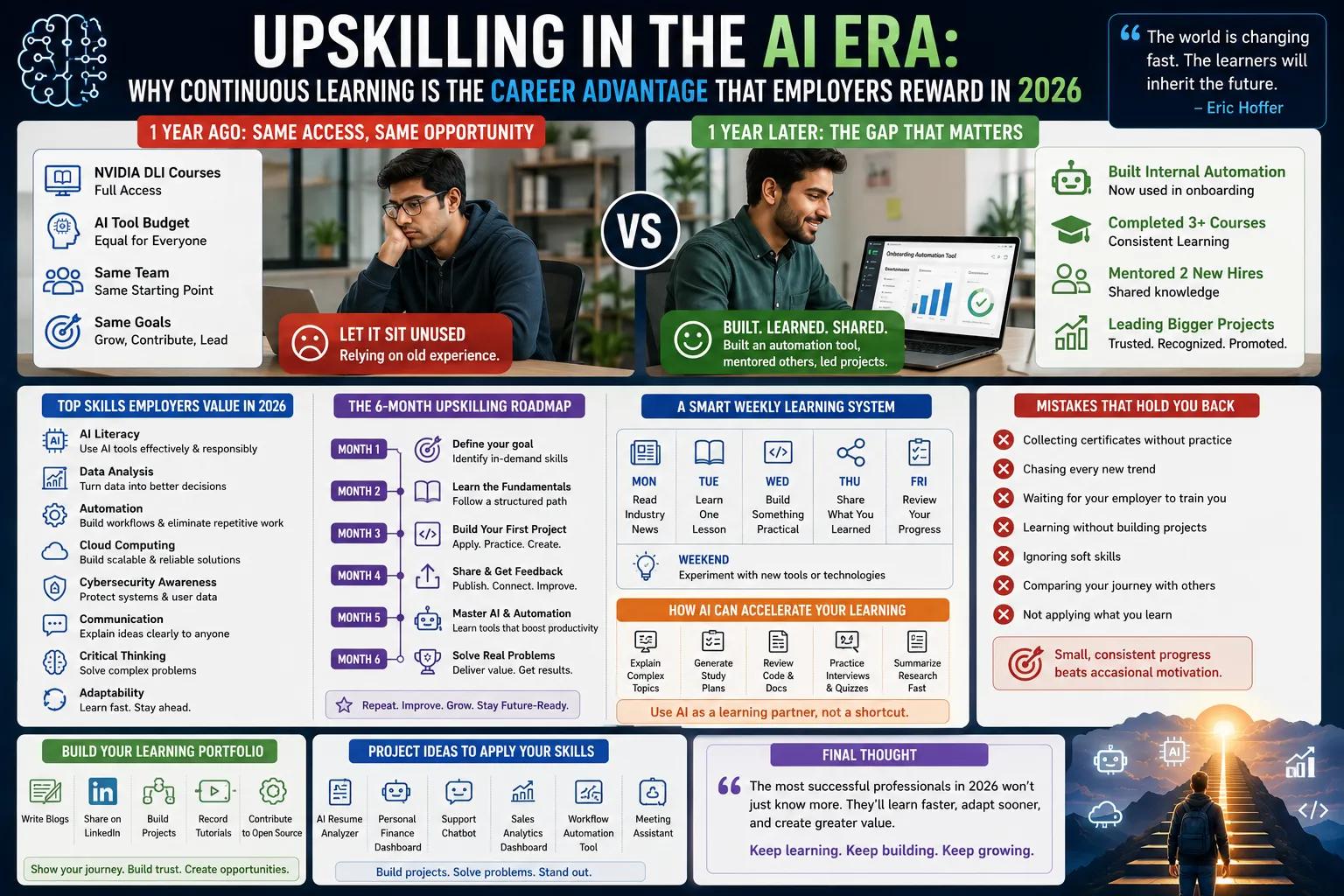
A year ago we gave every team member the same NVIDIA DLI course access and the same AI tool budget. One person finished three courses within a few months, built a small internal automation tool that now runs part of our onboarding process, and started informally mentoring two newer hires who joined after her. Another team member let the same access sit largely unused, relying on the experience she already had. A year later, the gap between them is obvious to anyone who looks. One is running larger projects with real ownership. The other is doing roughly the same work as a year ago.
Same access. Same budget. Same starting point. The difference was entirely what each of them chose to do with the time available, which is a much smaller and more controllable variable than most people treat it as.
Why Upskilling Has Turned Into a Real Business Priority
Companies are pouring real money into AI, automation, cloud infrastructure, and cybersecurity. None of that spending creates value on its own. People applying it do. What organizations increasingly need are employees who adapt to new technology without a long ramp up, learn independently rather than waiting for formal training, actually improve processes rather than just running them, solve genuinely complex problems, work well alongside AI tools, and help lead change rather than resist it. Because of this, upskilling and continuous learning have quietly shifted the hiring conversation from what degree someone holds to whether they can learn faster than the problems in front of them keep changing.
A Degree Opens a Door. Skills Are What Keep You Moving Through It
A degree still carries real weight, especially early in a career. It stops being enough on its own once a few years pass, because the underlying technology keeps shifting every few months, not every few years the way it used to. New models, new tools, new expectations from customers who've gotten used to faster, smarter service elsewhere. Professionals leaning entirely on knowledge from years ago tend to fall behind quietly. The ones who kept learning stay valuable regardless of how fast the ground underneath them shifts.
What Employers Are Actually Looking For in 2026
Technical skill still matters, but increasingly paired with real business understanding rather than existing alone. AI literacy, meaning using it responsibly and effectively in daily work rather than as a novelty. Data analysis that turns raw information into an actual decision. Automation that removes real repetitive load. Cloud fundamentals for anything that needs to scale. Cybersecurity awareness as a baseline rather than a specialist concern. Communication clear enough that a non technical stakeholder actually understands the reasoning. Critical thinking for the calls AI genuinely cannot make on its own. Adaptability fast enough to stay ahead of whoever else is learning the same tools. The strongest people we've worked with never stop at one of these. They build a stack where several of them reinforce each other:
AI Literacy
Using AI responsibly and effectively as a daily workflow driver rather than treating it as a novelty.
Data Analysis
Turning raw numbers and unstructured information into concrete, actionable business decisions.
Workflow Automation
Eliminating repetitive manual bottlenecks and streamlining operations end to end.
Cloud Fundamentals
Understanding modern distributed cloud infrastructure for systems that need to scale reliably.
Cybersecurity Awareness
Maintaining security best practices and data protection as an everyday baseline across all work.
Clear Communication
Translating complex technical architecture into plain language that non technical leaders understand.
Learning Stopped Being About the Certificate a While Ago
Plenty of professionals collect certificates. Fewer actually apply what those courses covered. The gap shows up almost immediately in a real conversation. Instead of asking which courses someone completed, the more useful questions are what they actually built, what real problem it solved, what measurable difference it made, and what they learned from doing it. A project proves a skill. A certificate mostly just suggests one, and it's a much weaker signal than people assume it is.
AI Has Made Learning Itself Faster, Which Is a Little Ironic
The same technology reshaping jobs also makes picking up new skills considerably easier. AI can explain a difficult concept clearly, build a personalized study plan, review code, run practice interview questions, summarize a dense research paper, generate a quick quiz to check understanding, sharpen writing, and help scaffold a practice project. The fastest learners tend to treat it as a genuine study partner rather than a shortcut that skips the actual understanding.
Build a Repeatable Personal Learning System
Random, occasional learning rarely compounds into much. A simple weekly shape works better: read something relevant one day, complete one real lesson another, build something practical a third, share what was learned with someone else, review progress honestly near the end of the week, and use part of the weekend to try a new tool without pressure. This is close to what the team member who built the onboarding automation tool was already doing, mostly without treating it as a formal system at all:
📖 Read & Research
Read an industry paper, technical breakdown, or case study relevant to your target skill.
🎯 One Core Lesson
Complete one structured course module or technical tutorial from start to finish.
🛠️ Practical Build
Write code, build a workflow, or test a script applying exactly what you learned yesterday.
🤝 Share & Teach
Explain the concept to a teammate, write a quick LinkedIn post, or document the solution.
📈 Weekly Review
Evaluate what stuck, what needs reinforcement, and set next week's primary learning goal.
⚡ Free Exploration
Test a brand new AI model or framework without deadlines, pressure, or formal expectations.
Real Projects Are Where the Actual Learning Sticks
Knowledge only becomes genuinely useful once it's applied to something real. Worth building: an AI resume analyzer, a personal finance dashboard, a support chatbot, a sales analytics dashboard, a portfolio site, a meeting assistant, a workflow automation tool, a business intelligence dashboard. Every finished project adds both real confidence and something concrete to point to later, which is exactly what separated the two team members from this article's opening once promotion conversations came up.
Build a Learning Portfolio People Can Actually See
One of the more underused career advantages right now is simply learning in public. LinkedIn posts about what's being learned. Real GitHub projects. Technical blog posts. The occasional recorded tutorial. Speaking at a community event when the chance comes up. Helping someone else work through a problem online. A portfolio like this tells the story of growth over time, not just a snapshot of finished work, which tends to be more persuasive than a static list of skills.
Common Mistakes That Quietly Stall This Out
Learning without ever practicing what was covered. Collecting certificates as the end goal rather than a step toward one. Chasing every new AI trend instead of going deep on a few that actually matter for the work at hand. Waiting for an employer to provide formal training instead of starting independently. Ignoring soft skills entirely in favor of technical ones. And comparing personal progress to someone further along instead of just continuing forward at a sustainable pace. None of these are dramatic on their own. They add up quietly over months, the same way the unused course access eventually became a real, visible gap:
❌ Passive Course Consumption
Watching video lectures without ever writing code or building a working prototype.
❌ Certificate Hoarding
Treating badges and completion certificates as the end goal instead of measurable competency.
❌ Shiny Object Syndrome
Jumping between every trending AI tool without achieving mastery in any single stack.
❌ Waiting for Employer Training
Stalling personal development until a manager explicitly assigns or schedules formal instruction.
❌ Ignoring Soft Skills
Focusing 100% on syntax while neglecting clear communication and stakeholder collaboration.
❌ Unrealistic Comparisons
Measuring your day-one progress against industry veterans instead of maintaining sustainable momentum.
A Practical Six Month Upskilling Roadmap
Month one, pick one specific career goal and identify exactly which skills it actually requires. Month two, complete one structured learning path all the way through rather than sampling several halfway. Month three, build a first portfolio quality project from what was learned. Month four, share that work publicly and actually ask for honest feedback. Month five, learn automation and AI workflows specifically, since this is where a lot of real leverage tends to sit. Month six, apply everything built so far to a genuine business problem or freelance project.
Repeating this cycle roughly every six months is close to what turned one year of identical access into two very different outcomes for the two team members in this article's story:
Target & Audit
Pick one specific career goal and identify exactly which technical and business skills it requires.
Structured Mastery
Complete one structured learning course or certificate all the way through without getting distracted.
First Real Build
Build a standalone, portfolio-quality working prototype directly applying what you mastered in Month 2.
Public Proof
Share your project code and walkthrough on LinkedIn and GitHub, asking peers for honest critique.
AI & Automation
Integrate AI automation workflows into your project to multiply its efficiency and real-world leverage.
Business Impact
Deploy the solution to solve a genuine business bottleneck for your employer or a freelance client.
Why the Consistent Learners Will Lead the Next Stretch of This
Technology keeps changing. New models keep showing up faster than anyone can fully master them. Some existing roles will shift meaningfully, and a few will change almost beyond recognition. The professionals who stay genuinely valuable through all of it won't necessarily be the ones with the largest stack of certificates. They'll be the ones who keep building new capability and operate as AI native professionals, adapting to whatever the business actually needs next, and creating real, visible value wherever they land. Learning has stopped being preparation for some future moment. At this point, it's simply the ongoing work itself.
Final Thoughts
The AI era isn't punishing ambitious people. It's rewarding the ones willing to keep evolving instead of settling into what already worked a year or two ago. Upskilling has stopped being optional for real career growth, whether the role is technical, creative, or entirely people focused.
Start small. Learn one new concept a week. Build one meaningful project a month. Share the progress publicly and actually ask for feedback on it. Over time, that consistency becomes a real advantage that no single degree, certificate, or job title can substitute for, exactly the way it played out for the team member who turned identical course access into a year of real, visible growth.
FAQ
How much time does meaningful upskilling actually require each week?
A few focused hours weekly, applied consistently, tends to outperform an occasional intense weekend. The team member who built the onboarding tool didn't dedicate huge blocks of time. She was simply consistent about using what she had access to.
Is it better to go deep on one skill or build a broader stack of several?
A focused, complementary stack of a few related skills tends to outperform either a single narrow skill or a wide, scattered pile of unrelated ones.
Do certificates still matter at all if projects are what employers actually look at?
They still help validate that structured learning happened, but they carry far less weight on their own than a real, finished project tied to a measurable result.
What's the fastest way to start closing an upskilling gap if I've fallen behind?
Pick one specific skill, follow the six month roadmap above starting from month one, and build a real project from it before moving to the next skill. Momentum matters more than trying to close the whole gap at once.
Written by Chintan Poriya, Marketing Head.
Read More in Career Advice
From AI Learner to AI Professional: How to Build a Job Ready Portfolio in 2026
One candidate's portfolio said "built a RAG chatbot" and nothing else. Another explained exactly why she chunked documents the way she did and what she measured to pick her embedding model. We hired the second one before the interview even ended.
Read article →
The IT Hiring Reset: Why Companies Are Hiring Again, But Only for AI Ready Professionals
We paused hiring for almost eighteen months. When we reopened a role this year, we didn't ask candidates whether they could write clean code. We asked them to walk us through an AI assisted debugging session they had actually done.
Read article →