Free Certifications That Actually Help Your Career in 2026 (Not the Ones That Just Look Good)
Chintan Poriya
Lead Career Editor & AI Research Director
Published: February 18, 2026
Table of Contents
A candidate applied for a data role last year with 34 certificates listed on their resume. Thirty-four. We counted, because it was genuinely unusual. We ended up hiring someone else for that role who listed three one from IBM SkillsBuild, one from freeCodeCamp, and a Cisco Python badge paired with two actual projects they could walk us through in detail.
That's not a knock on certificates. It's what actually happens when quantity and quality get confused. The 34-certificate resume told us this person finishes courses. It didn't tell us they could solve a problem we'd actually hand them. The three-certificate resume did, because the projects backing it up did the talking the certificates alone couldn't.
So here's the actual list of free certifications worth your time in 2026, and more importantly how to make sure they mean something when they land on someone's desk.
Why This Even Matters
A certificate on its own is a low bar to clear sit through some videos, pass a quiz, download a badge. What separates the useful ones from the wallpaper is whether they came with real practice attached, and whether you can explain what you actually learned in your own words when someone asks a follow-up question.
What We're Actually Checking For
When a certification shows up on a resume we're reviewing, the real questions are: is this from a platform we'd trust, does it teach something job-ready rather than purely theoretical, has this person built anything with it, and does it actually connect to the role they're applying for. A handful of certifications that check all four boxes will always beat a long list that checks none of them.
Certifications Worth Your Time
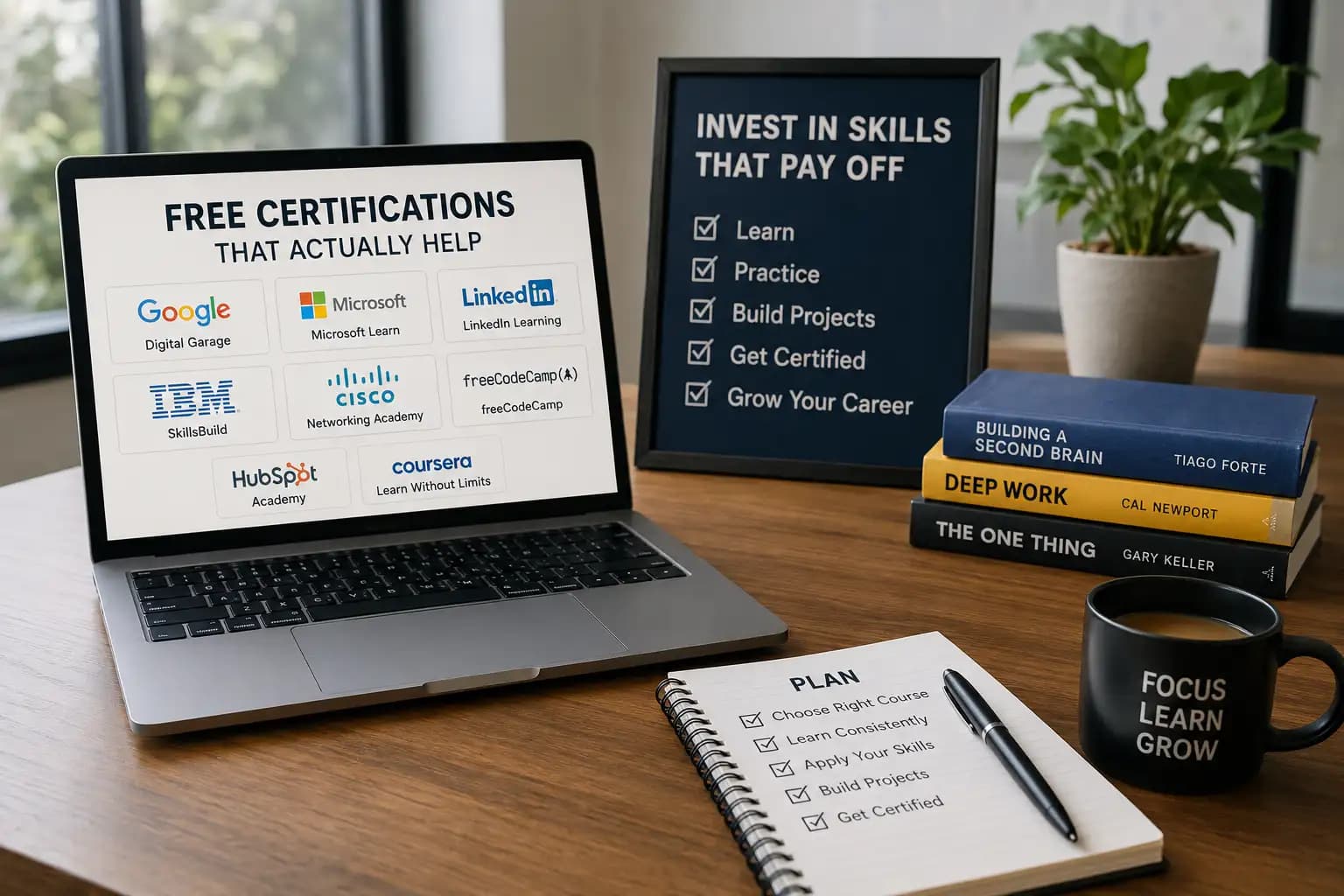
Google Digital Garage
Solid entry point for digital marketing, career development, and business fundamentals. We've seen this show up well on marketing-adjacent applications, especially paired with an actual campaign or content project.
Microsoft Learn
Free training across Azure, AI, Power Platform, Microsoft 365, and cybersecurity, with hands-on labs rather than passive video. One candidate we interviewed had done the Azure AI path and could actually walk through a deployment they'd built alongside it that combination is what made the certificate worth mentioning at all.
LinkedIn Learning
Often accessible free through university or public library access. Strong for leadership, communication, project management, and data analysis softer skills that are harder to demonstrate through a project alone, so the certificate carries a bit more weight here.
Cisco Networking Academy
Genuinely good beginner path into cybersecurity, networking, Python, and Linux. We've hired from this pipeline before it tends to produce people with real hands-on lab experience rather than just theory.
IBM SkillsBuild
Covers AI, data science, cloud, and cybersecurity, with digital badges that link directly to LinkedIn. The AI and data science tracks specifically have held up well against people we've interviewed the content matches what actually shows up in early-career AI work.
freeCodeCamp
Project-based by design, covering web development, Python, APIs, and machine learning basics. This is the one we'd point beginners toward first if they're aiming at software roles, purely because you can't finish it without building actual things.
HubSpot Academy
The standard for marketing-focused certifications content marketing, SEO, email, social, CRM. Well recognized specifically within marketing hiring, less relevant outside it.
Coursera audits
Free access to course content from Stanford, Yale, Michigan, Google, and IBM, even when the certificate itself costs money. If budget's tight, audit the course for the learning and skip the paid certificate the actual skill-building happens in the content, not the PDF at the end.
Matching Certifications to Career Path
| Career Path | Worth Learning |
|---|---|
| Software Development | Python, JavaScript, Git/GitHub, SQL, APIs |
| Artificial Intelligence | Prompt engineering, ML basics, generative AI, Python for AI |
| Digital Marketing | SEO, Google Analytics, content marketing, email marketing |
| Data Analytics | Excel, SQL, Power BI or Tableau, Python, statistics |
| Cybersecurity | Network security, ethical hacking basics, Linux, cloud security |
What Makes a Certificate Actually Count
Recent, relevant, and backed by something you built that's the short version. A certification from three years ago in a fast-moving area like generative AI reads very differently than one from last month. And a certificate with zero practical component attached is basically a reading log with a logo on it.
Certificates We'd Push Back On
Not every certificate is worth the time. Watch for ones with no practical assignments at all, ones from platforms nobody's heard of, ones that promise a guaranteed job (nothing does), and ones teaching technology that's already fading out of use. We've seen resumes list certifications in tools that were effectively obsolete two years before the application landed it doesn't help, and it can actually raise a question about whether someone's tracking what's current.
Making a Certificate Actually Stand Out
The certificate itself is step one, not the whole job. Build something with what you learned. Add the badge to LinkedIn. List it on the resume next to the project it connects to, not floating on its own in an unrelated skills section. Write a short post about what you built. Push the code somewhere visible. The candidate with the Azure AI badge and a deployed project got remembered specifically because both pieces were there the badge alone wouldn't have made the same impression.
Before You Enroll in Anything
Checklist Before Enrolling
Does this actually match where I'm headed?
Is it from an organization worth the time?
Will I walk away with something practical?
Can I build a project from it afterward?
Is the underlying skill still in demand right now?
If most of those are yes, it's probably worth doing. If you're mainly doing it because it's free and sounds impressive, that's usually a sign to skip it.
Final Thoughts
Free certifications are a legitimately good use of time when they're chosen well and backed by real practice. The mistake and it's the one we see most often on the resumes that don't get a callback is treating the certificate as the finish line instead of the starting point for something you actually build.
Three certifications with real projects behind them will outperform thirty-four without them, every time we've seen it play out. Pick the ones that match where you're actually headed, build something with each one, and let the work do more of the talking than the badge does.
FAQ
How many certifications should I realistically have on my resume?
There's no fixed number, but relevance matters far more than count. Three to five well-chosen, recent, project-backed certifications typically read stronger than a long unfiltered list.
Are paid certifications worth it over free ones?
Not automatically. Several free platforms freeCodeCamp and Cisco Networking Academy especially hold up just as well in our hiring process as paid alternatives, provided they come with real practice.
Should I remove old certifications from my resume?
If the technology or platform is outdated, yes, especially in fast-moving areas like AI or cloud tools. An old, no-longer-relevant certificate can do more harm than leaving it off entirely.
What matters more the certificate or the project built from it?
The project, generally. The certificate shows you completed structured learning; the project shows you can actually apply it, which is what most interviews end up probing for anyway.
Written by Chintan Poriya, Marketing Head.
Read More in Learning & Upskilling
Why Continuous Learning Is the Only Career Insurance You Need
Two engineers joined us the same month with nearly identical backgrounds. Eighteen months later, one leads our AI pipeline work and the other is doing the same tickets she started with. The gap wasn't ability. Here's what it actually was.
Read article →
How to Learn AI in 30 Days: The Exact Roadmap We Used to Onboard a Non-Technical Hire
We gave a marketing hire with zero AI experience 30 days before she touched a live campaign. Here's the exact day-by-day roadmap and what actually happened when she used it.
Read article →