How to Start Freelancing in India: A Practical Roadmap
Chintan Poriya
Lead Career Editor & AI Research Director
Published: May 6, 2026
Table of Contents
My first freelance gig was writing product descriptions at ₹2 a word. Five hundred words, ₹1,000, and I thought I'd found a decent way to earn on the side. What nobody mentioned going in was the three rounds of revisions the client asked for afterward: none of it paid, all of it eating into what had already been a thin rate. By the time that project actually closed, I'd made less per hour than I would have tutoring a school kid down the street.
The Reality of the ₹2-a-Word Trap
Result: Made less per hour than tutoring
That gig taught me the two things this guide is actually built around: pricing without understanding your own time is a trap, and a proposal that doesn't show you understood the client's actual problem gets treated like a commodity, which is exactly what happened to me, repeatedly, until I changed how I approached both.
Why Freelancing Is Genuinely Growing in India
India's become one of the largest freelance talent markets globally, and it's not just software development driving that: content, design, digital marketing, video editing, and AI-adjacent services are all part of it. The appeal is real: work from anywhere, pick your own projects, set your own hours, build more than one income stream, and work with clients well beyond your own city or country. For a growing number of people, it's stopped being a side hustle and become the actual career.
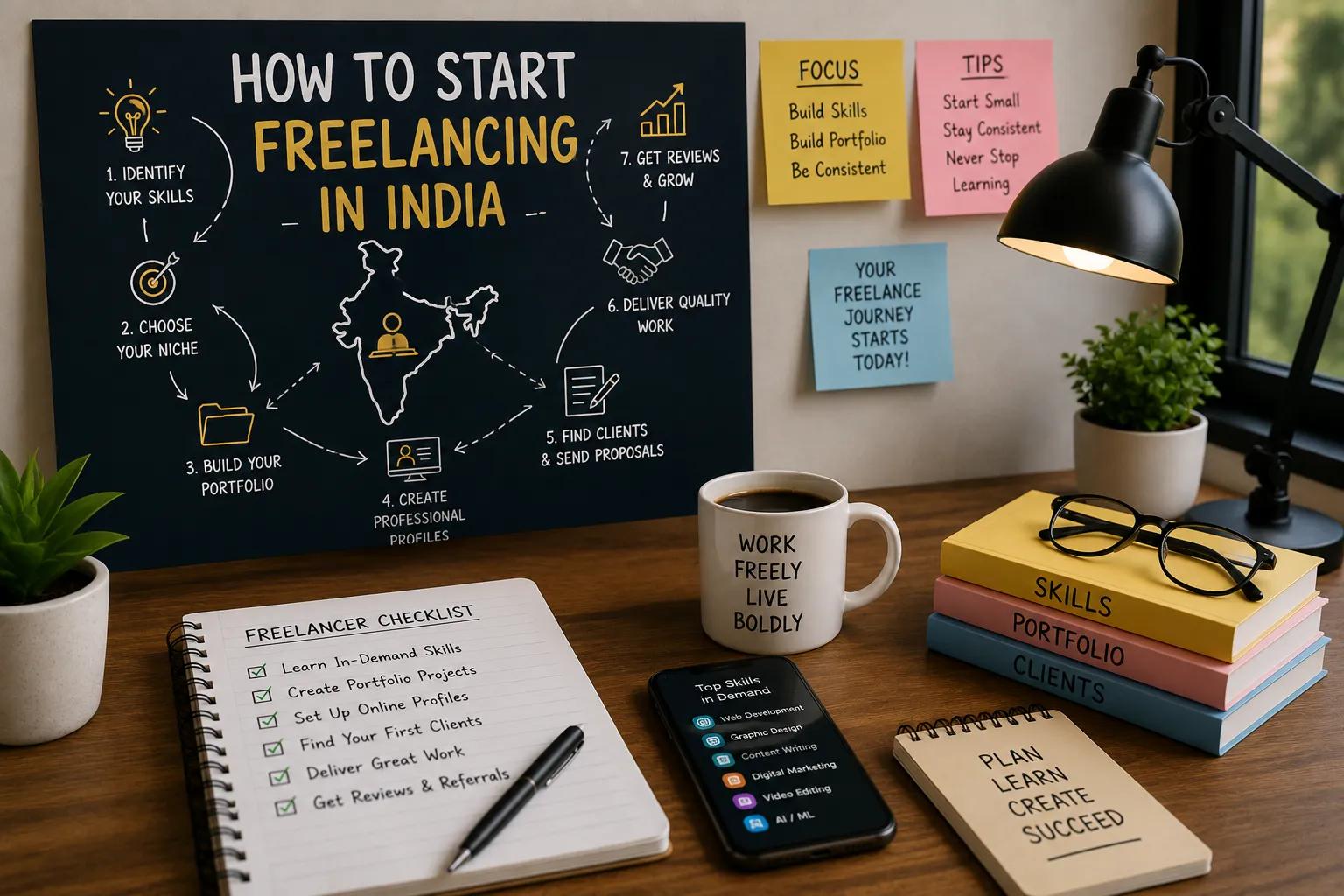
Step 1: Get Honest About What You Can Actually Offer
Before chasing clients, get specific about what you're good at, what problems you can genuinely solve, and what people are actually willing to pay for. Web development, mobile apps, AI and ML, UI/UX, graphic design, video editing, content writing, SEO, digital marketing, data analysis, virtual assistance: pick one to lead with. If you're a beginner, that's fine. Depth in one thing beats a thin spread across five.
Step 2: Specialize Instead of Staying Generic
Competes with thousands on price
Gives immediate reason to hire
This was my second real lesson, right behind the pricing one. "Content Writer" competes with thousands of other generalist writers on price alone, because there's nothing else to compete on. "SaaS Product Description Writer for B2B Tech Companies" gives a specific type of client an immediate reason to pick you over the generalist pool. The same logic applies everywhere: "Software Developer" versus "Python & FastAPI Backend Developer," "Graphic Designer" versus "Brand Identity Designer for Startups." Specific gets remembered. Generic gets negotiated down.
Step 3: Build Real Proof, Not Just a Resume
Clients hire evidence, not credentials. If you don't have paid work yet, build something real: a responsive business website, a small AI chatbot, a logo collection, a mock social campaign, a data dashboard: whatever fits your skill. For each piece, explain the actual problem, your solution, what you used to build it, and the result. That structure matters more than the polish of any single piece.
Step 4: Get Your Profiles Actually Complete
Your freelance platform profile and LinkedIn are the first thing a serious client checks, often before they ever message you. Professional photo, a headline that says something specific, a real introduction, your actual skills, portfolio samples, and relevant certifications if you have them. An incomplete profile reads as an unfinished one, and it costs you before a conversation even starts.
Step 5: Apply With Proposals Built for the Actual Project
The revision-heavy ₹2-a-word gig came from a generic pitch I'd sent to a dozen listings that week. Read the actual project description, and write something that shows you understood it: a personalized greeting, a clear read on what they actually need, relevant past work, a realistic timeline, and a professional close. That combination reads completely differently than a template with the client's name swapped in, and it's the difference between getting negotiated down and getting picked without a price fight.
Step 6: Deliver Work That Earns the Next Project
The first project matters more than the first payment. Hit deadlines, communicate clearly and regularly, keep quality high, send progress updates without being asked, and stay professional even when the client isn't. A happy client is far more likely to come back, or refer you, than a stranger is to hire you cold.
Step 7: Actually Ask for the Testimonial
Once a project wraps well, ask directly: a rating, a written testimonial, and permission to feature the work in your portfolio. Most satisfied clients are happy to give this if you ask; the mistake is assuming they'll offer it unprompted. Social proof does real work convincing the next high-paying freelance clients to skip the negotiation entirely.
Step 8: Price Like You Understand Your Own Time
My ₹2-a-word rate wasn't competitive pricing: it was pricing that never accounted for revisions, back-and-forth, or the actual hours involved. Competitive pricing can help you land the first few projects while you're building proof. It shouldn't be the entire strategy. As your portfolio, feedback, and demand grow, raise your rates to reflect that. Clients consistently read fair pricing as a signal of professionalism, not a red flag.
The Skills That Matter Beyond the Technical Ones
Communication, time management, problem-solving, managing the actual client relationship, negotiation, professional writing, and staying genuinely current in your field. These are what turn a one-off project into a repeat client. The technical skill gets you hired once; these get you hired again.
Mistakes That Cost Beginners the Most
Avoid these to protect your reputation
A 30-Day Roadmap to Get Moving
Week 1
Choose your niche, get the fundamentals solid, and build one real portfolio project.
Week 2
Finish your freelance platform profiles, update LinkedIn, and put together a simple portfolio site if you don't have one yet.
Week 3
Apply to 5 to 10 genuinely relevant projects daily on remote work platforms, write a personalized proposal for each one, and keep improving the portfolio as you go.
Week 4
Complete your first client project, ask for testimonials, and keep learning while you look for the next one.
Consistency across these four weeks matters more than how many applications you can technically fire off in a day.
Tips for Making This a Real Career, Not Just a Side Project
Keep learning skills that are actually in demand. Stay visibly active on the platforms where your clients look. Invest in the relationships that turn into repeat work rather than chasing a new client for every project. Deliver a bit more than what was asked, reasonably. Build a personal brand instead of staying anonymous. Keep the portfolio current. And track your income and expenses like the business it actually is; most freelancers skip this until tax season forces the issue. Watch out for AI resume mistakes if you are pivoting back to full-time.
Final Thoughts
Starting freelancing in India right now has more real opportunity behind it than it's had in years, with international clients actively hiring remote talent across nearly every skill on this list. The first month is about laying real groundwork: a specific niche, a portfolio that proves something, and proposals that show you actually read what was asked.
I didn't learn any of this from that first ₹2-a-word gig. I learned it from noticing what went wrong and changing the two things that actually mattered: how I positioned myself, and how I priced my time once I understood what it was actually worth.
FAQ
How much should a beginner charge for their first few freelance projects in India?
There's no fixed number, but price with your actual time in mind, including revisions, not just the headline rate. Competitive pricing can help you land early work, but it shouldn't ignore the real hours a project takes.
Do I need a portfolio before I've done any paid work?
Yes, and personal projects are enough to start. A well-explained personal project (the problem, your solution, the outcome) carries real weight even without a paying client attached to it.
How long does it typically take to land a first client following a roadmap like this?
It varies, but the first two weeks here are mostly foundation work: niche, profile, portfolio. Real traction usually starts showing in week two or three once applications are actually going out consistently.
Is it better to specialize immediately, or try a few different services first?
A short exploration period is fine if you're genuinely unsure what you're best at. But narrowing down within the first month or two makes a real difference. Generalist positioning is what kept my early rates low.
Written by Chintan Poriya, Marketing Head.
Read More in Freelancing Advice
Freelance Client Onboarding: How to Turn a New Client Into a Smooth Project
One of our early client automation projects started the same day the client said yes, no written scope, just a WhatsApp message confirming "build the lead bot." Three weeks in, we rebuilt two weeks of work for a feature nobody had actually agreed to in writing.
Read article →
The Freelance Offer Reset: How to Sell Business Outcomes When AI Can Do the Basic Work
We used to list one of our own service lines simply as "n8n automation setup." It brought in small, price sensitive inquiries asking us to match a cheaper quote. We rewrote it around a specific outcome instead, and the average deal size roughly tripled.
Read article →