How to Find High-Paying Freelance Clients in 2026
Chintan Poriya
Lead Career Editor & AI Research Director
Published: April 29, 2026
Table of Contents
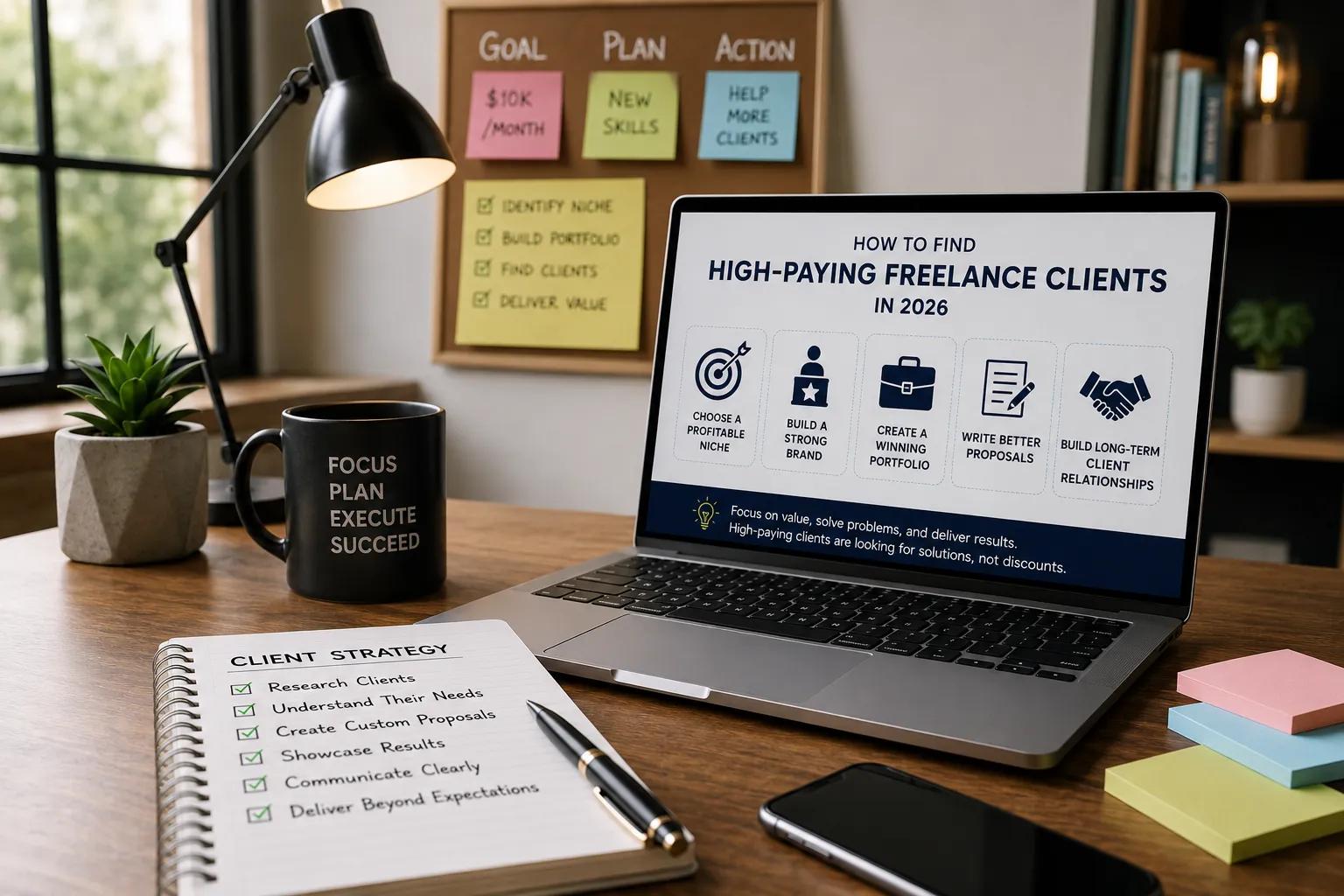
After that ₹5,000 website I've written about elsewhere, I spent close to a year taking whatever project came through the door: small budgets, tight deadlines, clients who negotiated on price before they'd even seen my work. The turning point wasn't a new skill. It was dropping "web developer" from my profile and replacing it with something specific: full-stack developer building FastAPI backends for early-stage SaaS startups. Same skills, same experience, completely different positioning. My average project value moved from the ₹5,000-10,000 range to well past ₹50,000 within a few months, without taking on any new clients I wouldn't have found before.
That's the actual lesson behind this entire topic. High-paying clients aren't hiding somewhere better-paying freelancers happen to find. They're responding to positioning, specificity, and trust signals that most freelancers never bother to build.
Why High-Paying Clients Think Differently
They're not asking who's cheapest. They're asking who can actually solve the problem, deliver on time, communicate clearly, and help the business move forward. Once you internalize that this is the actual question being asked, competing on price stops making sense: it's answering a question nobody with real budget is asking.
Build an Online Presence That Inspires Confidence Before You Even Talk
A clear profile photo, a headline that says something specific, a short introduction that explains your actual expertise, visible services, real portfolio examples, testimonials, and easy-to-find contact information. This is the first thing a serious client checks before reaching out, and a thin or generic profile quietly filters you out before a conversation even starts.
Pick a Niche, Even Though It Feels Like Narrowing Your Options
Competes on Price
Commands High Rates
This is the exact change that moved my numbers. "Web Developer" competes with every other web developer on every platform, on price, because there's nothing else to differentiate on. "Full-Stack React & FastAPI Developer for SaaS Startups" tells a specific type of client exactly why you're the right fit before you've said another word. The same shift works for design: "Graphic Designer" versus "Brand Identity Designer for E-commerce Businesses." Specific is memorable. Generic is interchangeable, and interchangeable competes on price by default.
Build a Portfolio That Shows Outcomes, Not Just Output
A polished screenshot proves you can execute. It doesn't prove you understood the problem. For every project, walk through the actual challenge, your solution, what you built it with, and the outcome: something like "built an AI-powered support chatbot that cut response time by 60% and improved satisfaction scores" tells a prospective client far more than "built a chatbot" ever could.
Write Proposals That Start With the Client's Problem
Most proposals lead with the freelancer's résumé. Flip it. Instead of "I have five years of experience," try: "I reviewed your requirements and noticed you need a FastAPI developer to improve API performance. I recently optimized a similar backend and cut response times by 40%. I'd like to talk through how I'd approach the same for your project." That's specific to what they actually asked for, and it reads completely differently than a template with the company name swapped in.
Stop Competing on Price
Discounting attracts exactly the clients you don't want: the ones who'll keep negotiating after the project starts, not just before it. Lead with what you actually deliver instead: reliability, communication, proven outcomes, quality that doesn't need a second round of fixes. Clients remember what you delivered. They rarely remember, or care, what your hourly rate was once the project's done well.
Build Relationships, Not Transactions
Repeat clients are consistently more valuable than new ones, and they cost far less effort to win each time: no proposal writing, no discovery call, no convincing. Deliver on time, communicate without being chased, offer a useful suggestion the client didn't ask for, and actually ask for feedback when a project wraps. A satisfied client returning with new work is one of the most efficient parts of a freelance business, and it's the part most freelancers under-invest in once the invoice is paid.
Handle Discovery Calls Like a Consultant, Not a Vendor
Serious clients often want a short conversation before committing. Ask real questions about their actual goals, listen more than you talk, offer practical suggestions rather than a sales pitch, and be honest about timelines even when the honest answer is less exciting. Clients notice, and remember, freelancers who are trying to solve the actual problem instead of just trying to close the deal.
Use AI to Move Faster Without Cutting Corners
Research a client's industry before the call. Sharpen a proposal draft. Draft follow-up emails. Generate first-pass project documentation. Prepare meeting notes afterward. All genuinely useful, but just personalize anything AI-assisted before it goes out. A proposal that reads as generic AI tools output undoes exactly the positioning work described above.
Raise Your Rates When the Signals Say You Should
Skills improving, portfolio growing, consistent positive feedback, a full pipeline, measurable business impact you can point to: these are the actual signals, not a calendar date or a vague feeling that it's "time." Higher rates, counterintuitively, tend to attract more professional clients, not fewer. The ones who negotiate hardest over small amounts are rarely the ones with real budget behind them.
Mistakes That Quietly Cap Your Rates
Eliminate these to break your rate ceiling.
A 30-Day Plan to Move Toward Better Clients
Week 1
Update the portfolio to lead with outcomes, sharpen the LinkedIn profile, and choose one clear niche instead of staying general.
Week 2
Apply to 5 to 10 genuinely well-matched projects daily on remote work platforms, personalize every proposal, and track what's actually getting responses versus what isn't.
Week 3
Publish something useful publicly, network with people in your niche specifically, and ask past clients for real testimonials.
Week 4
Review what actually worked, fix the weak points in your proposal process, and raise your rates if demand genuinely supports it.
Consistency across the month matters more than raw volume of applications sent.
Final Thoughts
High-paying clients aren't rarer than low-paying ones. They're just responding to different signals: specificity, evidence of real outcomes, and communication that shows you actually understood their problem before you pitched a solution. That one repositioning move, from generalist to specialist, did more for my freelance income than any new skill I picked up in that same period.
You don't need to be the most experienced freelancer in your field to command better rates. You need to be specific enough, and provably good enough at that specific thing, that price stops being the first question a serious client asks.
FAQ
How specific should my niche actually be?
Specific enough that a client immediately understands who you serve and what problem you solve: "FastAPI backend developer for SaaS startups" rather than just "developer." You can always widen it later once you've built a track record.
Will choosing a niche mean turning down work I actually need right now?
Sometimes, short-term. The trade-off is fewer, better-matched inquiries instead of a flood of generic ones. Most freelancers find the quality shift outweighs the initial narrowing within a few months.
How do I know when it's actually the right time to raise my rates?
When your pipeline is consistently full, your recent feedback has been strong, and you can point to measurable outcomes from recent work, not on a fixed schedule, but when those signals line up together.
Is AI-assisted proposal writing something high-paying clients will notice and hold against me?
Generic, unedited AI output is noticeable and does hurt you. A proposal that's clearly personalized to their specific project, whether or not AI helped draft it, reads no differently than one written entirely by hand.
Written by Chintan Poriya, Marketing Head.
Read More in Freelancing Advice
Freelance Client Onboarding: How to Turn a New Client Into a Smooth Project
One of our early client automation projects started the same day the client said yes, no written scope, just a WhatsApp message confirming "build the lead bot." Three weeks in, we rebuilt two weeks of work for a feature nobody had actually agreed to in writing.
Read article →
The Freelance Offer Reset: How to Sell Business Outcomes When AI Can Do the Basic Work
We used to list one of our own service lines simply as "n8n automation setup." It brought in small, price sensitive inquiries asking us to match a cheaper quote. We rewrote it around a specific outcome instead, and the average deal size roughly tripled.
Read article →