The Freelancing Advantage in 2026: How Top Freelancers Are Winning High Paying Clients in the AI Era
Chintan Poriya
Lead Career Editor & AI Research Director
Published: July 22, 2026
Table of Contents
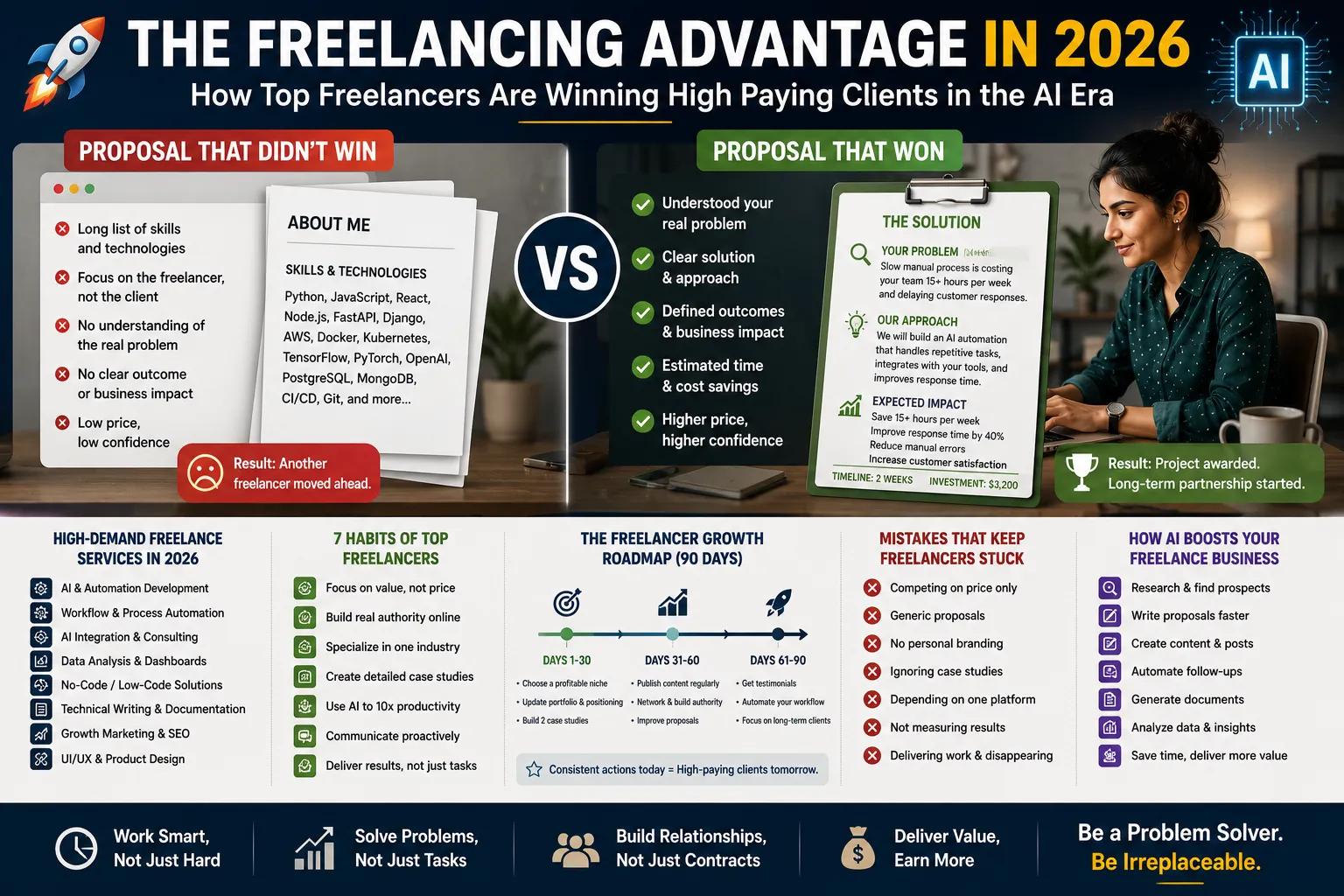
We needed a freelance AI developer for an automation project last month, and two proposals came in within a day of each other. The first listed every programming language, framework, and certification the developer had ever completed. Thorough, but it read like a resume with no connection to the actual project. The second proposal was shorter. It described our actual problem in specific terms, laid out exactly how she would solve it, and estimated the hours and cost the automation would save us once it was running. She charged almost twice what the first developer quoted.
We hired her without much hesitation.
That single comparison captures a real shift happening across freelancing right now. AI has not eliminated freelance work. It has changed what clients are actually willing to pay a premium for.
Freelancing Has Entered a New Phase
The freelance market keeps growing, and so does the competition inside it. Clients rarely struggle anymore to find someone who can write basic content, put together a simple logo, or generate code with AI assistance. What they genuinely struggle to find is someone who understands the actual business goal and can consistently deliver a result that's measurable. That gap is splitting freelancers into two groups. One competes on price. The other competes on value, and the second group earns considerably more.
AI Did Not Replace Freelancers. It Replaced the Generic Version of the Work
Commodity services have gotten a lot easier to automate. Basic blog writing, simple logo variations, generic landing pages, straightforward code generation, standard data entry. Meanwhile demand keeps growing for freelancers who can build real AI powered applications, design actual business workflows, automate operations end to end, improve a customer experience meaningfully, solve genuine technical problems, and integrate AI cleanly into systems that already exist. The freelancer's actual role is shifting from completing tasks to delivering a solution, which is exactly what separated the two proposals from this article's opening.
Clients Are Not Buying a Skill List. They Are Buying an Outcome
Most losing proposals talk almost entirely about the freelancer. The winning ones talk about the client. Instead of listing every technology touched, the stronger proposal explains what will actually change for the business. "I'll cut your customer response time by building a support assistant that handles common questions automatically and routes complex ones to your team" tells a client something real. A long tool list tells them almost nothing about what their day to day will look like once the work is done.
Value Based Pricing Is Becoming the Norm at the Top
Hourly pricing is not disappearing entirely, but the strongest freelancers increasingly price around the result rather than the time spent producing it. A redesigned site that lifts conversions. Automation that saves real staff hours every week. An SEO strategy that produces measurably more leads. A support workflow that reduces response time noticeably. Clients rarely ask how many hours something took. They ask what results they will actually get, and freelancers who can answer that clearly tend to earn meaningfully more than those still selling time alone:
Site Redesign
Outcome Priced
Priced on measurable conversion lift and user retention rather than hours spent designing in Figma.
Workflow Automation
Outcome Priced
Priced on eliminating 20+ weekly staff manual payroll and data entry hours.
SEO Strategy
Outcome Priced
Priced on generating qualified organic lead volume and lowering customer acquisition costs.
Support Assistant
Outcome Priced
Priced on cutting ticket resolution time by 50% and improving customer satisfaction scores.
Build Real Authority Before You Actually Need the Client
The strongest freelancers are not relying purely on platform listings to get noticed. They build trust ahead of time, so a prospective client already has a reason to believe them before the first message ever gets sent. Building a strong personal brand means publishing genuinely useful LinkedIn content, writing real technical posts, sharing honest case studies, breaking down finished projects publicly, recording the occasional tutorial, speaking at online events when the opportunity comes up, and contributing to open source work. All of this quietly reduces how much a freelancer ever has to compete purely on price.
Write Case Studies, Not Just Portfolio Pieces
A portfolio piece says here is something I built. A case study explains the actual challenge, the approach taken, the solution delivered, the measurable result, and what was learned along the way. The freelancer we hired for the automation project effectively did this inside her proposal itself, describing our problem and her solution in the same structure a strong case study would use inside a professional freelance portfolio. Clients hire people who can demonstrably solve a problem, not people who simply display a gallery of screenshots.
Go Deep on One Industry Instead of Staying General
A generalist freelancer competes against nearly everyone. A specialist competes against a much smaller, more relevant pool. Worth considering: AI for healthcare, AI for real estate, e commerce automation, SaaS growth consulting, financial analytics, HR automation, legal technology. Real industry knowledge often matters just as much as raw technical skill, because it lets a freelancer speak directly to a client's actual constraints instead of a generic version of the problem.
Treat AI as an Actual Business Partner, Not Just a Writing Tool
Strong freelancers use AI well beyond drafting text. Researching prospects before a pitch. Drafting a first version of a proposal. Preparing for a client meeting. Generating documentation. Estimating a realistic project timeline. Automating follow up messages. Organizing accumulated project knowledge. All of it saves real time, and the freelancers who pull ahead spend that saved time building stronger relationships with the clients they already have, rather than simply taking on more volume.
Focus on Keeping Clients, Not Just Winning Them
Landing a new client is genuinely hard work. Keeping one is considerably more profitable once it happens. To increase the odds of repeat business: communicate regularly without being chased, deliver ahead of the deadline when possible, explain the reasoning behind decisions rather than just the decisions themselves, suggest improvements the client didn't explicitly ask for, share progress proactively, and generally stay a step ahead rather than reactive. Long term clients meaningfully reduce how often a freelancer has to go searching for the next project from scratch.
Mistakes That Keep Freelancers Stuck at Lower Rates
Competing purely on price instead of positioning. Sending generic, copy paste proposals. Depending entirely on one platform for all incoming work. Ignoring personal branding almost completely. Never publishing anything publicly. Learning new tools without ever connecting them to an actual business problem. And delivering work without ever measuring or reporting the actual result it produced. Small shifts in positioning tend to move income more than learning yet another framework ever does:
❌ Price-Only Competition
Competing on being the cheapest option rather than positioning around unique value.
❌ Copy-Paste Proposals
Sending generic, templated pitches that focus on your credentials instead of the client's problem.
❌ Single-Platform Dependency
Relying 100% on freelance marketplace algorithms for all incoming project flow.
❌ Zero Public Authority
Never publishing case studies, tutorials, or industry insights publicly to build pre-sale trust.
❌ Disconnected Tool Learning
Learning complex new AI frameworks without connecting them directly to a measurable business outcome.
❌ Unmeasured Deliverables
Handing off finished files without measuring, tracking, or reporting the real ROI it produced.
A 90 Day Growth Plan
Month one, choose one genuinely profitable niche and rebuild the portfolio around it. Month two, publish a small handful of real case studies and share honest insights on LinkedIn regularly. Month three, sharpen the actual proposal process, automate the repetitive parts of the work with AI, ask existing clients directly for testimonials, and shift attention toward long term relationships rather than constantly chasing the next one time project.
By the end of three months, the positioning, credibility, and actual odds of landing high paying clients all move noticeably in the right direction:
Niche & Rebuild
Choose one profitable industry specialization and rebuild your portfolio around outcome-focused solutions.
Authority & Proof
Publish a small handful of detailed case studies and share honest technical insights on LinkedIn weekly.
Proposals & Retention
Sharpen outcome proposals, automate repetitive admin with AI, collect testimonials, and secure retainers.
The Future Belongs to Freelancers Who Solve Real Business Problems
The pattern across the freelance market is fairly clear. Routine, AI assisted execution work keeps getting more crowded and more commoditized. Business consulting, real AI integration, genuine automation, strategy, and specialized expertise keep gaining value instead. The freelancers who come out ahead will not necessarily be the ones who know the most individual AI tools. They will be the ones who understand exactly how those tools create measurable value for a specific client's specific problem.
Final Thoughts
Freelancing is not shrinking. It is changing shape. Clients no longer pay a premium simply because someone knows a language or a tool. They pay for freelancers who genuinely understand their business, communicate clearly, solve a real problem, and can point to a measurable result afterward.
Stop thinking like someone who completes tasks. Start thinking like a business partner. Go deep in one niche, build real case studies instead of a plain portfolio, treat AI as a genuine productivity multiplier, and consistently deliver results a client can actually measure. That's the exact difference between the two proposals from this article's opening, and it's the difference that decided who got the contract.
FAQ
Is it still possible to succeed as a generalist freelancer, or does specializing always win?
Specializing tends to command higher rates and less price competition, but a generalist can still do well by leaning hard on strong communication and reliable delivery. Specializing simply makes the case for a premium rate much easier to make.
How much more can value based pricing actually earn compared to hourly rates?
It varies by field and project, but freelancers who can clearly tie their price to a measurable business outcome consistently report higher earnings than those pricing purely by the hour.
Do I need a large personal following to build the kind of authority described here?
No. A modest, consistent body of genuine case studies and useful posts does more for credibility than a large but shallow following ever does.
What's the single fastest way to start winning higher paying clients?
Rewrite your next proposal around the client's actual problem and the result you'll deliver, rather than a list of your own skills. That single change is close to what decided the outcome in this article's opening story.
Written by Chintan Poriya, Marketing Head.