The Freelance Offer Reset: How to Sell Business Outcomes When AI Can Do the Basic Work
Chintan Poriya
Lead Career Editor & AI Research Director
Published: September 16, 2026
Table of Contents
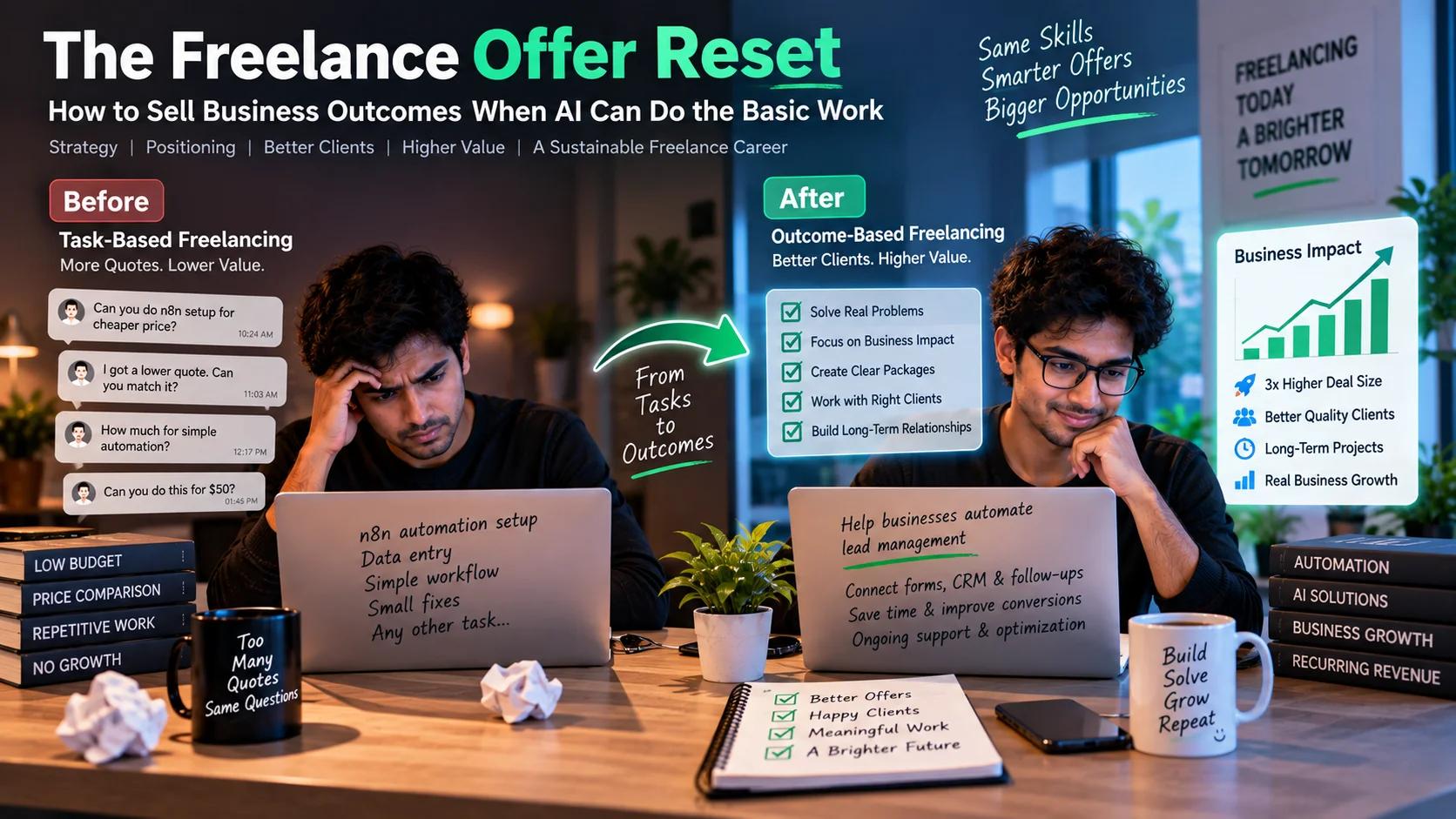
We used to advertise one of our own service lines as simply "n8n automation setup." It brought in inquiries, mostly small ones, mostly from people asking whether we could match a cheaper quote they'd gotten elsewhere. We rewrote the same service around a specific outcome instead, cutting a small business's manual lead handling time by connecting their forms, CRM, and follow up messages into one workflow.
The number of inquiries dropped. The average deal size roughly tripled almost immediately, because we'd stopped competing with every other person who could technically build a workflow and started talking to the specific businesses who actually had this specific problem.
The Lesson Behind the Shift
AI can now produce a rough first draft of basic tasks in minutes, which means selling the task itself is a rapidly shrinking business. Selling the business outcome behind the task is not.
What Is Actually Changing in Freelancing Right Now
AI is pulling on freelancing from two directions at once. It's automating a real slice of repetitive, easily defined tasks, and at the same time it's creating fresh demand for people who can actually implement, review, customize, and manage the AI supported systems that come out of that automation.
Basic copywriting, simple graphic work, and other easily defined gig tasks are under real pressure, while demand keeps building for freelancers with genuine judgment, especially as more businesses adopt AI without necessarily having anyone in house who can implement it properly. None of this guarantees any individual freelancer more demand or income automatically. What it does mean is that thinking only in terms of isolated tasks is a weaker position than it used to be.
The practical question worth sitting with is simple: How do you make your service easy for a client to actually understand, evaluate, and decide to buy?
Selling a Task Versus Selling an Outcome
Picture two freelancers side by side. The first says "I build n8n workflows." Technically accurate, and it explains nothing about what a client actually gets out of hiring them. The second says "I help small businesses reduce repetitive lead management work by connecting forms, CRMs, email notifications, and reporting into one automated workflow."
That second description names the target customer, the actual business problem, the type of solution, and the operational benefit a client can expect, without promising a specific financial number it can't actually guarantee.
Selling the Task (Commodity)
"I build n8n workflows" or "I write Python scripts"
- ✕ Competes exclusively on price and speed
- ✕ Attracts price-sensitive, demanding inquiries
- ✕ Output is directly substitutable by basic AI
Selling the Outcome (High Value)
"I help small businesses reduce manual lead handling time by connecting forms, CRM, and follow-ups"
- ✓ Fixes an expensive operational bottleneck
- ✓ Triples average deal size with qualified clients
- ✓ AI assists execution while your judgment leads
A useful formula behind an offer like that: the target customer, plus the business problem, plus the specific service, plus clearly defined deliverables, plus how success gets measured. Something like "I help small online stores organize customer inquiries by building a support workflow that categorizes messages, retrieves approved information, and routes complex cases to a human team member" says considerably more than "I am an AI automation expert," and it's exactly the shift that moved our own service line from a price comparison exercise into something clients actually wanted specifically from us.
Why Basic Services Keep Getting Harder to Stand Out With
When a lot of freelancers offer roughly the same service, clients end up comparing mostly on price, delivery time, ratings, portfolio examples, communication, and a general sense of expertise. AI complicates this further because plenty of basic outputs—a first draft article, a simple social graphic, straightforward code, a product description, a standard email sequence—can now get generated quickly by almost anyone.
What that output usually still needs is human review, real customization, fact checking, testing, and actual integration into a client's existing workflow. There's a growing amount of freelance demand now built specifically around fixing and refining flawed AI generated work, though a real share of that cleanup work tends to be low paid and repetitive rather than a genuine long term positioning strategy.
The real distinction worth internalizing is that using AI to produce an output is a completely different thing from delivering a reliable solution that actually works for a specific business. Freelancers differentiate themselves through real domain understanding, quality control, client communication, workflow integration, testing, documentation, security awareness, and a willingness to keep improving something after it ships, none of which AI does on its own.
Build a Package Around a Real Client Problem, Not a List of Skills
Rather than offering ten unrelated services, build one focused package for a specific type of customer. Take a local business automation package aimed at small service businesses whose leads arrive through several different channels, whose staff manually copy customer information around, whose follow ups are inconsistent, and whose customer requests are genuinely hard to track.
A package like this might include form and inquiry collection, lead categorization, CRM integration, email or WhatsApp notification setup, follow up reminders, a basic reporting dashboard, and workflow documentation, adjusted to the specific client's needs, technical environment, budget, and legal requirements. Discover how to structure this with our deep dive on AI automation for small businesses.
The point isn't selling "an automation." It's offering a structured way to fix a genuine business workflow problem, which is exactly what changed once we stopped calling our own offer generic automation setup.
Worth avoiding entirely: promising guaranteed revenue growth, guaranteed lead conversion, zero operational errors, a full replacement for employees, or unlimited automation. Define what will actually be delivered and how the result will genuinely be evaluated instead.
Add a Paid Discovery Phase Before Committing to Scope
Plenty of freelance projects get difficult purely because requirements were never clear at the start. A client saying "I need an AI chatbot" might actually mean customer support automation, product search, order tracking, human escalation, multilingual support, CRM integration, access control, or analytics, sometimes several of those at once. Starting development immediately, before that's untangled, tends to create scope changes and rework nobody budgeted for.
A paid discovery phase gives both sides real shared understanding before the main project starts.
📋 What a Paid Discovery Deliverable Includes
This phase should never become a way to dodge pricing clarity. Its actual purpose is building shared understanding before real money and time go into the build.
Use AI Inside Your Delivery Process, Not as Your Entire Value
AI genuinely speeds up delivery: generating initial code, drafting test cases, producing a first pass at documentation, helping think through error messages, and exploring implementation options. None of that removes the freelancer's responsibility to actually review the output, test the solution properly, and confirm it genuinely fits what was agreed.
A reliable shape for this looks like understanding the actual requirement, designing the solution, using AI for real assistance along the way, reviewing and validating everything it produces, testing against realistic inputs rather than clean happy path ones, and only then delivering with proper documentation.
This matters even more when customer data, financial systems, healthcare information, authentication, production infrastructure, or external APIs are involved. AI generated code or content should never be treated as automatically accurate, secure, or production ready just because it compiled or read smoothly.
Show Real Evidence Instead of Generic Claims
Plenty of freelancer profiles say some version of "highly skilled," "quality work," or "fast service," none of which a client can actually evaluate against anything concrete. A small, honest case study does far more work. If you are starting fresh, check our guide on how to build a freelance portfolio with no experience.
Explain the client's original situation without exposing anything confidential, describe how the work got done before you got involved, explain specifically what you contributed, mention the actual tools and methods used, be honest about what you tested and what the solution genuinely doesn't cover, and share observed results using real, verified numbers where you actually have them.
"The workflow reduced manual data entry steps from five to two during our test process" is considerably more useful and credible than "I completely transformed the business," and it's much closer to what actually happened with our own reworked automation package.
Never publish client data, screenshots, credentials, or internal information without clear permission first.
Build a Pricing Structure a Client Can Actually Follow
"How much will this cost" without a defined scope creates confusion on both sides almost immediately. Define what's actually included instead. Learn more about client positioning in our guide to finding high paying freelance clients.
Discovery Package
Requirements review, workflow audit, and implementation roadmap.
Basic Setup
One defined workflow with limited essential integrations.
Standard Delivery
Multi-tool integrations, error handling, testing & documentation.
Ongoing Support
Workflow monitoring, bug resolution, and monthly health check.
These are illustrative, not fixed market rates, since actual pricing depends on expertise, complexity, location, client budget, risk, timeline, and how much ongoing support is genuinely required. Every proposal should spell out the project scope, the number of revisions included, what access the client needs to provide, any third party costs, delivery milestones, the payment schedule, the support period, what's explicitly out of scope, and who owns what after handover. A clear scope protects both sides equally.
Write Proposals About the Client's Actual Situation, Not a Skills List
A generic proposal reading "Hello, I saw your project. I have experience in Python, AI, automation, and APIs. I can complete your work quickly" is easy to skim past and forget.
A stronger version reads closer to: "Your project involves connecting customer inquiries with an internal workflow. I'd first review the current process, identify the required integrations, and propose a solution with clear validation and error handling steps, then document the workflow so your team can maintain it after delivery."
That doesn't guarantee winning the project, but it proves the work was actually considered rather than the skills list simply copied in. A strong structure mentions the client's specific requirement, names a relevant challenge, explains the proposed approach, mentions genuinely similar past experience, defines a clear next step, and asks only the questions that are actually necessary. Sending the same proposal to every listing is exactly the habit worth breaking.
Build a Real Client Qualification System
Not every project fits every freelancer, and accepting one that doesn't tends to cost more than the fee covers. Worth checking before committing:
- 1.Clarity & Deliverables: Is the client's requirement genuinely understandable, are expected deliverables documented, and is there enough information to actually complete the work?
- 2.Access & Decision Makers: Can the client provide the access needed, is there an actual decision maker involved, and are approvals likely to move at a reasonable pace?
- 3.Technical Feasibility: Are the required APIs and third party services actually available and compatible, and are security and privacy requirements genuinely understood on both sides?
- 4.Budget & Timeline: Is the budget realistic for the scope, are payment terms clear, and is the timeline actually achievable?
- 5.Skill Alignment: Does the project genuinely match your skills, can you support it after delivery, and are the client's expectations reasonable to begin with?
Turning down a poor fit protects time, reputation, and delivery quality far more than a single extra project is usually worth.
Build Recurring Revenue Through Support, Responsibly
Freelancing doesn't need to run entirely on new client acquisition. Website maintenance, workflow monitoring, data pipeline checks, security updates, AI knowledge base updates, reporting improvements, and integration maintenance are all naturally ongoing needs.
Recurring support only works well when it's built on a clearly defined agreement: monitoring agreed workflows, reviewing reported errors, applying limited fixes, checking integration failures, and providing a monthly activity summary, with new feature requests clearly treated as separate work needing a separate estimate. Never promise continuous monitoring without the actual systems, availability, or process to genuinely back that promise up.
Protect the Business Itself, Not Just the Client Pipeline
Freelancers often spend a lot of energy finding clients and comparatively little protecting the business underneath that effort. Written agreements should document scope, payment terms, ownership, confidentiality, and responsibilities clearly. Payment protection means using an agreed structure and avoiding large unpaid commitments before proper financial arrangements exist.
Data security means never storing client credentials in unsecured documents or sharing anything sensitive through an unsafe channel. Backups should cover your own work as well as whatever the client's own requirements call for around production data. Change management means actually recording major changes to workflows, applications, and integrations as they happen, not reconstructing them later from memory. And a real exit process should document how access gets removed and how the project gets properly handed over once it's finished.
All of this matters more, not less, as more freelance work touches AI agents, real APIs, cloud platforms, and genuine business data.
Measure the Business With More Than Just Revenue
Revenue matters, but it's an incomplete picture on its own. Worth tracking: how many genuinely qualified inquiries actually come in, what share of proposals get a real response, how often a discovery conversation actually turns into a project, the average value per project, the actual delivery margin once project costs are subtracted, how often revisions pile up, how often clients come back for repeat work, whether clients pay on the terms agreed, and how much time support work actually eats after delivery.
A high value contract that demands endless revisions, unpaid extra support, and heavy third party costs can be a worse deal than a smaller one that closes cleanly, and revenue alone won't show you that difference.
A Sharper Way to Position a Freelance Service
A useful way to describe an offer combines four distinct layers:
Layer 1: The Actual Skill
Python development, data analysis, UI/UX design, video editing, automation, copywriting, whatever it genuinely is.
Layer 2: The Business Context
Who specifically gets helped: online stores, local service businesses, SaaS companies, agencies, real estate firms.
Layer 3: The Concrete Business Problem
Manual reporting, slow lead response times, repeated data entry, disorganized inquiry routing, customer churn.
Layer 4: The Delivery System
Discovery audit, tested implementation, edge-case validation, documentation, staff training, and ongoing monitoring.
Combined, something like "I help small businesses automate repetitive customer support and reporting tasks using carefully scoped workflows, tested integrations, and clear documentation" says considerably more than presenting yourself as a general freelancer ever could, and it's close to the exact language that replaced our own generic automation listing.
A Four Week Plan to Reset a Freelance Offer
Audit & Narrow Focus
Review the services currently on offer, note which ones are highly repetitive and easily commoditized, think honestly about the type of client actually worth attracting, and pick one or two business problems genuinely well understood already.
Build One Focused Offer
Build one focused offer around that problem, defining the target customer clearly, describing the actual problem, listing real deliverables, defining what's explicitly excluded, and preparing a sample workflow or case study to back it up.
Sharpen Sales & Proposals
Sharpen the actual sales process, rewriting the profile introduction, building a proposal template with customizable sections rather than a rigid copy paste block, preparing real discovery questions, defining payment and scope terms clearly, and reviewing how projects get qualified before acceptance.
Live Testing & Feedback Loop
Actually test it, reaching out to relevant prospects, tracking the specific questions clients ask, reviewing which proposals get a real response, identifying the parts of the offer that still read unclearly, and refining based on that real feedback rather than a guess.
Not every proposal or repositioned offer works immediately. Treat the whole process as an ongoing experiment rather than a one time fix, which is closer to how our own repositioning actually played out over several rounds of adjustment.
Mistakes Worth Avoiding
- ✕Selling every skill at once: Blurs positioning rather than sharpening it.
- ✕Promising uncontrollable results: Claiming guaranteed revenue, rankings, or conversions without a sound basis.
- ✕Starting with undocumented requirements: Reliably leads to disputes, scope creep, and unpaid rework later.
- ✕Unvetted AI outputs: Delivering AI-generated code or copy without rigorous testing and human fact-checking.
- ✕Unlimited revisions: Failing to define boundaries creates scope drag and margin collapse.
- ✕Ignoring third-party operating costs: Overlooking API fees, server hosting, and webhook monitoring subscriptions.
- ✕Competing purely on price: Attracts churn and low-budget friction without building sustainable enterprise value.
- ✕Sloppy handover: Leaving a client without proper credentials removal, documentation, or operational guides.
Final Thoughts
Freelancing in 2026 asks for more than learning a tool and publishing a service listing. AI is genuinely changing how certain tasks get produced, reviewed, and purchased, which means real thought now has to go into positioning, client relationships, delivery process, and the actual business value behind the work, not just the work itself.
None of this requires cutting AI out of the process. It requires understanding exactly where it helps, where real human judgment is still required, and how to deliver something that actually matches what a specific business needs, the same shift that took our own automation offer from a price comparison to a specific, well understood solution clients sought out directly. The next stage of freelancing isn't about producing more work. It's about making the work more relevant, more measurable, more reliable, and more genuinely useful to the businesses being served.
Frequently Asked Questions
Is freelancing still a viable path in 2026?
Yes, though demand varies meaningfully by skill, market, experience, and service type. AI is reducing demand for some routine tasks while creating real new requirements around implementation, review, and judgment.
Do freelancers actually need to learn AI tools themselves?
It helps considerably with research, drafting, development, and workflow efficiency, but understanding the limitations and reviewing generated output matters just as much as knowing how to use the tools in the first place.
What does an outcome oriented freelance service actually look like?
It's a service described around a client's real business problem, clear deliverables, and a defined way to measure success, rather than just the task being performed in isolation.
Should every freelancer offer ongoing monthly support?
No. It only makes sense when the service genuinely requires continued maintenance and the freelancer can clearly define what that support actually covers.
How can scope creep actually be avoided?
Written requirements, clearly defined deliverables, revision limits, explicit exclusions, milestone based approvals, and a documented process for handling change requests all help keep a project inside its original scope.
Is the cheapest freelancer generally the safest choice for a client to pick?
Not necessarily. Price is one factor among several, expertise, communication, reliability, security practices, scope clarity, and long term maintenance needs all matter just as much in most real projects.
Written by Chintan Poriya, Marketing Head.
Read More in Freelancing Advice
Freelance Client Onboarding: How to Turn a New Client Into a Smooth Project
One of our early client automation projects started the same day the client said yes, no written scope, just a WhatsApp message confirming "build the lead bot." Three weeks in, we rebuilt two weeks of work for a feature nobody had actually agreed to in writing.
Read article →
Build a Freelance Portfolio That Wins Clients
We hired a freelancer with zero paid experience over three others because her portfolio explained the problem, not just the design. Here's how.
Read article →