Top Skills to Learn in 2026 (What Actually Slowed Us Down as a Company This Year)
Chintan Poriya
Lead Career Editor & AI Research Director
Published: December 17, 2025
Table of Contents
We lost three days last quarter not to a hard technical problem, but to a genuinely simple one. A cloud environment variable was misconfigured on a client deployment, and it took us most of a week to track down because nobody on the team who touched it that day had solid cloud fundamentals. Once someone who actually knew what they were looking at got involved, the fix took maybe twenty minutes.
That's the pattern behind this list. It's not built from a trend report. It's built from watching what actually slows a team down or speeds it up, day to day, at a company that works across AI, automation, and client delivery. None of these eight are flashy. All of them have cost us real time when someone on a project didn't have them, or saved real time when someone did.
Why This List, Not a Longer One
Trying to learn everything at once is how most people end up mastering nothing. These eight came up repeatedly enough in hiring decisions, in project delays, in what actually got a client project unstuck that they earned a spot. Depth in a few beats a shallow pass at twenty.
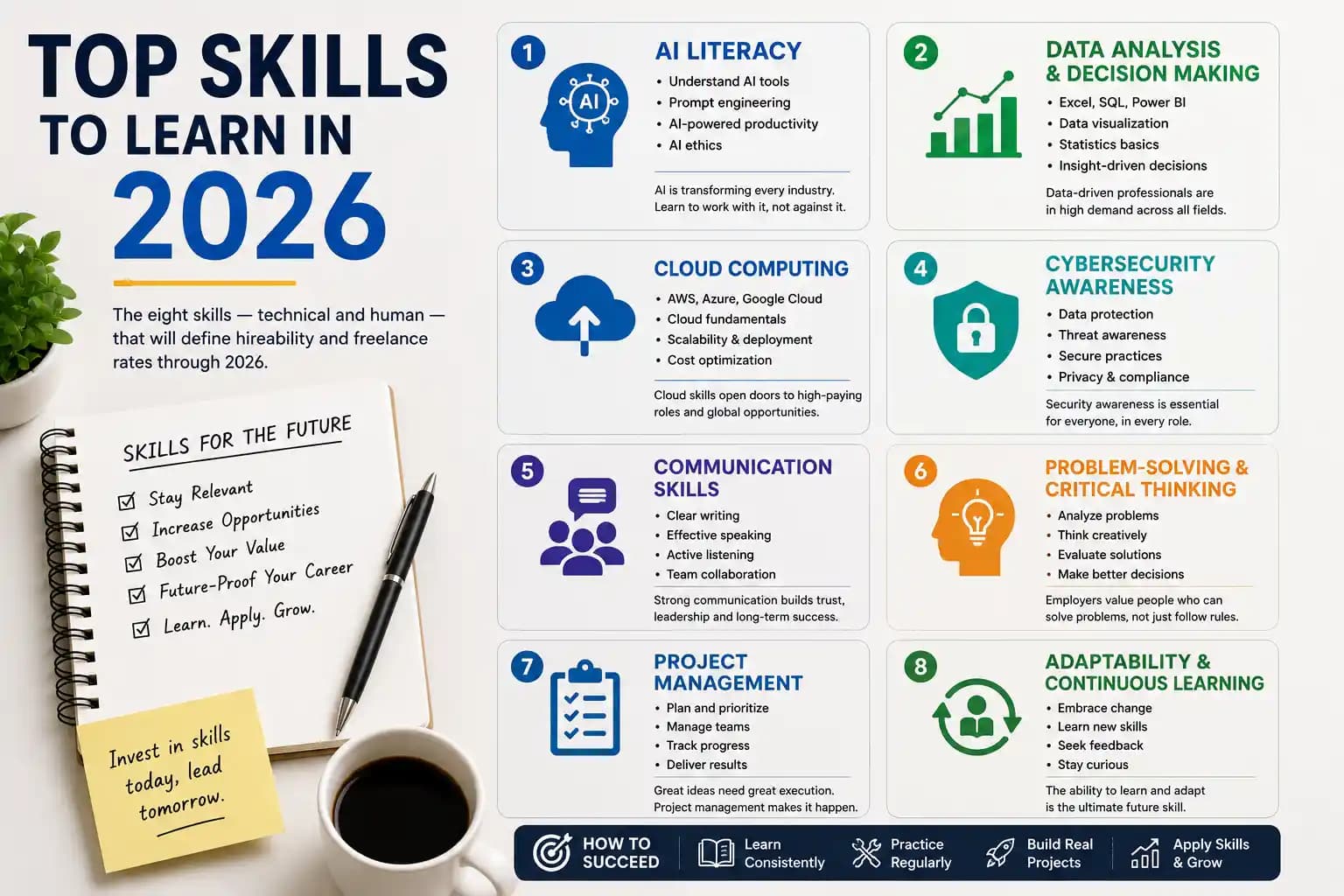
AI Literacy
Not just for engineers anymore genuinely useful across marketing, support, and operations too. The specific pieces worth learning: generative AI basics, prompt engineering, AI-powered productivity tools, a working understanding of AI ethics and limitations, and basic workflow automation. We've written full pieces on prompt engineering and AI agents separately if you want the deeper version of this. The person on our team who picked this up fastest cut her own content drafting time roughly in half within a month.
Data Analysis and Decision-Making
Excel, SQL, Power BI or Tableau, Google Sheets, basic statistics, and enough visualization skill to make a chart that actually communicates something. You don't need to become a data scientist you need to be able to look at a dataset and pull out what actually matters instead of guessing. This is one of the more universally useful skills on this list; it shows up in marketing, ops, finance, and engineering alike.
Cloud Computing
This is the one from the story above. AWS, Azure, or GCP pick one and get comfortable with the fundamentals: deployment basics, environment configuration, and how services actually talk to each other. You don't need to be a cloud architect. You need to not lose three days to a misconfigured variable because nobody on the project understood what they were looking at.
Cybersecurity Awareness
Not a specialist skill anymore a baseline expectation. Password hygiene, multi-factor authentication, recognizing phishing attempts, basic data privacy practices, secure file sharing, and enough network security fundamentals to avoid the obvious mistakes. Even in non-technical roles, this has become table stakes; the cost of one team member falling for a phishing email is disproportionate to how little time it takes to build the awareness that prevents it.
Communication Skills
Technical skill without the ability to explain it clearly gets lost in translation, repeatedly. Explaining complex ideas simply, writing emails that actually get read and acted on, presenting clearly, collaborating without friction, listening well, and building relationships that hold up under pressure. We've watched genuinely strong technical work get undervalued internally because nobody could explain why it mattered and watched more average work get more credit because someone communicated it well.
Problem-Solving and Critical Thinking
AI generates information fast. It doesn't replace judgment about which information actually matters for your specific situation. Building this means practicing analyzing problems logically, weighing different solutions honestly, making calls under incomplete information, thinking creatively when the obvious answer doesn't work, and adapting quickly when circumstances shift mid-project. This is the skill that ages the best it doesn't go stale the way a specific tool or framework eventually does.
Project Management
Setting real priorities, managing deadlines honestly, coordinating a team without constant check-ins, allocating resources sensibly, tracking progress visibly, and actually delivering. Tools like Notion, Trello, ClickUp, Asana, or Jira help, but the underlying skill is the part that matters the tool just makes it visible. We've seen projects with a mediocre tool and a strong project manager outperform projects with a great tool and no one actually managing it.
Adaptability and Continuous Learning
Technology moves fast enough that any specific skill on this list has a shelf life. What doesn't expire is the habit of staying current reading what's changing in your field, taking the occasional course, practicing new tools before they become mandatory, asking for feedback, and actually learning from mistakes instead of just moving past them. This might be the single most durable skill on the whole list, because it's what lets you rebuild the other seven as they shift.
Technical Skills vs. Human Skills
| Technical | Human |
|---|---|
| Artificial Intelligence | Communication |
| Data Analysis | Leadership |
| Cloud Computing | Critical Thinking |
| Programming | Creativity |
| Cybersecurity | Collaboration |
| Automation | Emotional Intelligence |
| Digital Tools | Adaptability |
| Project Management Software | Problem-Solving |
The strongest people we've hired or worked with tend to sit somewhere in both columns, not entirely in one. A brilliant technical hire who can't communicate the reasoning behind a decision creates almost as much friction as a great communicator with no technical grounding.
Where to Actually Learn These
You don't need an expensive degree for most of this. Free and low-cost courses, YouTube (genuinely underrated for technical fundamentals), professional certifications from platforms we've covered in a separate piece, personal projects, open-source contributions, industry blogs and communities, and just consistent hands-on practice. Consistency matters more than which specific resource you pick.
Skill Combinations That Actually Raise Freelance Rates
A single skill gets you into the applicant pool. A useful combination gets you picked. Clients consistently prefer someone who can solve two connected problems over hiring two separate people for each half.
Mistakes That Slow This Down
What to Avoid
Trying to learn five of these eight simultaneously and making real progress on none of them.
Watching tutorials without ever building something with the material.
Chasing whatever's trending this month instead of finishing what you started last month.
Treating soft skills as optional extras rather than genuinely load-bearing.
Quitting after a few weeks because the payoff doesn't feel immediate yet.
Skipping real projects entirely reading about a skill and being able to use it under pressure are two very different things.
A Six-Month Plan If You're Starting From Scratch
AI fundamentals & communication
These reinforce each other more than people expect; explaining an AI-assisted output clearly is its own skill.
Data analysis (Excel & SQL)
Pick a real dataset that interests you rather than a generic tutorial dataset.
Cloud basics & cybersecurity
Cloud computing basics and cybersecurity fundamentals overlap more than they seem to on paper.
Build a combined project
Build something that combines the technical skills from months 1 through 3. This is where the learning actually compounds instead of sitting as separate, disconnected facts.
Project management & collaboration
By this point you'll have real projects worth organizing properly.
Portfolio & execution
Build a portfolio around what you've made, update LinkedIn to reflect it honestly, and start applying it freelance work, an internship, or a role.
One consistent hour a day across six months adds up to more than most people expect looking at month one from the outside.
Final Thoughts
2026 won't reward the person who knows the most trivia about the most tools. It'll reward the person who can combine real technical grounding with the judgment and communication to actually apply it under real conditions the kind of gap that turned a twenty-minute cloud fix into a three-day outage on our end, purely because the second half of that equation was missing in the moment it mattered.
Pick one skill from this list to start. Build something real with it before moving to the next. The compounding effect across six months is bigger than it looks from day one.
FAQ
Which of these eight skills should I prioritize if I can only focus on one right now?
It depends on your field, but AI literacy and communication are the two with the broadest reach across almost every role they tend to amplify whatever technical skill you already have.
Do I need to become an expert in all eight to be competitive?
No. Genuine competence in three or four, paired with baseline awareness of the rest, is realistic and effective. Depth in a few matters more than shallow exposure to all eight.
How long does it actually take to see career benefits from learning a new skill like this?
It varies, but most people see a real, usable shift within two to three months of consistent practice full mastery takes longer, but usable competence arrives faster than people expect.
Are technical skills more valuable than human skills like communication in 2026?
Neither on its own goes as far as the combination. We've consistently seen strong technical work undervalued when it wasn't communicated well, and average work overvalued when it was.
Written by Chintan Poriya, Marketing Head.
Read More in Career Advice
From AI Learner to AI Professional: How to Build a Job Ready Portfolio in 2026
One candidate's portfolio said "built a RAG chatbot" and nothing else. Another explained exactly why she chunked documents the way she did and what she measured to pick her embedding model. We hired the second one before the interview even ended.
Read article →
The IT Hiring Reset: Why Companies Are Hiring Again, But Only for AI Ready Professionals
We paused hiring for almost eighteen months. When we reopened a role this year, we didn't ask candidates whether they could write clean code. We asked them to walk us through an AI assisted debugging session they had actually done.
Read article →