From Prompting to Building: Why AI Implementation Skills Are the Hottest Career Advantage in 2026
Chintan Poriya
Lead Career Editor & AI Research Director
Published: June 24, 2026
Table of Contents
A year ago, one of our job postings listed "strong prompt engineering skills" as a core requirement. We got dozens of applicants who could write a genuinely good prompt in a sandbox environment and had never shipped anything connected to a real database, a real API, or a real user. We rewrote the posting. The new version didn't mention prompting once it asked for someone who'd deployed a RAG pipeline end to end, handled the messy parts of connecting it to existing systems, and could talk through what broke along the way. The applicant pool got noticeably smaller. The quality of who showed up got noticeably better.
That's the actual shift happening across AI hiring right now, and it's easy to miss if you're still optimizing for the skill that mattered two years ago instead of the one that matters now.
AI Has Moved Into a New Phase
The pattern's been fairly consistent: first, people experimenting with chatbots out of curiosity. Then businesses adopting AI tools for writing, coding, and research. Then organizations starting to weave AI into everyday operations. We're now solidly into the phase where AI is expected to be part of core business processes, not a standalone tool someone opens occasionally. That shift changes what "AI skill" actually means on a resume.
What Employers Actually Need Right Now
Most companies already have access to AI tools that part's solved. What they're missing is someone who can answer the harder questions: which processes should actually be automated, how AI integrates with what already exists, how it improves the customer experience without breaking something else, how to deploy it securely. These are implementation problems, not prompting problems, and it's exactly the gap our rewritten job posting was trying to close.
The Rise of People Who Actually Build the Thing
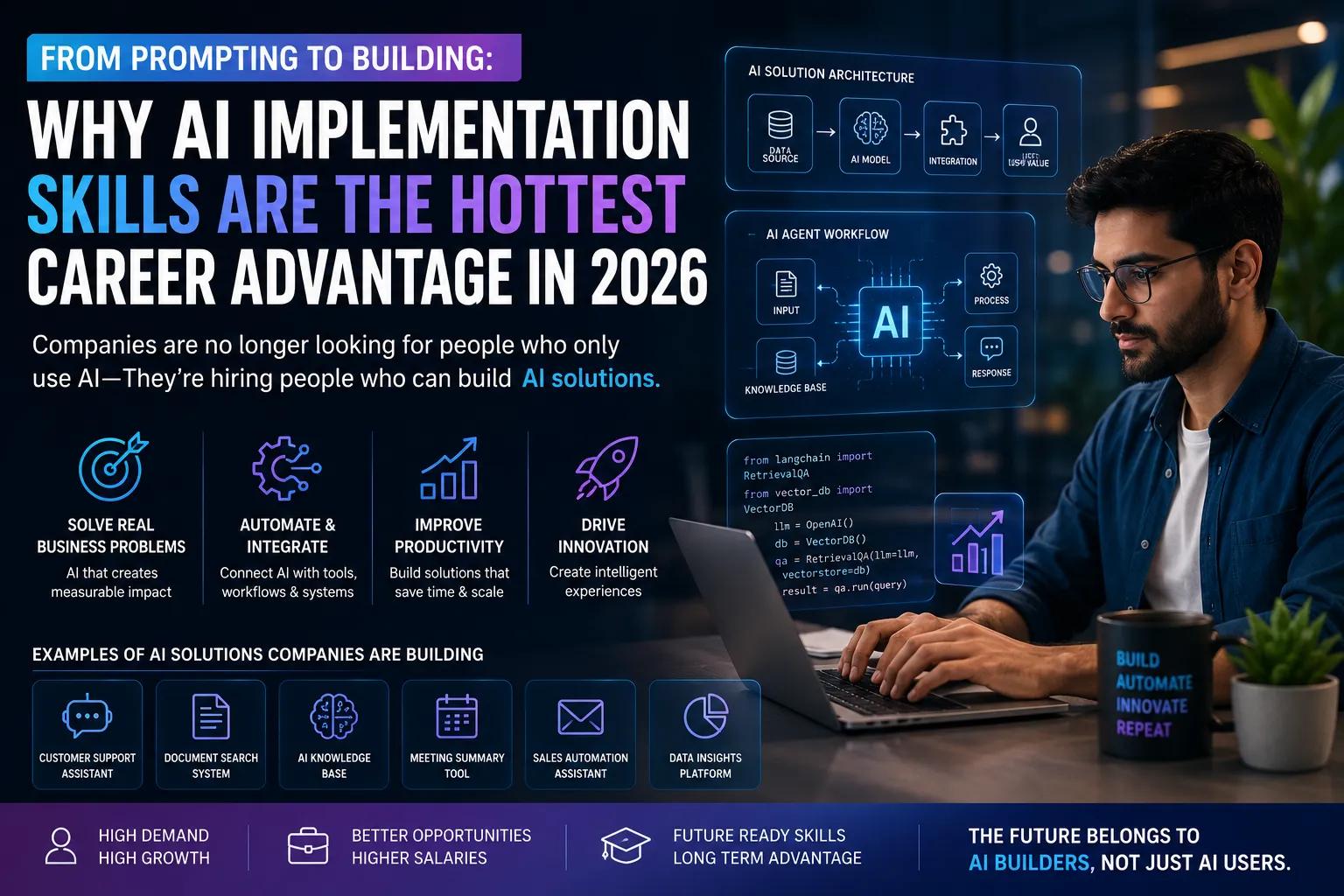
Someone who can turn an idea into a working system not just describe what it should do. Real examples of what this looks like in practice: an AI resume analyzer, a customer support assistant, an internal knowledge base, a document search platform, a meeting summary tool, a sales automation assistant, a research platform, an internal chatbot. Every one of these demonstrates something a prompting sample can't that the person can carry an idea through to something that actually runs.
The Skills That Actually Matter Now
Python, LLM APIs, prompt engineering as a foundation rather than the whole skill set, RAG, vector databases, API integration, workflow automation, cloud deployment, evaluation methods, and enough security and governance awareness to not create a liability. Nobody needs to master all of this overnight the goal is understanding how these pieces fit together to solve an actual problem, which is a very different skill from being fluent in any one of them in isolation.
Think Like a Business Problem Solver, Not an AI Enthusiast
Companies rarely say "we need someone who knows AI." They say they need faster customer response times, automated document processing, better internal knowledge management, higher employee output. AI is the tool, not the ask. The candidates who stand out in our hiring conversations are consistently the ones who talk about the business problem first and the technology second not the reverse.
Build a Portfolio That Shows Results, Not Just Capability
For AI-focused roles specifically, the portfolio increasingly matters more than almost anything else on the resume. For each project: the actual business challenge, your AI solution, what you built it with, the measurable result, and what you learned along the way. A portfolio built around outcomes reads completely differently than one built around "here's a thing I made."
Why a Project Beats a Certificate Almost Every Time
Certificates confirm you finished a course. Projects prove you can actually do the work. We're consistently more likely to remember and follow up with someone who built a working document search system than someone who completed another course on the same topic the candidate from our rewritten posting made that gap obvious within the first five minutes of conversation.
Human Skills Still Do a Lot of the Heavy Lifting
Even as the technical bar rises, communication, leadership, critical thinking, collaboration, creativity, decision-making, and adaptability haven't gotten less important if anything, they matter more once the technical work gets genuinely complex, because someone still has to explain the trade-offs to a non-technical stakeholder and make a sound call under real uncertainty.
A Six-Month Roadmap From Prompting to Actually Building
Month 1
Fundamentals
Python fundamentals and core AI concepts.
Month 2
APIs & Prompting
Prompt engineering properly, plus real API work with LLM providers.
Month 3
RAG & DBs
Build something real using RAG and a vector database.
Month 4
Workflows
Workflow automation projects connecting AI into an actual process.
Month 5
Deployment
Deploy what you've built and take security seriously.
Month 6
Portfolio
Turn all of it into a real portfolio with case studies.
Learning by actually building consistently produces stronger candidates than learning by watching tutorials alone this was true of nearly every strong applicant we've hired against that rewritten job posting.
Mistakes That Slow This Down
Collecting certificates without ever building anything from them. Staying stuck at the prompting stage instead of pushing into implementation. Ignoring the actual business use case in favor of the technology itself. Never deploying anything a project that only runs on your own laptop demonstrates less than people think. Copying tutorials instead of building an original solution. And avoiding real user feedback, which is often where the actual hard lessons about a system's weaknesses show up.
The Next Wave Isn't AI Users It's AI Builders
The professionals gaining the most ground aren't the ones who use AI tools well. They're the ones who design, integrate, and manage the systems that make AI part of how a business actually runs day to day. That doesn't mean everyone needs to become an AI researcher it means understanding, concretely, how AI creates real value inside an organization, and being able to build toward that instead of just around it.
Final Thoughts
AI has stopped being a standalone productivity tool and started becoming core infrastructure for how businesses actually operate. As that shift plays out, the gap between people who can prompt well and people who can build and ship something real is exactly where the hiring advantage now sits it's the gap our rewritten job posting was built to find, and it's the same gap most AI-adjacent hiring is quietly filtering for now, whether or not the posting says so explicitly.
Don't stop at prompting. Build something that actually runs, connect it to something real, and be ready to explain what broke along the way. That's what separated the candidates we hired from the ones we didn't.
FAQ
Is prompt engineering still worth learning if implementation skills matter more now?
Yes it's still the foundation everything else builds on. The shift isn't away from prompting, it's toward not stopping there.
Do I need a computer science background to become an AI builder?
Not necessarily. Python fundamentals plus consistent, hands-on project building closes most of this gap over a few months, even without a formal technical degree.
What's the fastest way to show I can actually implement AI, not just prompt it?
Deploy something real even a small project and be able to explain what broke during deployment and how you fixed it. That story demonstrates implementation skill more than any prompt sample could.
How long does it realistically take to move from prompting to building?
The six-month roadmap above is a realistic pace for consistent, dedicated effort. Some people move faster with prior technical background; the sequence matters more than the exact timeline.
Written by Chintan Poriya, Marketing Head.
Read More in Career Advice
From AI Learner to AI Professional: How to Build a Job Ready Portfolio in 2026
One candidate's portfolio said "built a RAG chatbot" and nothing else. Another explained exactly why she chunked documents the way she did and what she measured to pick her embedding model. We hired the second one before the interview even ended.
Read article →
The IT Hiring Reset: Why Companies Are Hiring Again, But Only for AI Ready Professionals
We paused hiring for almost eighteen months. When we reopened a role this year, we didn't ask candidates whether they could write clean code. We asked them to walk us through an AI assisted debugging session they had actually done.
Read article →