The Productivity Myth: Why Busy People Aren't Always the Most Productive in 2026
Chintan Poriya
Lead Career Editor & AI Research Director
Published: July 15, 2026
Table of Contents
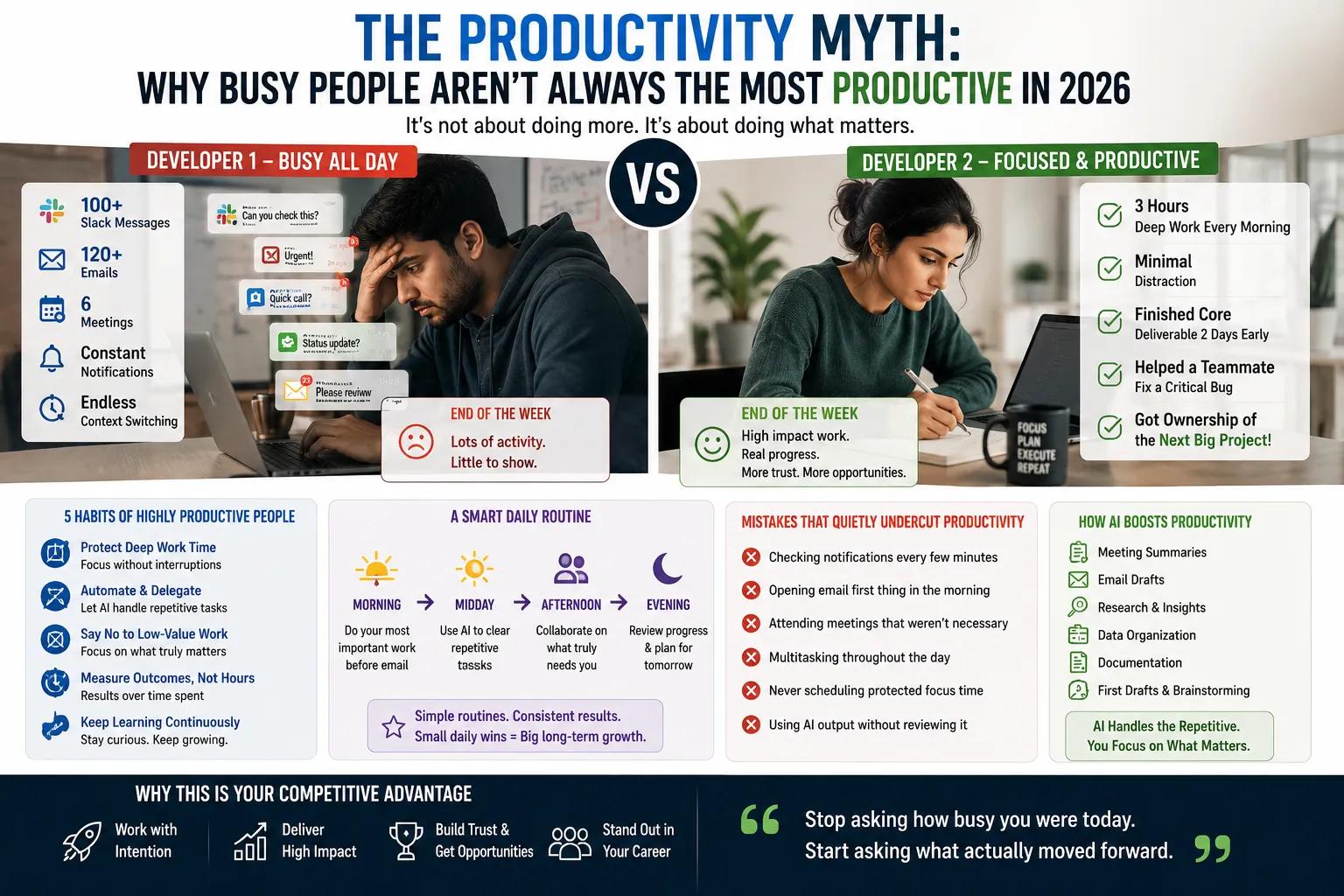
During one sprint last quarter, one developer on our team answered over a hundred Slack messages and sat through six meetings across five days. Another developer, working on the same sprint, blocked three hours every morning, skipped every meeting that wasn't strictly required, and finished the sprint's core deliverable two full days early. She spent the freed up time helping a teammate untangle a separate bug.
Guess who got handed ownership of the next, larger project.
For years, plenty of professionals have quietly confused being busy with being productive. In 2026, that confusion is turning into one of the more common obstacles to actually growing a career, and it shows up clearly the moment two people on the same team are compared side by side.
The Always Busy Trap
Most people genuinely start the day with good intentions. Then reality shows up. Slack notifications. Emails. Meetings. Calls. Constant context switching. Small "quick" requests that aren't quick at all. Status updates nobody really needed. By evening, the day feels completely full, yet the actual important task hasn't moved an inch. Activity feels like progress. It isn't the same thing as progress, and the gap between the two is exactly where the developer with a hundred Slack messages lost her week. Falling into the productivity trap creates the illusion of hard work without the results to show for it.
What Productivity Actually Rewards Now
A few years ago, productivity often meant long hours, fast replies, heavy multitasking, and showing up to every meeting invite. Increasingly, what actually gets rewarded is different: better decisions, faster execution on what matters, real focused thinking, sensible automation, and outcomes that hold up under scrutiny. The goal was never to produce more raw activity. It's to create more actual value, which is a much smaller and more specific target than "being busy all day" ever was.
AI Didn't Give Anyone Extra Time
Plenty of people assumed AI adoption would shorten everyone's workday. Instead, something more predictable happened. The time saved got filled right back up with more work, because ambition and competition keep raising expectations regardless of how efficient the tools get. Technology saves time. People tend to reinvest it rather than pocket it, which is part of why AI adoption alone hasn't made most teams feel less busy, even when it's genuinely helping.
Protecting Focus Is the Actual Skill
The developer who finished early wasn't working harder in raw hours than the one buried in Slack. She protected uninterrupted time and used it well. A useful pattern to try: ninety minutes of focused work, notifications off, no meetings scheduled, no email open, one single priority. That block regularly produces more real output than an entire distracted afternoon, and it's the exact pattern that separated the two developers in this article's opening.
Stop Measuring the Day by Hours Worked
A long day doesn't automatically produce better results, and it often produces worse ones once fatigue sets in. Better questions to ask at the end of a day: what actually got finished, what real problem got solved, what value got created, what moved the business forward. Output matters far more than raw activity, and it's a much better predictor of who gets the next opportunity than hours logged ever is.
Cut Tool Overload Instead of Adding to It
Most professionals are juggling a stack of apps daily: email, Slack, Teams, Notion, docs, video calls, project trackers, AI assistants. Every added tool is another possible interruption. Rather than reaching for one more productivity app, it's often more effective to simplify the stack that already exists. Removing a redundant tool sometimes helps more than adding a new one ever could.
Let AI Take the Repetitive Work Off Your Plate
AI is genuinely strong at meeting summaries, email drafts, research, organizing data, documentation, first drafts, and brainstorming. That frees up real human energy for decision making, strategy, genuine creativity, actual customer conversations, and leadership. The strongest teams use AI to support thoughtful work rather than as a replacement for it, which is why becoming an AI native professional is a distinction worth being deliberate about rather than assuming will happen automatically.
Meetings Should Have to Earn Their Spot on the Calendar
Before accepting the next meeting invite, it's worth asking whether it genuinely needs real time discussion. Could it be a shared document instead? A short recorded video? A Slack message? A quick AI generated summary circulated afterward? Every meeting that didn't need to happen quietly steals real focus time from the work that actually mattered that day.
Five Habits Shared by the Most Productive People We've Worked With
Protecting real deep work time. Automating the genuinely repetitive parts of the job. Saying no to low value requests, even when saying yes feels easier in the moment. Measuring outcomes instead of hours logged. And continuing to learn rather than coasting on what already works. These productivity habits compound quietly over months, and they're a fair description of exactly what the developer who finished early was already doing without necessarily naming it that way:
1. Protecting Deep Work Time
Blocking 90 to 180 minutes of uninterrupted focus daily without email, notifications, or meetings allowed in the calendar.
2. Automating the Repetitive
Using AI and automation tools to handle meeting summaries, formatting, and drafting so energy stays on strategic decisions.
3. Saying No to Low-Value Requests
Politely declining optional meetings and non-critical interruptions even when saying yes feels easier in the moment.
4. Measuring Outcomes, Not Hours
Evaluating the workday by what real problem got solved and what value got created rather than by how long you sat at the desk.
5. Continuing to Learn
Consistently upgrading your skills and tool stack instead of coasting on what already worked three years ago.
A Simple Daily Routine Worth Trying
In the morning, finish the most important task before email even gets opened. At midday, use AI to clear the repetitive parts of the workload. In the afternoon, collaborate with the team on whatever genuinely needs real discussion. In the evening, review honestly what actually got done and set tomorrow's plan before closing out. Simple routines like this consistently outperform complicated systems that are harder to actually stick to:
Morning
Deep Focus
Finish the single most important task before opening email or Slack.
Midday
AI & Batching
Use AI assistants to clear repetitive tasks, summaries, and initial drafts.
Afternoon
Collaboration
Attend necessary meetings and collaborate on items needing live discussion.
Evening
Review & Plan
Review actual outcomes achieved today and define tomorrow's top priority.
Mistakes That Quietly Undercut Productivity
Checking notifications every few minutes throughout the day. Opening email first thing instead of starting with the actual priority. Accepting meetings that didn't need to happen. Multitasking constantly despite knowing it costs more than it saves. Never actually scheduling protected focus time. And using AI output without reviewing it carefully before it goes anywhere important. None of these feel like big mistakes in the moment. They add up quietly, the same way the hundred Slack messages did across one otherwise ordinary week:
❌ Constant Notification Checking
Letting Slack and email pings fracture your focus every few minutes.
❌ Opening Email First Thing
Letting other people's urgencies hijack your morning energy before touching your main priority.
❌ Defaulting to Meetings
Accepting invites that could have easily been resolved via an asynchronous doc or message.
❌ Persistent Multitasking
Juggling multiple tasks at once and paying the heavy cognitive switching cost.
❌ No Protected Focus Time
Leaving your calendar wide open for random interruptions and reactive work.
❌ Unreviewed AI Output
Copy-pasting AI generated text or code without applying critical evaluation and human oversight.
Why This Is Becoming a Real Competitive Advantage
Organizations keep investing in AI and new tools, but the real gains tend to show up when people pair those tools with better habits, clearer priorities, and genuine support from whoever they report to, not simply from having more software available. The professionals who actually pull ahead over the next few years won't necessarily be the ones logging the longest hours. They'll be the ones working with real intention behind what they choose to spend time on.
Final Thoughts
Real productivity was never about filling every minute of a calendar. It's about making meaningful progress on the work that actually creates value, which is exactly what separated the two developers from this article's opening. One filled her week with visible activity. The other protected her attention and finished what mattered, then had time left over to help someone else.
Stop asking how busy today felt. Start asking what actually moved forward. That single shift in the question changes a surprising amount about how the rest of the day, and eventually the career, tends to unfold.
FAQ
Is being constantly busy ever actually a sign of real productivity?
Occasionally, but far less often than it feels like in the moment. The real signal is whether meaningful work actually moved forward, not how full the day felt.
How long should a protected focus block actually be?
Ninety minutes is a solid starting point for most people. Some can sustain longer, but even a shorter, genuinely uninterrupted block outperforms a much longer distracted stretch.
Does using AI tools automatically make someone more productive?
Not by itself. The real gains show up when AI gets paired with better habits and clearer priorities, not simply from having access to more tools.
What's the fastest way to tell if I'm busy or actually productive?
Look back at the end of the day and name one specific thing that genuinely moved forward. If that's hard to answer clearly, the day was probably busier than it was productive.
Written by Chintan Poriya, Marketing Head.
Read More in Productivity
Stop Overthinking: How to Take Action and Make Progress Every Day
I sat on the idea behind BytezBot for four months before writing a single line of code. Here's what that taught me about action over planning.
Read article →
The Productivity Trap: Why Busy Isn't Getting Things Done
I counted 47 Slack notifications during a 3-hour coding block. By my math, two hours went to recovering focus. Here's what actually fixed it.
Read article →