The Productivity Trap: Why Busy Isn't Getting Things Done
Chintan Poriya
Lead Career Editor & AI Research Director
Published: May 20, 2026
Table of Contents
Last sprint, I counted 47 Slack notifications during a single three-hour block I'd meant to spend debugging a workflow. Not urgent messages: mostly things that could've waited an hour, sometimes a day. Each one pulled my attention for maybe fifteen seconds to read, and then, by every account I've seen on refocusing after an interruption, several more minutes to actually get back to the depth of thought I'd been at before the ping. Rough math on that: somewhere close to two hours of a three-hour block spent recovering focus rather than actually debugging. I felt busy the entire time. I got about one hour of real work done.
That gap (feeling busy versus actually being productive) is the entire trap this article is named for, and it's a lot more expensive than it feels like in the moment.
Why Busy and Productive Aren't the Same Thing
- Notifications answered
- Emails cleared out
- Meetings attended
Zero meaningful progress
- Deep work block completed
- Strategic milestone hit
- Focused problem solved
Work that actually matters moved forward
A day full of notifications answered, meetings attended, and emails cleared can look, from the outside, like a genuinely productive day. It often isn't. Real productivity is measured by whether the work that actually matters moved forward. A day can be entirely full without a single hour of that happening, which is roughly what my three-hour block turned into before I started paying attention to it. Building robust productivity habits is essential here.
What an Interruption Actually Costs
The Slack notification math above isn't an exaggeration of how this works: interruptions during focused work carry a real recovery cost, not just the few seconds it takes to glance at the message. Multiply that recovery time by thirty or forty interruptions across a normal day, and the total lost time adds up to something that would alarm most people if they actually tracked it. That is exactly why most people don't.
Why Multitasking Makes This Worse, Not Better
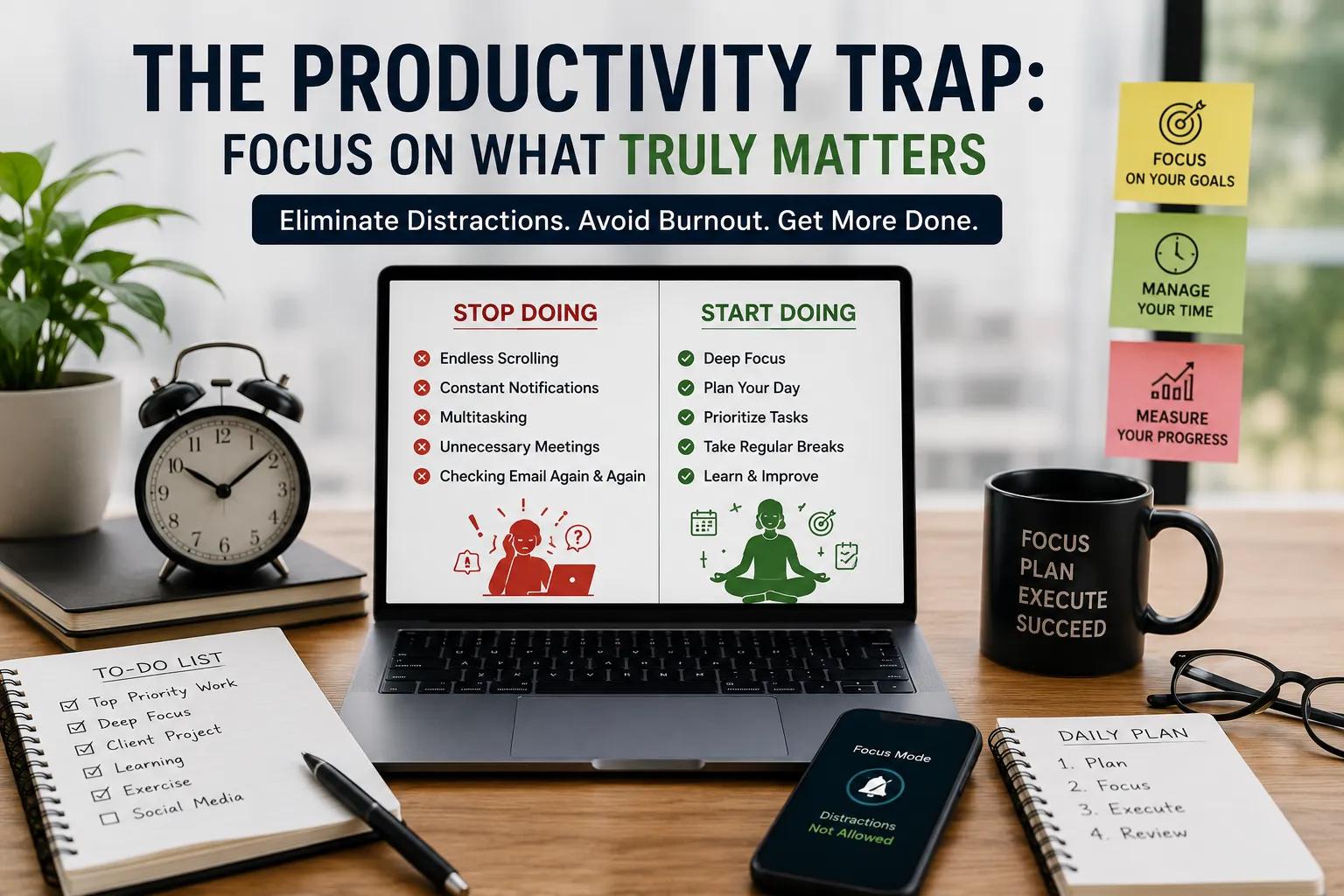
Multitasking feels efficient in the moment and rarely is. The brain isn't running two complex tasks simultaneously. It's switching rapidly between them, and each switch carries its own small cost in fatigue, mistakes, and total time to finish either task. Single-tasking (one task, fully finished, before starting the next) consistently outperforms this, even though it feels slower in the middle of doing it.
Building a Workspace That Doesn't Fight You
Environment matters more than most people give it credit for. A desk with only what the current task needs on it. Notifications actually off, not just silenced. Headphones when the office or the household gets loud. Browser tabs closed down to what's relevant right now. Phone somewhere out of reach during a real focus block, not just face-down on the desk, which barely helps compared to actually being in another room.
Using AI to Buy Back Time, Not to Stop Thinking
AI tools genuinely help here when they are aimed at the right work: summarizing long documents, drafting emails, generating meeting notes, organizing research, brainstorming a starting list of ideas, automating the repetitive parts of a workflow. Where it backfires is when it becomes a substitute for the actual thinking instead of a way to clear space for it. The goal is more time for the strategic and creative work, not less thinking overall.
Matching Work to Your Actual Energy, Not the Clock
Not every hour carries the same mental capacity. Figure out when you're naturally sharpest (for most people it's earlier in the day, though not universally) and protect that window for writing, coding, studying, or anything that needs real strategic thought. Push email, meetings, and administrative work into the lower-energy stretches instead. Managing energy this way tends to outperform simply managing time on a clock, because it matches the work to the mental state actually available for it.
The Two-Minute Rule
If something takes less than two minutes, do it immediately instead of adding it to a list. A quick reply, filing a document, scheduling a meeting, updating a task tracker. These pile up fast when deferred, and each one deferred adds a small ongoing mental tax: a thing you're now tracking instead of a thing that's done.
Scheduling Real Time Away From Screens
Counterintuitively, some of the best productivity gains come from stepping fully away from the work: a short walk, stretching, water, a few pages of an actual book, a few minutes of just sitting without a screen in front of you. The brain needs genuine recovery time to sustain focus across a full day, and skipping this doesn't actually buy you more output; it just borrows against the next block of focused work.
A Real Shutdown Routine, Not Just Closing the Laptop
Plenty of people finish work without ever mentally finishing it: the laptop closes, but the open loops keep running in the background all evening. Before ending the day: review what actually got done, set tomorrow's priorities while it's fresh, clear the physical workspace, close unnecessary tabs, and actually log out of work applications instead of leaving them running. A consistent version of this routine does real work reducing evening stress, not just organizing tomorrow.
Mistakes That Quietly Undo All of This
Avoid these hidden traps
A Simple Daily Framework
Morning
Set the top three priorities, do the most important one first, and hold off on social media until that's done.
Afternoon
Meetings, email, collaborative work. Naturally the more fragmented part of most days, so don't fight it by scheduling deep work here.
Evening
Review progress honestly, set tomorrow's priorities, and actually disconnect rather than leaving work half-open in your head all night.
Start With One Habit, Not All of Them
Trying to overhaul everything at once tends to collapse within a week. Pick one: notifications actually off, one protected deep work block, tomorrow's plan set before leaving today, social media held off during work hours, or real breaks taken instead of skipped. Small, consistently repeated changes compound into something real. Trying to install five new habits simultaneously rarely survives past the first rough day.
What to Actually Do About This Today
Pick one upcoming block of focused work, even 90 minutes. Turn off every notification source you can find, not just the obvious ones. Put your phone in another room. Work that block single-task, start to finish, on one thing only. Afterward, compare how it felt and how much actually got done against a normal, notification-heavy block from earlier this week. The gap is usually bigger than people expect going in; mine certainly was.
Final Thoughts
Productivity was never about cramming more into a calendar. It's about protecting enough real, uninterrupted attention that the work which actually matters gets to move forward instead of getting chipped away by forty small interruptions that each felt harmless in the moment. In a world of constant notifications and endless meetings, that protected attention has become one of the more genuinely valuable professional skills available.
Forty-seven notifications in three hours taught me that more clearly than any productivity article had up to that point. Track your own version of that number once, honestly, and it tends to make the case better than any advice can. Use productivity apps to reinforce these changes.
FAQ
Is checking notifications occasionally during deep work really that costly?
Yes, more than it feels like in the moment. Each interruption carries a real refocusing cost beyond the few seconds it takes to read it. Across a full day of frequent checking, that adds up to a meaningful chunk of lost focused time.
Is multitasking ever genuinely fine?
For low-stakes, low-focus tasks, switching around costs little. For anything requiring real concentration (writing, coding, analysis) single-tasking consistently produces better results in less total time.
How long does it take to notice a real difference after cutting distractions?
Often within a single focused block, as described above. Longer-term habit change (genuinely fewer notifications, consistent deep work blocks) usually takes a few weeks of consistent practice to fully stick.
Do productivity apps help with any of this, or is it mostly about habits?
Apps help once the underlying habit exists: a calendar to protect a deep work block, a notification manager to actually enforce quiet hours. Without the habit first, an app just becomes one more thing to check.
Written by Chintan Poriya, Marketing Head.
Read More in Productivity
The Productivity Myth: Why Busy People Aren't Always the Most Productive in 2026
One developer answered over a hundred Slack messages and sat through six meetings in a single week. Another blocked three hours each morning and finished the sprint's core deliverable two days early. Guess who got the bigger project next.
Read article →
Stop Overthinking: How to Take Action and Make Progress Every Day
I sat on the idea behind BytezBot for four months before writing a single line of code. Here's what that taught me about action over planning.
Read article →