Work Smarter, Not Harder: 10 Productivity Habits That Actually Held Up in 2026
Chintan Poriya
Lead Career Editor & AI Research Director
Published: March 18, 2026
Table of Contents
A Week in Review: The Productivity Gap
I ran a time tracker for one full week without telling myself I was doing an experiment I just wanted to see where the hours actually went. Forty-seven hours logged. Six of them were real, uninterrupted deep work. The rest was meetings, Slack, half-finished tasks I kept switching away from, and email I checked roughly every eleven minutes according to the log.
That number six out of forty-seven is what made me actually rebuild how I structure a day, instead of just nodding along to productivity advice the way I had for years. Most of what I read about productivity felt true in a vague way but never changed anything I actually did. So this list isn't the generic version. It's what changed after I saw that number and didn't like it.
Why This Actually Matters (Beyond Feeling Busy)
Being busy and being productive aren't the same thing, and the time-tracking week made that obvious in a way no article ever had. Real productivity means fewer stalled tasks, fewer 9 PM "wait, did I actually send that" moments, and work that's done well enough the first time that you're not redoing it two days later.
Here's what actually shifted once I fixed the habits below: fewer dropped tasks between me and the team, meetings that started on time because I wasn't scrambling in from something else, and the one that surprised me most noticeably fewer small bugs shipped in BytezBot workflow updates, because I stopped context-switching mid-debug.
The 10 Habits Checklist
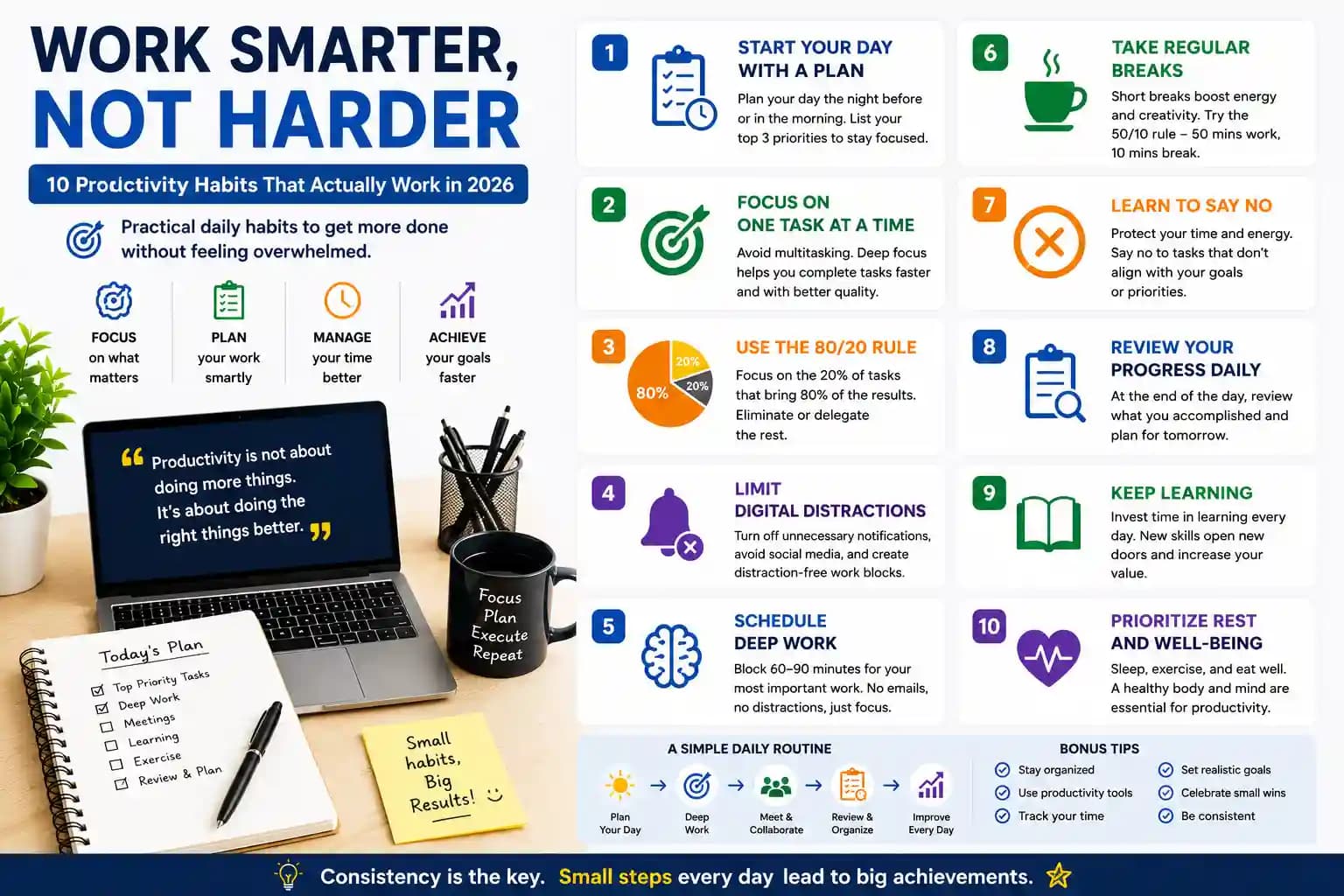
1. Plan the Day Before It Starts, Not During It
I used to open my laptop and let whatever notification hit first decide my morning. Now I spend five minutes, usually with coffee still too hot to drink, picking three things that actually need to happen that day. Everything else is optional until those three are done.
The three-question version I actually use: What absolutely has to move today? What can genuinely wait? What am I avoiding because it's harder, not because it's less important?
2. One Task, Fully Finished, Before the Next One Starts
Multitasking felt efficient right up until I compared output quality. A workflow I debug in one continuous 90-minute block gets fixed correctly. The same workflow debugged in fifteen-minute fragments between Slack messages takes twice as long and I miss something the first time, almost without fail.
Finish the task. Then take the break. Then move on. It sounds almost too simple to write down, and that's exactly why most people skip it.
3. Find the 20% That Actually Moves Things
Not every task pulls its weight. When I actually looked at what moved BytezBot and AdvizeU forward in a given week, it wasn't the twelve small admin tasks it was two or three specific things: a workflow fix, a content rewrite, a client call that unblocked a decision. The rest was motion without progress.
Before adding something to today's list, ask if it's one of the few things that actually matters, or just something that felt productive to check off.
4. Cut Off the Notifications That Are Actually Costing You
Every notification is a context switch, and context switches are expensive that eleven-minute email-checking habit from the time-tracking week wasn't a rounding error, it was hours. Now: phone in another room during focus blocks, browser tabs closed except what the current task needs, email checked at set times instead of on ping.
5. Block Real Deep Work Time And Protect It Like a Meeting
60 to 90 minutes, no interruptions, one objective. I now block this the same way I'd block a client call, because if it's not on the calendar as a real commitment, something else will eat it. Writing, debugging a workflow, reviewing a system prompt end to end all of it goes faster and comes out cleaner in one of these blocks than spread across a scattered afternoon.
6. Take the Break Before You Actually Need It
I used to push through until I was too fried to keep going, which meant the break came too late to actually help. Five minutes away from the screen, a short walk, water instead of another coffee small, but it resets focus in a way that pushing through never does.
7. Say No Before You're Overcommitted, Not After
I've said yes to things I shouldn't have, more than once, because saying no in the moment felt harder than just agreeing. The cost always showed up later a missed deadline somewhere else, or work that got rushed because there wasn't actually room for it. Now the check is simple: does this matter, does it fit my actual priorities, do I have the time or am I just hoping I will.
8. Close the Day With an Honest Look Back
A few minutes at the end of the day: what actually got done, what slowed things down, what I'd do differently tomorrow. This is where I first noticed the pattern of losing afternoons to Slack I wouldn't have caught it without writing it down daily instead of just feeling vaguely behind.
9. Keep Learning, Even in Small Doses
Even twenty minutes a day adds up faster than people expect. Some of what's now standard in our workflows better error handling patterns, cleaner prompt engineering structures came from small pieces of reading or documentation review that didn't feel significant in the moment.
10. Rest Isn't the Opposite of Productivity
I skipped this one for longer than I should have, treating sleep and downtime as what was left over after work was done instead of something that made the work possible. It's the reverse. A tired brain makes the same mistake twice and doesn't notice until the third time.
Common Mistakes vs. What Actually Works
Common Mistake
What Actually Works
Tools Worth Actually Using
Tools don't fix bad habits, but the right ones remove friction once the habits are in place. What I actually use day to day: Notion for planning and notes, Google Calendar for blocking deep work time, Todoist for the daily three-task list, and a simple Pomodoro timer for focus blocks. Pick two or three that fit how you already work adding a fourth or fifth tool usually creates more overhead than it saves.
What a Realistic Day Actually Looks Like
Morning
Review the day's three priorities. Do the hardest one first, before email or Slack gets a chance to derail it.
Afternoon
Meetings, email responses, continued project work. This is naturally the more fragmented part of the day, so I don't schedule deep work here anymore.
Evening
Quick review of what actually got done, what slowed things down, and tomorrow's three priorities set before closing the laptop.
Staying Consistent Without Burning Out on the System Itself
Pick one habit from this list, not all ten. I tried adopting everything at once the first time and abandoned the whole system within a week because it felt like a second job just to maintain it. Adding one habit every week or two, and giving yourself room to miss a day without scrapping the whole thing, is what actually sticks.
A Task You Can Do Today
Run your own version of that time-tracking week. You don't need special software a simple spreadsheet or even a notes app works. For three days, log what you're actually doing in 30-minute blocks, honestly, including the Slack scrolling and the "just checking one thing" email detours.
At the end of day three, add up your real focused work time versus your total logged hours. That gap is usually where the fix needs to happen, and it's rarely where people expect.
FAQ
How long does it take to see a difference from changing habits like this?
The time-tracking exercise itself shows results in three days you'll see the gap between busy hours and productive hours almost immediately. Habits sticking long-term takes longer, usually a few weeks of consistent practice before it stops feeling like effort.
Is multitasking ever actually fine?
For low-stakes, low-focus tasks sorting files, simple replies switching around doesn't cost much. For anything that requires real concentration, like debugging or writing, single-tasking consistently produces better results in less total time.
What if I only have time to adopt one habit from this list?
Start with the daily deep work block. It has the most direct effect on actual output, and once it's in place, several of the other habits tend to follow naturally because you're already protecting focus time.
Do productivity apps actually help, or are they a distraction themselves?
They help once the underlying habit exists. Adding a new app before fixing the habit usually just becomes another thing to check and another source of notifications.
Written by Chintan Poriya, Marketing Head.
Read More in Productivity
The Productivity Myth: Why Busy People Aren't Always the Most Productive in 2026
One developer answered over a hundred Slack messages and sat through six meetings in a single week. Another blocked three hours each morning and finished the sprint's core deliverable two days early. Guess who got the bigger project next.
Read article →
Stop Overthinking: How to Take Action and Make Progress Every Day
I sat on the idea behind BytezBot for four months before writing a single line of code. Here's what that taught me about action over planning.
Read article →