Become an AI Power User: The Career Skill That Could Define Your Future in 2026
Chintan Poriya
Lead Career Editor & AI Research Director
Published: April 22, 2026
Table of Contents
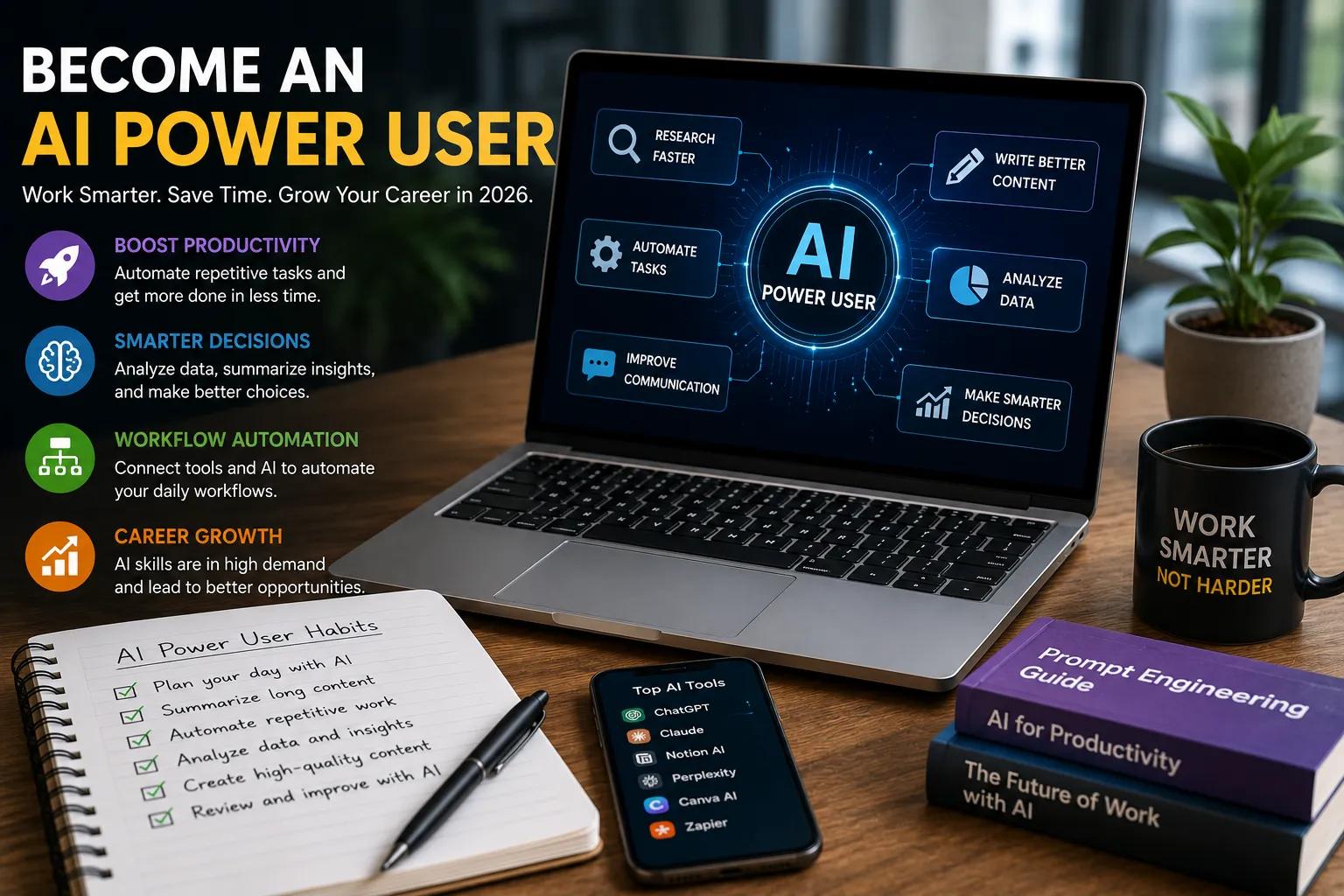
Two people on our content team use ChatGPT daily. One turns a blog draft around in about 40 minutes, and it usually needs minor edits before it's ready. The other spends closer to three hours on the same kind of piece, and it still needs a substantial rewrite by the time it lands on my desk. Same tool, same general skill level going in, wildly different output. The difference isn't effort the second person works just as hard. It's that one of them has built a real system around the tool, and the other is still starting from a blank prompt box every single time.
That gap is what people mean when they talk about an "AI power user," and it's become one of the more genuinely valuable distinctions in hiring and internal development this year.
Drafting Time Comparison
What an AI Power User Actually Is
It's not someone who spends the whole day talking to ChatGPT. It's someone who's built AI into the actual structure of their work research, drafting, analysis, workflow in a way that consistently produces better results with less wasted motion. The 40-minute drafter isn't smarter or more talented. She's built templates, refined her prompting over months, and knows exactly which parts of the process to hand to AI and which parts still need her own judgment.
Why This Actually Matters to Employers
We're not looking for people who simply know AI tools exist. We're looking for people who know when to use them, when not to, and how to verify what comes back before it goes anywhere near a client. That distinction shows up directly in project timelines the projects that move fastest on our end consistently have someone on them who's built real AI fluency, not just occasional familiarity.
What This Actually Looks Like Day to Day
For the person turning around drafts in 40 minutes, a normal day includes: AI-assisted email triage and task prioritization first thing, first drafts and spreadsheet analysis generated with AI support through the middle of the day, and end-of-day summaries and next-day planning wrapped up the same way. AI isn't running her whole day it's threaded through the parts of it that don't need her full judgment, freeing up the parts that do.
| Task | Casual AI User | AI Power User |
|---|---|---|
| Prompting | Single sentence, broad request | Detailed context, format, and role |
| Output Handling | Copy/paste directly into work | Edits heavily, verifies facts, applies judgment |
| Tool Choice | Uses ChatGPT for everything | Uses specialized tools for specific tasks |
| Workflow | Separate tab, occasional use | Integrated directly into daily tools via automation |
The Skills That Actually Make the Difference
Prompt engineering
The core skill underneath everything else. A vague prompt gets a vague, generic result we've written a full piece on this specifically, and it's the single highest-leverage skill on this whole list.
Critical thinking
Never take an AI response at face value. Check facts, question assumptions, verify anything that matters before it ships. The three-hour drafter's biggest issue, when we actually looked at it, wasn't prompting it was accepting the first draft too readily and not catching what needed fixing until it was already too far gone to be a quick edit.
Workflow automation
Connecting AI into your actual daily tools instead of treating it as a separate app you visit occasionally. This is where the real time savings compound not in any single interaction, but in the tasks that stop needing manual attention at all.
Communication
AI drafts fast. It doesn't build trust on its own that still requires a human editing pass that makes the output sound like an actual person wrote it, with actual judgment behind it, not a template.
Problem-solving
AI generates options. Deciding which option actually fits the situation is still entirely a human skill, and it's becoming more valuable relative to raw generation, not less, as generation itself gets commoditized.
AI Isn't Eliminating This Job It's Changing What the Job Requires
The realistic version of the AI-and-jobs conversation isn't replacement, it's redefinition. AI is absorbing the repetitive parts of most roles while raising the value of judgment, creativity, leadership, and the ability to actually collaborate with a team. The 40-minute drafter didn't become less valuable because AI got good at drafting she became more valuable, because she's the one who knows what to do with the extra two and a half hours that used to go into a single blog post.
Building an AI Skill Stack Without Learning Twenty Tools
Trying to master every AI tool that launches this year is a fast way to get shallow at all of them. Pick a handful that actually match your daily work a writing assistant, a research tool, a meeting summarizer, maybe an image generator or coding assistant depending on your role and go deep on those instead of skimming across dozens. The 40-minute drafter uses maybe four tools total, but she's genuinely fluent in all four.
Build Something, Don't Just Read About This
Reading about AI power users won't make you one. Building something will. Real project ideas worth trying: an AI resume builder, a meeting summary assistant, a customer support chatbot, a study planner, a research assistant, a content generation tool, an email automation workflow. Pick one, finish it, and you'll understand this whole topic more deeply than another ten articles would teach you.
What Actually Holds People Back
Copying AI output straight into final work without editing it this is most of what separated our two content writers. Vague, underspecified prompts that force multiple rounds of regeneration instead of getting it closer to right the first time. Skipping fact-checking on anything that actually matters. Relying on a single tool for everything instead of matching the right tool to the right task. Never building an actual project, staying purely in "reading about it" mode. And stopping after one course instead of treating this as an ongoing practice the tools keep changing, and so does what "good" looks like.
A 30-Day Plan to Actually Close This Gap
Week 1
Learn prompt engineering properly and try three or four popular AI tools to see what actually fits your work.
Week 2
Apply AI to your real daily tasks: email, research, first drafts. This is where the habit starts forming, not in a separate practice session but inside the actual work you already do.
Week 3
Build one real AI-powered workflow or small project. Not a tutorial follow-along something tied to your actual job or a genuine personal interest.
Week 4
Update your LinkedIn to reflect what you've built, share the project somewhere visible, and start going deeper on whichever piece of this felt most useful so far.
Consistency across these four weeks matters more than speed through any single one of them. For more, see how to learn AI in 30 days.
Final Thoughts
The real divide forming right now isn't between people who got replaced by AI and people who didn't. It's between people who built a real system around these tools and people still starting from a blank prompt box every time the exact gap between our 40-minute drafter and our three-hour one, and it shows up in output quality far more than it shows up in effort.
You don't need a technical background to close that gap. You need curiosity, a willingness to actually build something instead of just reading about it, and enough consistency to let the habit compound. Start with one new workflow this week. That's genuinely how it starts.
FAQ
Do I need to be technical to become an AI power user?
No. The 40-minute drafter in this article isn't a developer her advantage comes from prompt structure, editing judgment, and a consistent workflow, not coding ability.
How many AI tools should I actually be using regularly?
Three or four, used deeply, beats a dozen used superficially. Pick the ones that match your actual daily tasks rather than trying every new tool that launches.
What's the fastest way to tell if I'm getting real value from AI, or just using it superficially?
Track your actual output time and quality before and after a specific change a new prompt structure, a new tool, a new workflow step. If neither improves, the change isn't doing what you think it is.
Is it too late to build this skill if I've barely used AI tools so far?
No. The 30-day plan above is designed for exactly that starting point genuine, consistent practice over a month closes most of this gap faster than people expect.
Written by Chintan Poriya, Marketing Head.
Read More in Career Advice
From AI Learner to AI Professional: How to Build a Job Ready Portfolio in 2026
One candidate's portfolio said "built a RAG chatbot" and nothing else. Another explained exactly why she chunked documents the way she did and what she measured to pick her embedding model. We hired the second one before the interview even ended.
Read article →
The IT Hiring Reset: Why Companies Are Hiring Again, But Only for AI Ready Professionals
We paused hiring for almost eighteen months. When we reopened a role this year, we didn't ask candidates whether they could write clean code. We asked them to walk us through an AI assisted debugging session they had actually done.
Read article →